History
Takarada Ebisu Shrine is a small shrine in Nihonbashi-Honcho 3-chome, Chuo Ward, Tokyo. Its name is read “Takarada Ebisu Jinja,” and it is also written 宝田神社 (Takarada Jinja) or 寶田恵比寿神社. According to the Japanese Wikipedia its former rank was that of an unranked shrine (mukaisha), and since 1873 it has been a concurrently served shrine of Kanda Shrine (Kanda Myojin).
According to the “Goen-gi” (shrine history) based on the Bettara Market preservation society’s leaflet, around 1606 (Keicho 11) the shrine, then called Takarada Shrine, was the guardian shrine of Takarada village outside Edo Castle. When Tokugawa Ieyasu ordered the three villages of Takarada, Iwaida and Chiyoda to move in order to expand the castle, Magome Kageyu is said to have enshrined the village’s guardian and led the residents in a group move. For his service in accompanying Ieyasu from Mikawa when he entered Edo, Kageyu is said to have received an Ebisu statue to pray for the prosperity of the Tokugawa house, and it has been enshrined as a guardian ever since. The statue is attributed to the Kamakura-period master Unkei, though one theory credits Hidari Jingoro. The same history explains that Kageyu became a supervisor of the three official post-horse stations (san-denma), and the town name Odenma-cho was given after that title.
The Japanese Wikipedia records that the shrine was originally an Inari shrine called “Takarada Inari” and that it moved to its present site in the Bunsei era (1818–1830). A summary based on the Tokyo shrine directory says that in the Great Kanto Earthquake of 1923 every building except the main hall burned, and the worship hall was rebuilt in the early Showa period. Details of the deities and the shrine’s history differ somewhat between sources, so this page sets out each source’s account side by side.
Highlights
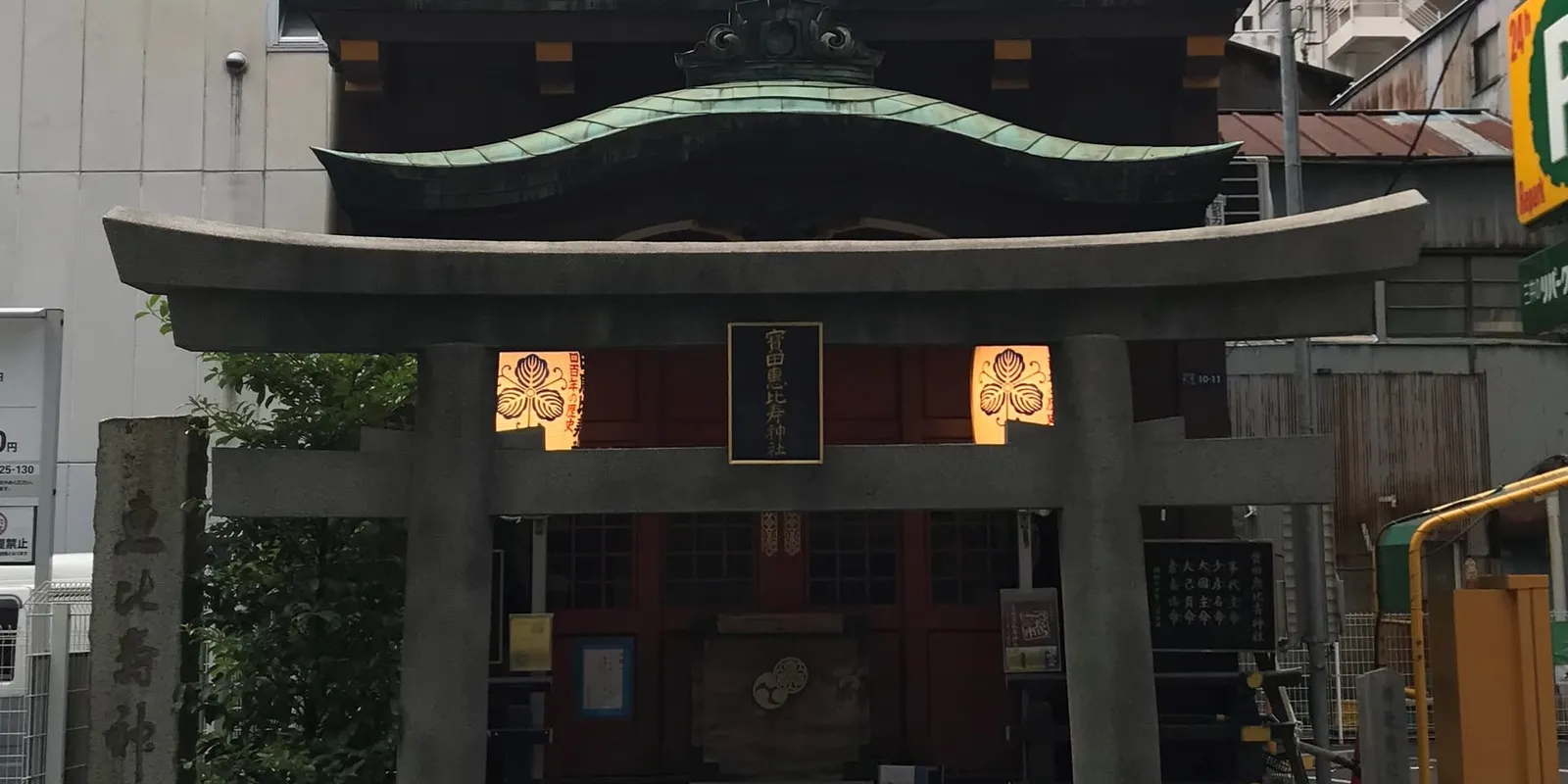
The grounds are a small shrine in the middle of an office district, surrounded by buildings and parking lots. According to a personal blog account, there is a stone marker reading “Ebisu Jinja” and a small torii, and the lanterns carry the words “Nihonbashi Bettara Market.” The same blog says it is normally unstaffed, with no guardian lion-dogs, and the hand-washing pavilion appears to be out of use. No nationally or metropolitan-designated cultural properties are listed in the sources checked.
According to the Japanese Wikipedia, the Ebisu statue is a seated figure in half-lotus pose, made of zelkova in joined-wood construction with inlaid glass eyes, about 50 cm tall. It could not be confirmed whether the shrine shows it to the public.
Nearby, according to the Japanese Wikipedia, a monument to Magome Kageyu stands in front of the Ozu Honkan Building. It is a clue for following the footsteps of the person who appears in the shrine’s history.
Visiting Tips
No official visiting hours were found. Because it is a small shrine with no regular shrine office, it is best to drop in during a walk around the neighborhood rather than to count on amulets or prayer services.
According to a personal blog account, goshuin are given at a temporary booth during the Bettara Market (October 19–20), at ¥500, as pre-written sheets since 2022 (official information could not be confirmed).
The nearest stations are Kodemmacho on the Hibiya Line and Exit 5 of Shin-Nihonbashi on the JR Sobu Rapid Line, each about a 3-minute walk. No parking information was found, and since the surrounding roads are closed on market days, we recommend visiting by train.
Annual Festivals
- Nihonbashi Seven Lucky Gods New Year visit (7 days from January 1): Listed among the annual events in the preservation society’s information. Note that some guides assign Ebisu of the route to Sugimori Shrine, and the Japanese Wikipedia describes the shrine as a “former” member of the Seven Lucky Gods, so the pilgrimage guides differ by source.
- Hatsu-Ebisu Festival (January 20): According to the preservation society’s annual event table. A summary based on the Chuo City history gives January 10 instead, so sources differ.
- Setsubun Festival (February 3): According to the preservation society’s annual event table.
- Takarada Ebisu Shrine Grand Festival / Bettara Market (October 19–20): The 19th is the Bettara Market and the 20th the Ebisu festival. It is said to have begun as a market for supplies for the Ebisu-ko on the 20th, and the name took hold from the fame of the sweet pickled daikon. One tradition about the name says that young men, using the crowds as cover, stuck pickled daikon (bettara) on the sleeves of women worshippers’ kimono to tease them (per the preservation society). The number of stalls ranges from about 300 to 500 depending on the source.
- New Year’s Eve (11:00 PM–3:00 AM): Listed in the annual event table.
Dates can change from year to year, so check the latest information with the preservation society (090-4674-7071) or similar.
Nearby Food & Sightseeing
- Jisshi Park (site of the Denmacho Jail): Right by Kodemmacho Station. According to Chuo City, it is the site of an Edo-period jail and is designated a Tokyo historic site. The park holds a monument marking where Yoshida Shoin died.
- Ozu Honkan Building (Magome Kageyu monument): According to the Japanese Wikipedia, the monument to Magome Kageyu stands in front of this building. A historic spot tied to the shrine’s history, worth seeing along with a visit.
Frequently Asked Questions
- Q. What is Takarada Ebisu Shrine famous for?
- A. It is known for the Bettara Market (Bettara-ichi), held every year on October 19 and 20. According to the market's preservation society, it began as a market selling items for the Ebisu-ko festival on the 20th, such as a god image, a lucky mallet and hanging sea bream, and the name took hold after the market's sweet pickled daikon, bettara-zuke, became popular. Ebisu is regarded as a guardian of business prosperity, family prosperity and fire protection.
- Q. Where is it, and what is the nearest station?
- A. It is at 3-10-11 Nihonbashi-Honcho, Chuo Ward, Tokyo. It is about a 3-minute walk from Kodemmacho Station on the Tokyo Metro Hibiya Line, or about 3 minutes from Exit 5 of Shin-Nihonbashi Station on the JR Sobu Rapid Line. The nearest Toei Bus stops are "Honcho 3-chome" and "Kodemmacho."
- Q. Can I get a goshuin here?
- A. According to a personal blog account, goshuin are given at a temporary booth in the grounds during the Bettara Market (October 19–20), for ¥500, and since 2022 they are pre-written sheets. Official information on regular availability could not be found, so it is not certain. Before you go, check with the preservation society (090-4674-7071) or similar.
- Q. When is the Bettara Market held?
- A. The preservation society's page says it takes place every year on October 19 and 20 (the weekdays change by year). The 19th is the Bettara Market itself and the 20th is the Ebisu festival (Ebisu Shinsai). The page gives no opening hours, and because the surrounding roads are closed, visitors are asked to come by train rather than car.
- Q. Which deities are enshrined here?
- A. The shrine's signboards and other sources list Kotoshironushi, Sukunahikona, Okuninushi, Onamuchi and Susanoo, and some sources add Ukanomitama (sources differ). The object of worship is an Ebisu statue said to be by the Kamakura-period sculptor Unkei and to have been given by Tokugawa Ieyasu. The shrine is said to have been originally an Inari shrine called "Takarada Inari."
Plan Your Visit
Before you go, you can book a stay and get your shrine-visit items ready.
Amazon links open Amazon.co.jp (Japan) in English; whether an item ships overseas depends on the product.
※ Contains ads (PR). Links open external sites such as Amazon, Rakuten, Trip.com and Booking.com.