History
Omi Jingu enshrines the 38th emperor, Emperor Tenji, and stands at the foot of a hill on the west shore of Lake Biwa, near the site of Omi Otsu no Miya (the Otsu Capital), where he made his capital. In 667, Tenji moved the capital from Asuka to Omi Otsu no Miya, and went on to enact the Omi Code and establish a school system, among many other new policies. The Nihon Shoki also records him as the emperor who set up a rokoku (water clock) and first announced the time.
As a shrine its history is a recent one. From the mid-Meiji era, a movement grew among local people to found a shrine to Tenji, and in 1938 the founding was announced with the approval of Emperor Showa. The enshrinement ceremony was held on November 7, 1940, marking the 2,600th anniversary of the imperial calendar. A former Kanpei Taisha (Great Shrine of the Imperial Household), it is today one of the 16 chokusai-sha (shrines to which the Emperor sends an envoy), and an imperial envoy attends the annual festival on April 20. Its divine virtues are described as being the “ancestral deity of time,” a deity of good fortune and guidance, and a guardian of culture, learning, and industry.
Highlights
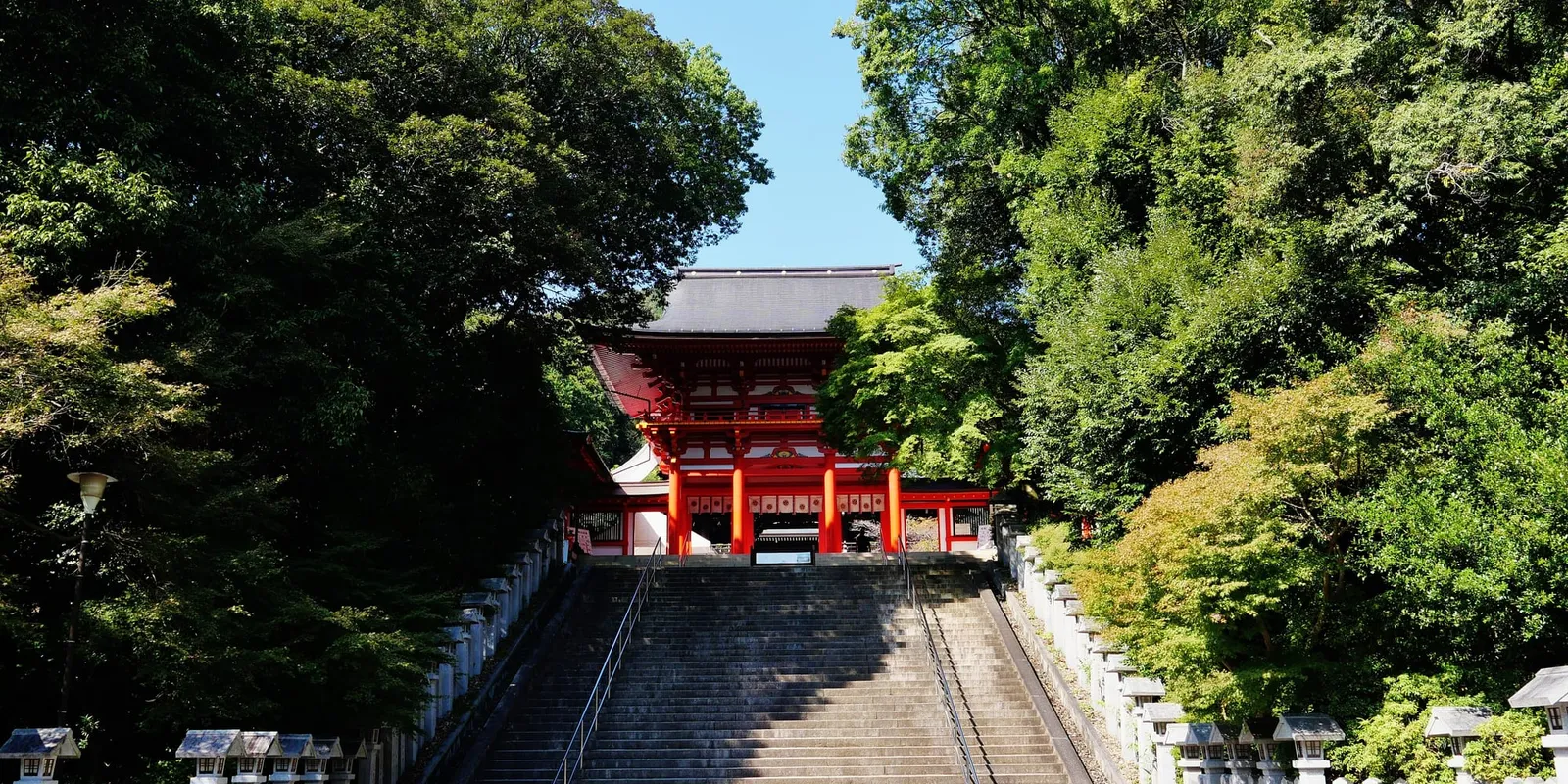
A vermilion-lacquered Romon gate stands atop a flight of stone steps, and beyond it corridors lead past the outer worship hall and inner worship hall to the main hall. The shrine buildings, known as “Omi-zukuri” (or “Showa-zukuri”) style, are arranged on a hillside slope with corridors surrounding the main hall and the inner and outer worship halls. Regarded as a representative work of modern shrine architecture, they have been Registered Tangible Cultural Properties of Japan since 1998 (note that this is the “registered” category, not Important Cultural Property). The grounds cover roughly 60,000 tsubo, giving plenty of room to stroll through a quiet sacred precinct.
The Clock Museum and Treasure Hall (Tokeikan Homotsukan) on the grounds opened in 1963 as Japan’s first clock museum and was renovated into its present form in 2010. The first-floor Clock Museum displays one of Japan’s oldest pocket watches, bestowed by the Takamatsunomiya family (handed down from the Arisugawa-no-miya family), assorted Japanese-style clocks, and a suiyokyugi pendulum device said to be the only one surviving in complete form. The second-floor Treasure Hall shows items such as Soga Shohaku’s “Landscape with Pavilions” folding screen (an Important Cultural Property; the one on display is a reproduction), ceramics by Kawai Kanjiro, and a Hyakunin Isshu woven karuta set. Outside the museum, a rokoku (water clock) and sundial donated by the clock industry are also on display.
Because Emperor Tenji’s poem is the opening verse of the Ogura Hyakunin Isshu anthology, Omi Jingu is also known as the “sacred ground of karuta,” and it served as a setting for the manga, anime, and film series Chihayafuru, which centers on competitive karuta. Votive karuta boards dedicated to the shrine are displayed on the grounds.
Visiting Tips
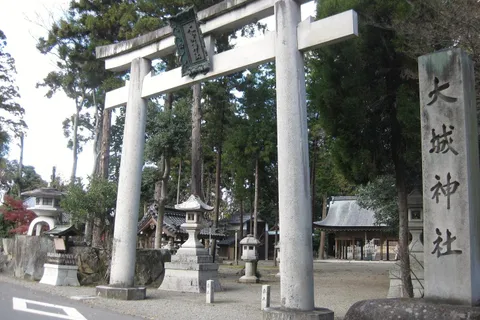
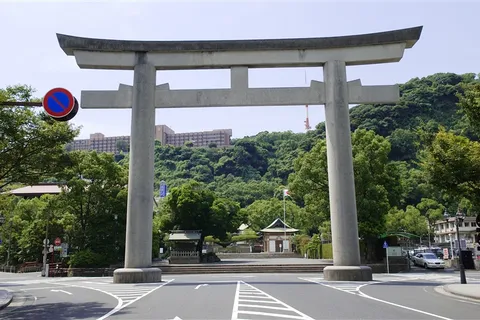
Opening hours differ by facility: the grounds are open 6:00 AM–6:00 PM, the amulet and goshuin office 9:00 AM–4:30 PM, prayer services are accepted 9:30 AM–4:00 PM (no reservation needed for individuals), and the Clock Museum is open 9:30 AM–4:30 PM (last entry 4:00 PM). The gate by the torii closes at 6:00 PM, so try to arrive by about 5:30 PM at the latest. Goshuin are given out at the amulet office just to the right after the Romon gate: ¥500 for a regular one and ¥1,000 for the cut-paper design. The Clock Museum is closed on Mondays except national holidays.
Pets are not allowed inside the Romon gate (even in a cage or carried). For wheelchair users, there is a slope beside the Clock Museum, near the uppermost parking area, that leads to the outer worship hall without steps, but there are steps up to the inner worship hall.
By train, it is about a 9-minute walk from Omi-jingu-mae Station on the Keihan Ishiyama-Sakamoto Line (about half of it inside the grounds). If you are coming by JR, take the Kosei Line from Kyoto Station to Otsukyo Station (about 11 minutes), walk about 150 m to Keihan Otsukyo Station, and ride one stop to Omi-jingu-mae. There are no taxis at Omi-jingu-mae Station. By car, there is a parking lot for about 200 cars, free except from the night of December 31 to January 5.
Annual Festivals
- New Year’s visit (from January 1): The shrine can be visited through the night from January 1 to 3. A parking fee (¥1,000) applies at New Year, and nearby roads become very congested, so public transport is encouraged.
- Karuta Festival and the Meijin and Queen Title Matches (early to mid January): At the Karuta Festival, the opening poem of the Hyakunin Isshu, “Aki no ta no kariho no io no toma wo arami…,” is recited before the deity, and torihime attendants in court attire perform the Karuta Biraki ceremony; attendance and viewing are free. The title matches that decide the top players of competitive karuta are a New Year tradition here. In 2026, the title matches were held on Sunday, January 11, and the Karuta Festival on Monday, January 12 (a national holiday). Dates vary from year to year.
- Annual festival and Omi Matsuri (April 20; Omi Matsuri on the first Sunday after): The annual festival commemorates the move of the capital to Omi Otsu no Miya and is attended by an imperial envoy. At Omi Matsuri, 19 children’s mikoshi from the neighborhood gather.
- Yabusame (first Sunday of June): A mounted archery ritual that recalls Emperor Tenji’s hunts at Kamouno.
- Rokoku Festival (June 10): A festival for Time Day, which marks the day Emperor Tenji built a rokoku at Otsu no Miya and announced the time to the people. It is held mainly by people in the clock industry.
- National High School Karuta Championship (July): Often called the “Koshien of karuta,” it was held on July 19 and 20 in 2026.
- Enshrinement Anniversary Festival (November 7): Commemorates the shrine’s enshrinement in 1940.
Nearby Food & Sightseeing
- Jingu Saryo: A Japanese cafe and sweets shop on the grounds, in a registered cultural property building built as a rest house for worshippers when the shrine was founded. It serves shaved ice and gluten-free dorayaki (10:00 AM–6:00 PM, closed Tuesdays).
- Omi Otsu no Miya Nishikiori Site: A nationally designated historic site regarded as the center of the Omi Otsu Capital where Emperor Tenji moved the capital. It lies just west of Omi-jingu-mae Station and pairs well with a visit to the shrine.
- Mii-dera (Onjo-ji): The head temple of the Tendai Jimon school and one of Otsu’s most prominent old temples. Omi Jingu also holds some of its ceremonies, such as the Emperor Kobun Festival, jointly with Onjo-ji.
Frequently Asked Questions
- Q. What are the visiting hours?
- A. The grounds are open from 6:00 AM to 6:00 PM, and the gate by the torii closes at 6:00 PM, so aim to arrive by about 5:30 PM. The amulet and goshuin office is open 9:00 AM–4:30 PM, and prayer services are accepted 9:30 AM–4:00 PM.
- Q. Where can I get a goshuin?
- A. At the amulet office just to the right after the Romon gate, between 9:00 AM and 4:30 PM. A regular goshuin costs ¥500, and a cut-paper goshuin featuring the gate and the shrine crest costs ¥1,000.
- Q. Is there parking?
- A. Yes, there is a parking lot for visitors with room for about 200 cars (about 500 with temporary lots at New Year). It costs ¥1,000 per car (¥2,000 for tour buses) only from the night of December 31 to January 5, and is free the rest of the year. Roads nearby get very congested at New Year, so public transport is recommended.
- Q. What are the Clock Museum's admission fee and hours?
- A. Admission is ¥300 for adults and ¥150 for elementary and junior high school students (free for small children). It is open 9:30 AM–4:30 PM (last entry 4:00 PM) and closed on Mondays except national holidays. Allow about 15 minutes for a visit.
- Q. When are the Meijin and Queen karuta title matches held?
- A. They are held every year in early to mid January at Omi Kangakukan. In 2026, the 72nd Meijin and 70th Queen title matches took place on Sunday, January 11, and the Karuta Festival (Karuta Biraki ceremony) was held the next day, Monday, January 12 (a national holiday). Dates change from year to year, so check the official site for the latest schedule.
Plan Your Visit
Before you go, you can book a stay and get your shrine-visit items ready.
Amazon links open Amazon.co.jp (Japan) in English; whether an item ships overseas depends on the product.
※ Contains ads (PR). Links open external sites such as Amazon, Rakuten, Trip.com and Booking.com.