History
Ōuo Shrine (Ōuo Jinja) stands on the Ariake Sea coast in Tara, in southern Saga Prefecture. Its principal deity is said to be Ōuo Daimyojin. The year of its founding is unknown, but according to the Saga Prefecture Heritage database, Shigemoto, the sixth lord of Isahaya, rebuilt the shrine in 1682 and erected the torii in 1693.
As for the origin, a story recorded in the town history is well known. Villagers left a corrupt local magistrate on Okinoshima; he prayed to the dragon god and was carried back on the back of a great fish. Enshrining that great fish is said to be how the shrine began. What kind of fish it was varies by source (yellowtail and “namiuo” are both given). The on-site sign (put up by the Sakaemachi district) and the Tara Town Tourism Association’s page also present the story as an event of “about 300 years ago (around 1693),” tying the legend to the year the torii were erected.
The shrine and its sea torii are designated Saga Prefecture Heritage No. 2017-1 (“Approach to the Sea God: Ōuo Shrine and the Sea Torii”), and, according to Tara Town, were certified in 2021 as one of Japan’s “Hundred Moons” (the moon lighting the sea torii).
Highlights
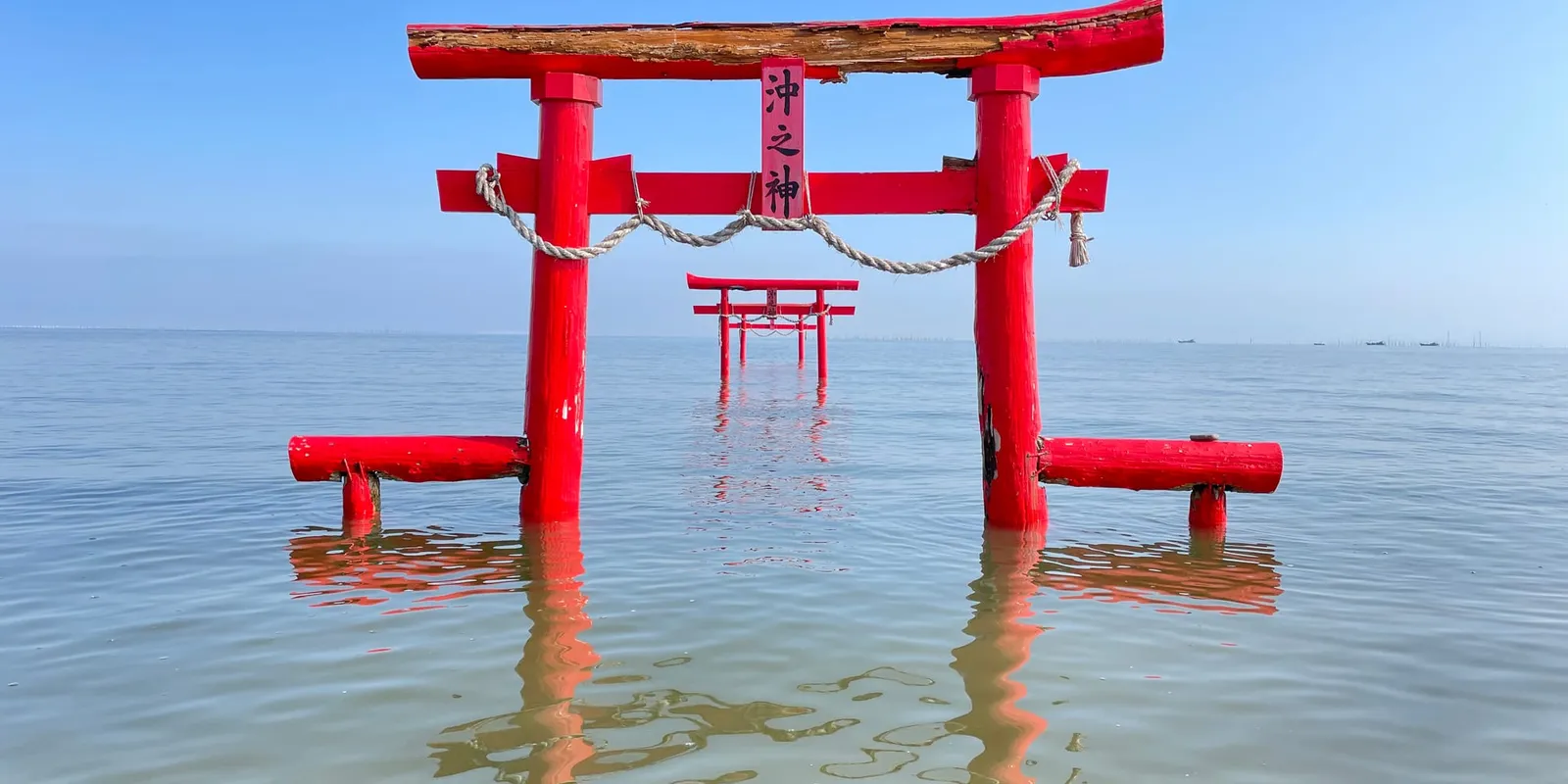
The main attraction is the set of three vermilion sea torii standing in the shallows of the Ariake Sea. According to the Tara Town Tourism Association, they are the shrine’s second torii, built between the shrine and Okinoshima and extending about 200 m from the shore; the plaque reads “Oki no Kami.” The Saga heritage description notes that the sacred Mount Tara, Ōuo Shrine, and Okinoshima (the stage of the legend) lie on a single straight line, so the torii form what it calls “the very approach to the god of the sea.”
The Ariake Sea has what Tara Town describes as “Japan’s largest-class tidal range, up to 6 m,” and the scene changes completely with the hour. At high tide the torii appear to float on the water; at low tide you can walk beneath them. According to Nippon Tabi Magazine, the outermost torii is more than half submerged at high tide, and the different depths at which the three are submerged show how deep the water is. Morning and evening light, moonlight, and starry skies add to the atmosphere, and the spot is known as a favorite for photography.
The torii are rebuilt about every 30 years by custom, most recently on February 6–7, 2024 (the 6th year of Reiwa) because of age, as announced by the Tara Town Tourism Association. Some of the photos on this page show the torii before that rebuild.
Visiting Tips
It is about a 10-minute walk from Tara Station on the JR Nagasaki Line, or about 5 minutes by car from Michi-no-Eki Tara. From the Kashima side, take the Yutoku Bus (bound for Takezaki Port) and get off at “Tara Sakaemachi (Kaichu Torii),” right beside the site. The official Saga tourism site Asobo-Saga lists parking for roughly a dozen or so cars and 3–4 large buses, but vehicle entry may be restricted during the spring and autumn nori-harvest seasons and during the August lantern event. Please follow the signs on site for where to stop.
Choose your timing by the view you want. For torii floating on the water, aim for around high tide; to walk out to the torii, aim for around low tide. Exact times change daily, so check them in advance, for example with the Japan Meteorological Agency tide table linked from the Tara Town page. Mudflats and shorelines can be muddy and the tide comes back in, so watch your footing and the time.
The land around the torii is used by fishers. Tara Town asks visitors to be considerate when fishing work is underway; work periods are given as roughly April (early to late) and from September to around the end of October (the dates vary by source and year). Please observe quietly and keep out of the way of vehicles and work.
We could not confirm from official information whether goshuin are offered, and some listings say there are none. If you are hoping for one, please ask the Tara Town Tourism Association (+81-954-67-0065).
Annual Festivals
- Sen-no-Toro Matsuri (Thousand Lanterns Festival, every August): A community event by local residents that, according to the Saga Prefecture Heritage database, is held every August. Tourism sites describe several hundred lanterns lined up beside the sea torii. Vehicle entry may be restricted at this time, so please check dates and access with the Tara Town Tourism Association.
Nearby Food & Sightseeing
- Michi-no-Eki Tara: The roadside station that houses the Tara Town Tourism Association’s information desk, about 5 minutes by car from the sea torii. The in-station “Tarafuku-kan” and its rental bicycles are also listed as nearby facilities on the Saga tourism site.
- Takezaki crab and grilled oysters: The Tara Town Tourism Association recommends enjoying the local specialties “Takezaki crab and grilled oysters” and the scenic hot springs. Several oyster-grilling restaurants are found in the town.
- Tara Station (JR): The nearest station to the sea torii, about a 10-minute walk. The starting point if you come by train.
- Mount Tara (Taradake): The sacred mountain behind the torii; the Saga heritage description says the sea torii stand on a straight line linking Mount Tara, Ōuo Shrine, and Okinoshima.
Frequently Asked Questions
- Q. How many sea torii are there, and when can I see them?
- A. According to the Tara Town Tourism Association, three sea torii stand in the Ariake Sea at Sakaemachi in Tara. They can be seen year-round: at high tide they appear to float on the water, and at low tide you can walk beneath them.
- Q. Should I go at high tide or low tide?
- A. It depends on the view you want, because the two look very different. Near high tide the torii appear to float on the sea; near low tide you can walk out to and under them. The Ariake Sea has a tidal range of up to 6 m, and the outermost torii is described as being more than half underwater at high tide. Check the day's high and low tide times in advance, for example with the Japan Meteorological Agency tide table linked from the Tara Town page.
- Q. Is there parking?
- A. The official Saga tourism site Asobo-Saga lists parking for roughly a dozen or so cars and 3–4 large buses (other listings describe it as free). However, vehicle entry may be restricted during the spring and autumn nori-harvest seasons and during the August lantern event. A spring 2024 notice from the tourism association said cars cannot be stopped directly in front of the torii, so please confirm current conditions with the association (+81-954-67-0065).
- Q. Can I get a goshuin at Ōuo Shrine?
- A. We could not confirm from official shrine or town sources whether goshuin are offered. One visitor-listing site (Hotokami) states there are none. Please check with the Tara Town Tourism Association (+81-954-67-0065) before you go.
- Q. Which deity is enshrined, and when were the sea torii built?
- A. The deity is given as Ōuo Daimyojin. The shrine's founding date is unknown, but the Saga Prefecture Heritage database records that Shigemoto, the sixth lord of Isahaya, rebuilt the shrine in 1682 and erected the torii in 1693. A custom of rebuilding the torii every 30 years has been handed down, and they were last rebuilt on February 6–7, 2024 because of age.
Plan Your Visit
Before you go, you can book a stay and get your shrine-visit items ready.
Amazon links open Amazon.co.jp (Japan) in English; whether an item ships overseas depends on the product.
※ Contains ads (PR). Links open external sites such as Amazon, Rakuten, Trip.com and Booking.com.