History
Oyama Jinja enshrines Maeda Toshiie, celebrated as the founder of the mighty Kaga Domain — the “Kaga Hyakumangoku,” one of the wealthiest domains of the Edo period — together with his principal wife, Lady Matsu. After Toshiie’s death in 1599, his son Maeda Toshinaga wished to enshrine his father as a deity, but the political climate of the time, shaped in part by the domain’s relationship with the Tokugawa shogunate, made it difficult to openly deify a former lord.
It was not until 1873, in the early Meiji era, that former Kaga Domain retainers came together to found a shrine dedicated to Toshiie on the former site of the Kanaya Goten mansion, within what had been the Kanaya-demaru bailey of Kanazawa Castle. The shrine took the name “Oyama” from an old alternate name for Kanazawa Castle itself, “Oyama-jo.” Two years after its founding, in 1875, the shrine’s now-famous Shinmon gate — later designated a National Important Cultural Property — was completed.
In 1879, the second and third lords of the domain, Maeda Toshinaga and Maeda Toshitsune, were added as secondary deities, and in 1998 Toshiie’s wife, Lady Matsu (posthumous Buddhist name Hoshun-in), was enshrined alongside him. Because husband and wife are worshipped together, the shrine today is known for blessings of marital harmony, as well as for good fortune, career success, and victory in competition — fitting tributes to a man who rose from a low-ranking page to found one of Japan’s greatest domains.
The Shinmon Gate — A Unique Fusion of Japanese, Chinese, and Western Styles
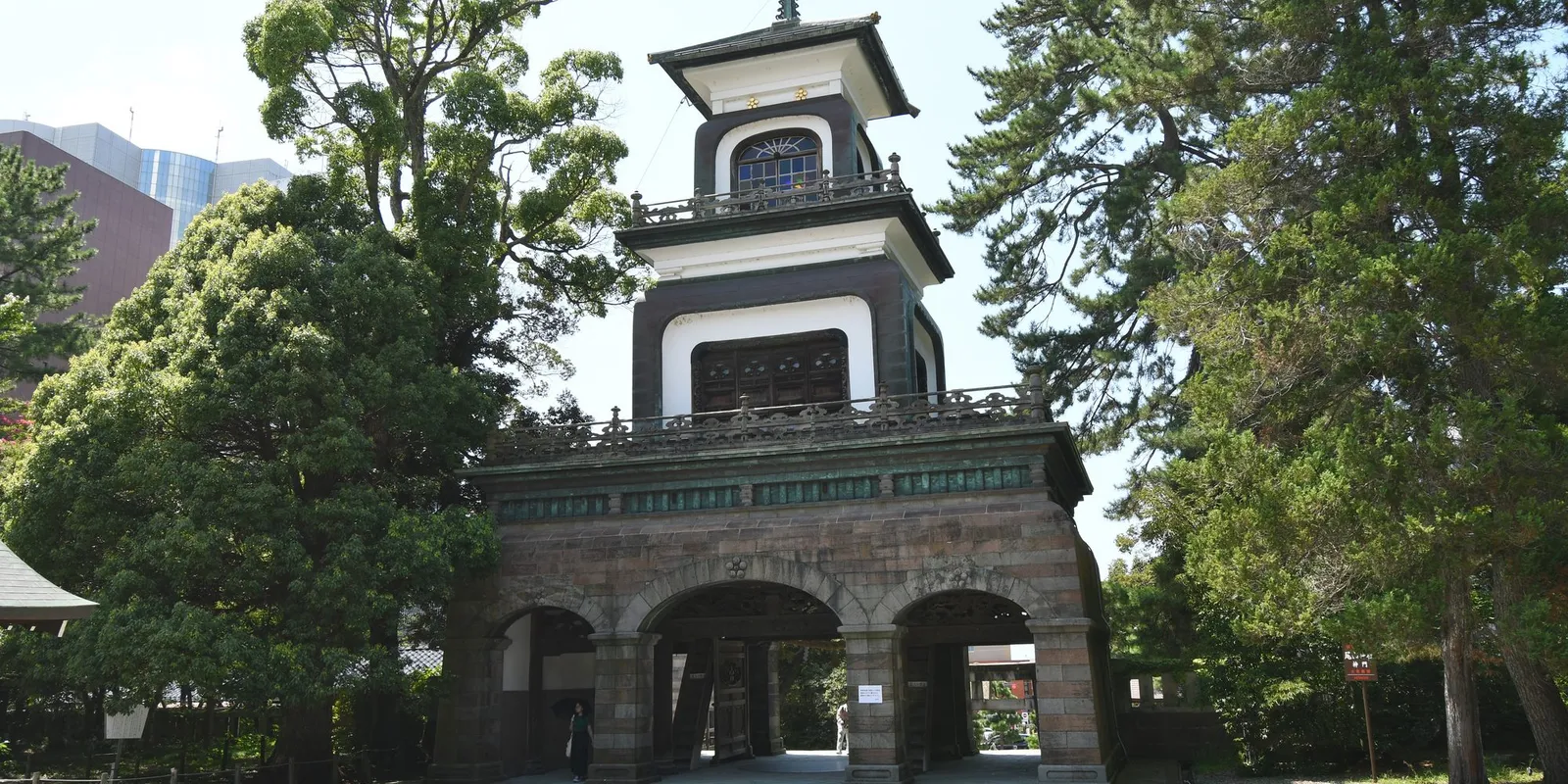
No description of Oyama Jinja is complete without its Shinmon gate, completed in 1875 under the Kanazawa master carpenter Tsuda Kichinosuke. Its ground floor is built from a traditional Japanese triple-arch wooden framework; its middle floor takes on the appearance of a southern Chinese temple; and its top floor rises in the form of a Western-style dome — a one-of-a-kind fusion of Japanese, Chinese, and Western architectural traditions found nowhere else in the country. The exterior is faced with Tomuro stone, a material closely associated with the Kaga Domain, and the gate reaches roughly 25 meters in height including its lightning rod.
Its most striking feature is the colorful stained glass (giyaman) set into all four sides of the top floor. After dark, a lamp was once lit on this floor, and the illuminated gate reportedly served as a de facto lighthouse, guiding ships sailing along the Sea of Japan. Introducing bold Western engineering and design into a Shinto shrine building during Japan’s civilization-and-enlightenment (bunmei kaika) era was a remarkably progressive undertaking for its time. Taller buildings in the area and reduced atmospheric clarity mean the light can no longer be seen from the sea, but the gate is illuminated from sunset until around 22:00, taking on an especially dreamlike appearance after nightfall. The lightning rod fixed to the roof’s peak is said to be the oldest surviving example in Japan, and the gate itself was designated a National Important Cultural Property in 1950.
The Shin’en — A “Garden of Musical Instruments”
After passing through the Shinmon gate and paying respects at the haiden, it’s well worth continuing on to the Shin’en, the garden spread out behind the worship hall. This strolling pond garden dates to the late Edo and early Meiji periods, when it formed the grounds of the Kanaya Goten, a Maeda family mansion that once stood on this site; it was carried over into the shrine’s precincts when Oyama Jinja was founded.
The bridges and islands dotting the pond bear names drawn from the instruments of gagaku, Japan’s ancient court music — Koto Bridge, Yatsuhashi, Biwa Island, and Hosho Island among them — giving the garden its affectionate nickname, the “Garden of Musical Instruments.” Designated a Kanazawa City Place of Scenic Beauty in 1954, it offers a quiet, seasonally changing stroll and stands alongside the Shinmon gate as one of the shrine’s two signature attractions.
Visiting Tips
The grounds can be visited at any hour, but the shrine office handling goshuin and prayer requests is open 9:00–17:00. The compact precincts — Shinmon gate, haiden, and Shin’en garden together — can be fully explored in thirty minutes to an hour, making for a rewarding stop that combines striking hybrid architecture with a tranquil Japanese garden. Right next door stands the Nezumita-mon gate and its bridge, reconstructed in 2020 after being lost for roughly 140 years; crossing it leads on foot to the Gyokusen’inmaru Garden inside Kanazawa Castle Park. The shrine’s location also makes it easy to fold into a walking route that takes in Kenrokuen Garden and Kanazawa Castle Park.
Annual Festivals
- Otsuitachi Mairi (1st of every month): A monthly rite praying for peace in the coming month.
- Tsukinamisai (27th of every month): A monthly service held on the 27th, the date of Maeda Toshiie’s death each month.
- Reitaisai Grand Festival (April 27): Held on the anniversary of Maeda Toshiie’s death in 1599, this is Oyama Jinja’s most important annual festival.
- Oyama Matsuri (late May–early June): Held in cooperation with the Kanazawa Hyakumangoku Festival, which commemorates Maeda Toshiie’s entry into Kanazawa Castle, featuring drum performances and other events.
- New Year’s Visit / Hatsumode (January 1–3): One of Kanazawa’s most popular New Year destinations, drawing large crowds over the first three days of the year.
Nearby Food & Sightseeing
- Nezumita-mon Gate and Bridge: A turret gate faced with black namako plaster and its accompanying wooden bridge, connecting Oyama Jinja to the Gyokusen’inmaru Garden inside Kanazawa Castle Park; reconstructed in 2020 after roughly 140 years, it lets visitors walk directly between the two sites.
- Kenrokuen Garden: Ranked among Japan’s three great gardens, this strolling garden was cultivated over generations by the lords of the Kaga Domain and lies about a 10-minute walk from Oyama Jinja.
- Omicho Market: Known affectionately as “Kanazawa’s kitchen,” this lively market close to Oyama Jinja is popular for its fresh seafood rice bowls and sushi stalls.
Frequently Asked Questions
- Q. What kind of shrine is Oyama Jinja?
- A. Oyama Jinja enshrines Maeda Toshiie, founder of the powerful Kaga Domain ("Kaga Hyakumangoku"), together with his principal wife, Lady Matsu (Hoshun-in). It was founded in 1873 by former domain retainers on the former site of the Kanaya Goten mansion, within what had been the Kanaya-demaru bailey of Kanazawa Castle. The shrine is nationally famous for its Shinmon gate — a National Important Cultural Property that blends Japanese, Chinese, and Western architectural styles — and is one of Kanazawa's leading sightseeing spots.
- Q. Why does the Shinmon gate have stained glass?
- A. The Shinmon gate was completed in 1875. Its ground floor uses a traditional Japanese wooden triple-arch technique, its middle floor draws on southern Chinese temple design, and its top floor takes the form of a Western-style dome — an unmatched fusion of Japanese, Chinese, and Western styles found nowhere else in Japan. The top floor is fitted with colorful panes of glass (giyaman) on all four sides; after dark, a lamp was lit there, and the glowing gate reportedly served as a de facto lighthouse, guiding ships along the Sea of Japan coast. Taller buildings and hazier air have since blocked the view from the sea, but the gate is lit up from sunset until around 22:00, taking on a dreamlike appearance after dark. The lightning rod fixed to its roof is said to be the oldest still in existence in Japan.
- Q. Who are the deities enshrined at Oyama Jinja?
- A. The principal deity is Maeda Toshiie, founder of the Kaga Domain. In 1879, the second and third domain lords, Maeda Toshinaga and Maeda Toshitsune, were added as secondary deities, and in 1998 Toshiie's wife, Lady Matsu (posthumous name Hoshun-in), was enshrined alongside him. Because husband and wife are worshipped together here, the shrine is also known for blessings of marital harmony.
- Q. What is the Shin'en garden?
- A. Behind the haiden, beyond the Shinmon gate, lies the Shin'en, a strolling pond garden dating to the late Edo and early Meiji periods that carries on the grounds of the former Kanaya Goten mansion garden. Its islands and bridges bear names drawn from gagaku court music instruments — such as Biwa Island, Hosho Island, Koto Bridge, and Yatsuhashi — earning it the nickname "Garden of Musical Instruments." It is a Kanazawa City Designated Place of Scenic Beauty, and offers a quiet stroll through changing seasonal scenery alongside the Shinmon gate as one of the shrine's two main highlights.
- Q. How do I get to Oyama Jinja, and is parking available?
- A. It's about a 5-minute taxi ride from JR Kanazawa Station, or about a 3-minute walk from the "Minamicho / Oyama Jinja" bus stop on the Hokuriku Railroad bus network. It's also within walking distance of Kenrokuen Garden and Kanazawa Castle Park. A small free parking area is available on the grounds, but space is limited, so using a nearby paid parking lot is recommended during busy periods.
Related Shrines
Tokyo, Koto Ward
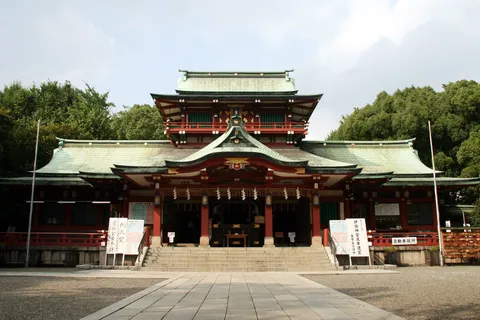
Tomioka Hachimangu
Tomioka Hachiman-gu
- Victory in Competition
- Luck in Competition
- Business Prosperity
Hyogo, Kobe (Chuo Ward)
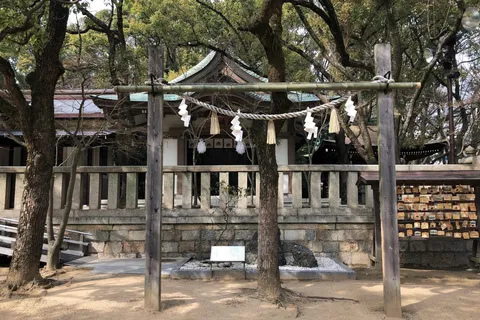
Minatogawa Jinja
Minatogawa-jinja
- Good Fortune
- Victory in Competition
- Luck in Competition
Ishikawa, Hakui
Keta Taisha
Keta Taisha
- Good Relationships
- Marital Harmony
- Business Prosperity