History
Tamaki Shrine stands near the summit of Mt. Tamaki (1,076 m) at the southern end of the Omine mountain range, deep in the mountains of Totsukawa Village in the far south of Nara Prefecture. It has long been revered as the inner shrine of the Three Kumano Shrines. According to the official website, it was founded in 37 BC, in the reign of the tenth emperor, Sujin, when the deity Hayatama was enshrined to protect the royal capital from fire and to drive away evil. There is also a tradition that Emperor Jimmu passed through on his legendary eastern campaign.
In the Heian period the shrine became a syncretic Shinto-Buddhist site and was known as “Tamaki Sansho Gongen” or the inner shrine of the Three Kumano Shrines, flourishing as a sacred place. It was also one of the training sites of the Kumano and Omine Shugendo ascetics, who travel the route from Kumano to Yoshino, and in the Edo period the temple Takamuro-in served as its administrator. After the Shinto-Buddhist separation of 1868 (Keio 4), the mixed worship was ended, and the shrine went through the name “Tamaki Sansho Okami” before becoming today’s Tamaki Shrine. In 2004 it was inscribed as part of the World Heritage “Sacred Sites and Pilgrimage Routes in the Kii Mountain Range.”
The main shrine enshrines five deities: Kuninotokotachi no Mikoto, Izanagi no Mikoto, Izanami no Mikoto, Amaterasu Omikami, and Kamuyamatoiwarebiko no Mikoto (Emperor Jimmu). Kuninotokotachi at the center is the deity said in the Nihon Shoki to have appeared at the very beginning of heaven and earth. Because the shrine is so hard to reach, it is also known by the saying that you cannot arrive unless you are “called by the gods.” In the TV Asahi program “Tuesday’s Yoshizumi Kotaro” 2-hour special (“Nara Park Great Adventure & World Heritage Kumano Hidden Shrine”), broadcast on May 5, 2026, Yoshizumi Ishihara and Kotaro Koizumi visited Tamaki Shrine as a hidden shrine deep in the mountains.
Highlights
The roughly 30,000 square meters of grounds were long a sacred precinct where felling trees was forbidden, which allowed a forest of giant cedars to grow. This cedar grove is designated a Natural Monument by Nara Prefecture (1959) and includes the “Jindai-sugi,” said to be 3,000 years old, along with the “Tokotachi-sugi” and the “O-sugi.” The O-sugi is the largest cedar in the grounds, about 11 m around at eye level and roughly 50 m tall, rising straight toward the sky. A pair of cedars known as “Meoto-sugi” can also be found along the way.
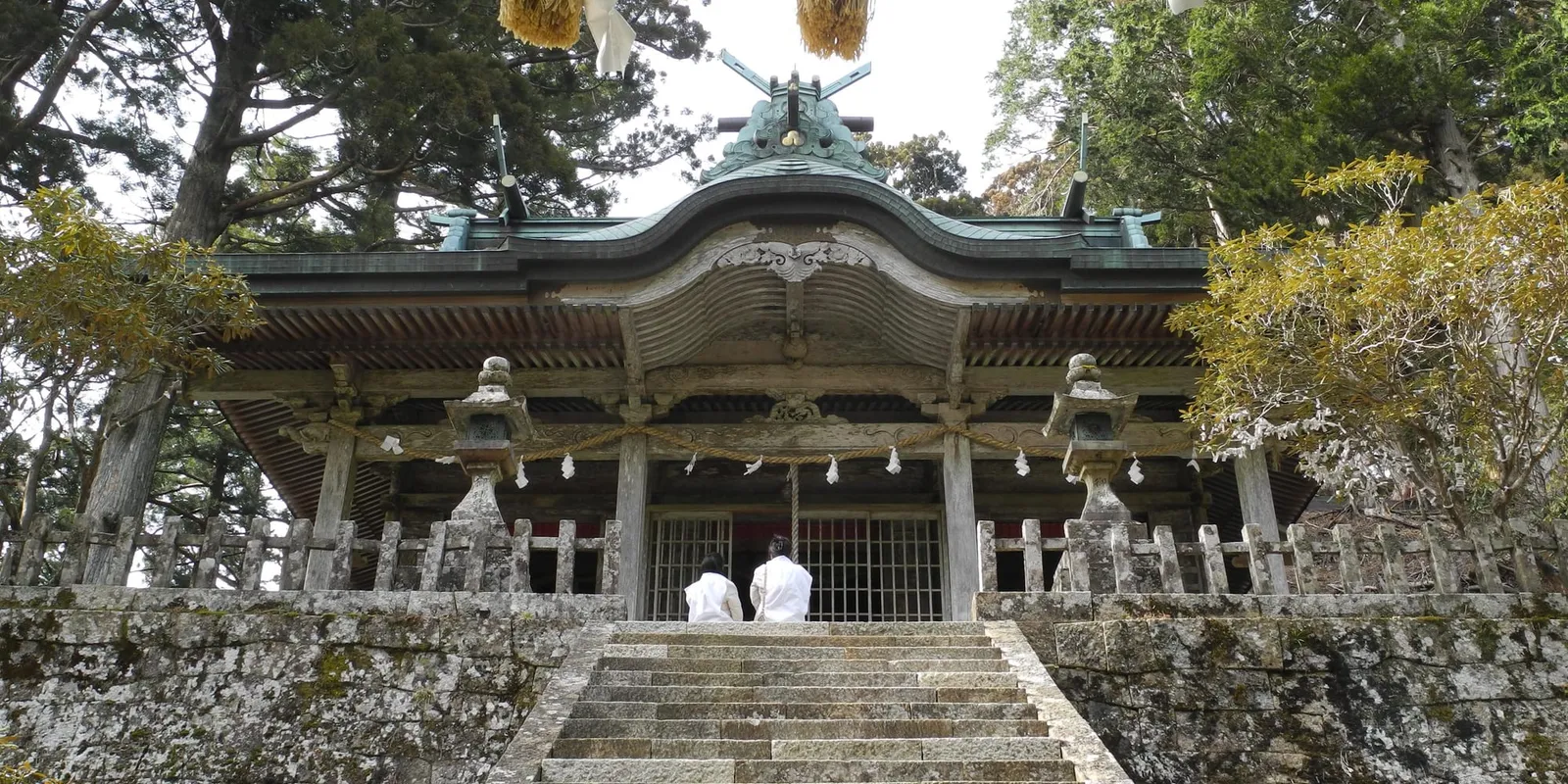
The main shrine (honden) is built of zelkova wood in the irimoya style, with a karahafu gable over the front and a chidori-hafu gable above it, and is thought to preserve the style of its rebuilding in 1794 (Kansei 6). Irimoya-style main halls are rare in Nara Prefecture. Next to it on the west stand the subsidiary shrines Wakamiya-sha and Jinmu-sha.
The shrine office and kitchen were built in 1804 (Bunka 1), at the end of the Edo period, as the main hall and living quarters of the administrator temple Takamuro-in, and were designated an Important Cultural Property of Japan in 1988. The interior is known for fusuma paintings of flowers and birds by a late-Edo Kano-school painter, but according to the official website, viewing of the paintings is currently suspended for conservation repairs. Please check the official site for when it resumes. The temple bell from the Heian period (also an Important Cultural Property) is currently kept at the Totsukawa Village Local History Museum while it is being restored.
Within the grounds is also the subsidiary shrine Tamaishi-sha (enshrining Onamuchi no Mikoto). It is said to be where Emperor Jimmu placed a jewel while praying for victory, a sacred place connected with the shrine’s name, and it preserves an old form of worship centered on stones rather than a building.
Visiting Tips
From the Tamakiyama parking lot it is about a 20-minute walk to the main shrine, through a torii gate and along the approach, which includes stone steps. At over 1,000 m above sea level it is cooler than the lowlands and often foggy, so wear comfortable shoes and clothing suited to the season.
From Totsukawa Onsen to the parking lot is about 30 minutes by car on a mountain road. Some sections have no guardrails, and snow and ice are possible in winter. Closures and other road information are posted in the “Road Information” section of the official website, so check before you set out. On some days all of Totsukawa Village has been closed to traffic because of rainfall restrictions, and the official site advised postponing the visit in bad weather. If you are not driving, the nearest bus stop is Totsukawa Onsen on the Nara Kotsu Yagi–Shingu line; from there, a taxi on weekdays or a reservation-only World Heritage bus on weekends and holidays (suspended in winter) is needed.
Since January 1, 2022, visitors have been asked not to bring pets into the grounds (apart from the buildings); guide, hearing, and service dogs are allowed. The goshuin fee and hours are not listed on the official website; the hand-written goshuin is often reported at ¥300, but it may change, so please confirm at the shrine office. For formal worship (a prayer service), men are asked to wear a suit.
Annual Festivals
- Annual Festival (October 24, with an eve festival on October 23): The shrine’s largest festival, falling on Saturday, October 24 in 2026. On that day extra village-run buses run from Totsukawa Onsen to the Tamakiyama parking lot; the official site lists up-bound departures from 8:25 AM to 8:40 AM (Hotel Subaru and Totsukawa Onsen) and down-bound departures from the parking lot between 11:00 AM and 12:10 PM. The ceremonies vary from year to year, so check the official site for details.
- Hatsuuma Festival at Mihashira Shrine (first Horse day in March): The annual festival of the auxiliary Mihashira Shrine in the grounds, which the official site says is the grandest after the October festival.
- Tamaishi Shrine Festival (May 13): The annual festival of the subsidiary Tamaishi Shrine.
- Dainichido Grand Festival (August 8): The Dainichido hall’s hexagonal shrine is opened to view on the 8th of every month, and the principal image is shown on August 8 (viewing is from the outside of the building only).
- New Year (January 1): The New Year ceremony; the festival of burning old amulets is held on January 28.
- Summer purification (June 30) and year-end purification and Joya-sai (December 31): Seasonal purification rites.
Nearby Food & Sightseeing
- Totsukawa Onsen: The hot spring town with the bus stop used as the starting point for Tamaki Shrine. The public bath Iori-no-Yu is known for its free-flowing natural spring water, and it is a good stop before or after the mountain visit.
- Tanize Suspension Bridge: A suspension bridge in Totsukawa Village about 297 m long and 54 m high, introduced as the longest suspension bridge in Japan used for daily life.
- Kumano Hongu Taisha: One of the Three Kumano Shrines, on the Wakayama side. Tamaki Shrine is also called the inner shrine of the Three Kumano Shrines, and many visitors pair the two.
Frequently Asked Questions
- Q. What are the visiting hours and is there an admission fee?
- A. The grounds are open to visitors and there is no admission fee. The shrine office is reported to be open 8:00 AM–5:00 PM, but hours can change with the season and events, so it is best to confirm with the shrine office (0746-64-0500) or the official website. According to the official site, the painted fusuma doors inside the shrine office are currently closed to viewing because of renovation work.
- Q. How do I get there, and is there parking?
- A. Public transport is limited. Beyond the Totsukawa Onsen stop on the Nara Kotsu Yagi–Shingu bus line, you use a taxi on weekdays or, on weekends and holidays, a reservation-only World Heritage bus (suspended in winter; please check). By car, take Route 168 and a mountain road up to the free Tamakiyama parking lot, then walk about 20 minutes to the main shrine. Some road sections have no guardrails, so drive carefully. Snow and ice are possible in winter, so check the road information on the official website.
- Q. Can I get a goshuin at Tamaki Shrine?
- A. Yes. The hand-written goshuin is often reported to cost ¥300, but neither the fee nor the hours are listed on the official website, so please confirm at the shrine office when you visit. Other types, such as a paper-cut goshuin, also seem to be offered at times.
- Q. Has Tamaki Shrine been featured on TV?
- A. Yes. In the TV Asahi broadcast of "Tuesday's Yoshizumi Kotaro" 2-hour special ("Nara Park Great Adventure & World Heritage Kumano Hidden Shrine") on May 5, 2026, Yoshizumi Ishihara and Kotaro Koizumi visited the shrine, which is said to be reachable only if you are "called by the gods."
- Q. When is the annual festival?
- A. The annual festival (Reisai) is held every year on October 24, with an eve festival on October 23. In 2026 it falls on Saturday, October 24, and extra village-run buses are scheduled from Totsukawa Onsen to the Tamakiyama parking lot (up-bound from 8:25 AM, down-bound from 11:00 AM to 12:10 PM). Other events include the Hatsuuma Festival at Mihashira Shrine (the first Horse day in March) and the Tamaishi Shrine festival (May 13).
Plan Your Visit
Before you go, you can book a stay and get your shrine-visit items ready.
Amazon links open Amazon.co.jp (Japan) in English; whether an item ships overseas depends on the product.
※ Contains ads (PR). Links open external sites such as Amazon, Rakuten, Trip.com and Booking.com.