History
Yoshino Jingu stands on Yoshinoyama in Yoshino, Nara Prefecture, and enshrines Emperor Go-Daigo, the 96th emperor and the founder of the Southern Court. Its former rank was Kanpei Taisha (a major state shrine), and today it is a Beppyo Shrine of the Association of Shinto Shrines. It is counted among the “Fifteen Shrines of the Kenmu Restoration,” which are linked to Go-Daigo’s Kenmu Restoration.
After Go-Daigo died in 1339 (Engen 4), his statue was placed at Yoshimizu-in in Yoshino, where Buddhist memorial services continued. When Shinto and Buddhism were separated in the Meiji era, Yoshimizu-in became a shrine dedicated to Go-Daigo (later Yoshimizu Shrine), and the government signaled its intention to build a separate state-funded shrine to him. In 1889 (Meiji 22), at the wish of Emperor Meiji, the founding of the Kanpei Chusha (mid-rank state shrine) “Yoshino-gu” was decided. The shrine buildings were completed in 1892 (Meiji 25), and a ceremony moved the statue of Go-Daigo from Yoshimizu Shrine to the new shrine. The statue moved at that time is said to have been carved by Emperor Go-Murakami of the Southern Court. The shrine was raised to Kanpei Taisha in 1901 (Meiji 34) and renamed “Yoshino Jingu” in 1918 (Taisho 7).
Highlights
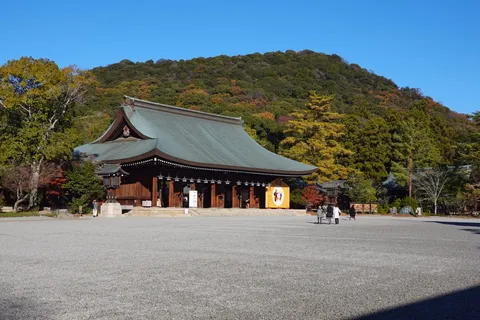
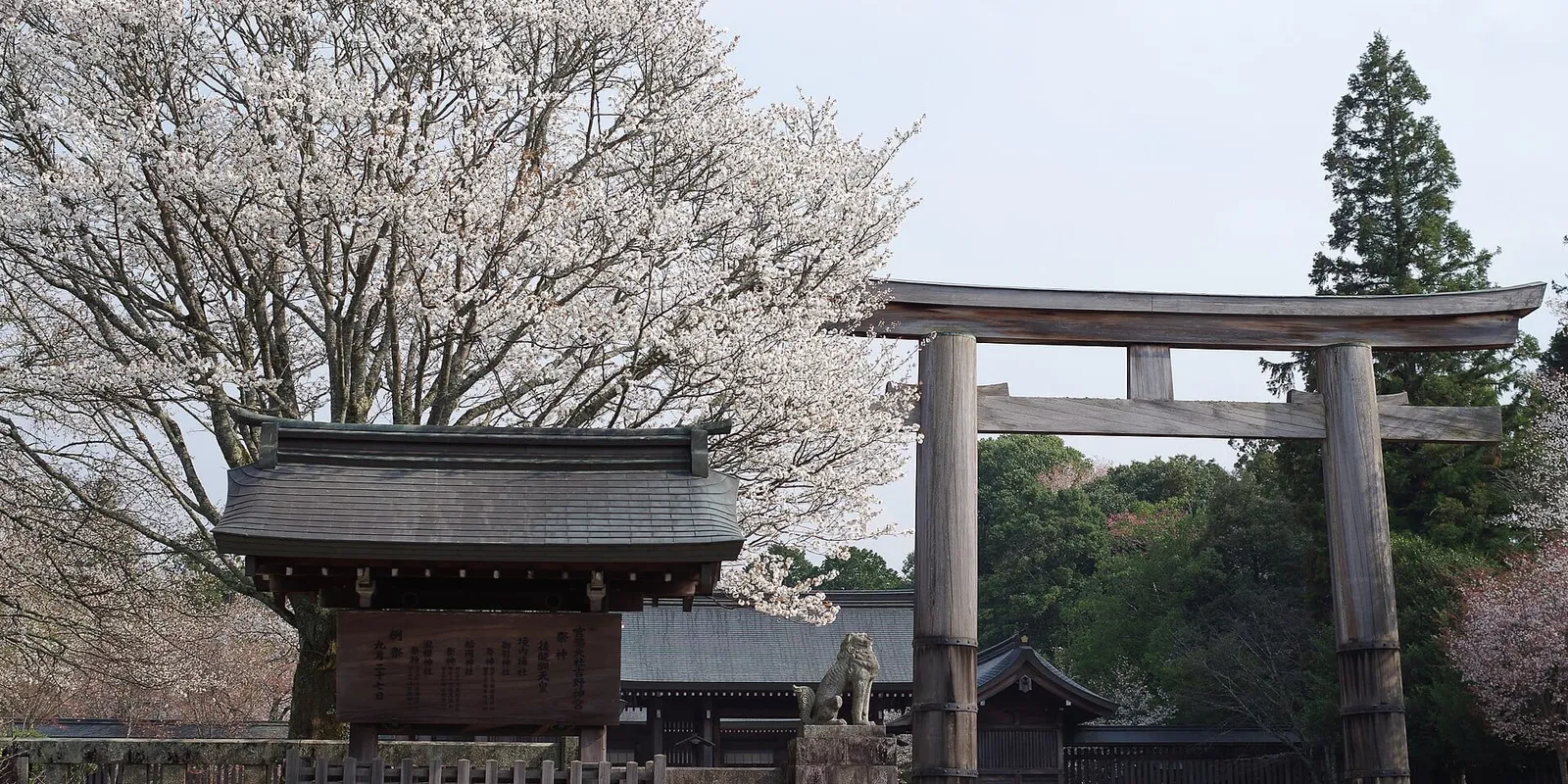
The main hall was raised in 1927 (Showa 2), the worship hall was completed in 1928 (Showa 3), the shinmon gate in 1929 (Showa 4), and the great torii in 1930 (Showa 5). Built entirely of cypress (hinoki), the complex is regarded as a representative example of modern shrine architecture. The main hall, worship hall, and gate all face north, toward Kyoto, reflecting Go-Daigo’s longing to return to the imperial palace there. On September 20, 2022, 26 buildings and 3 structures on the grounds were designated Important Cultural Properties of Japan.
The grounds also hold three subsidiary shrines dedicated to loyal retainers of the Southern Court, seven in all: Mikage Shrine (Hino Suketomo and Hino Toshimoto), Funaoka Shrine (Kojima Norinaga, Kojima Takanori, and Sakurayama Koretoshi), and Takizakura Shrine (Doi Michimasu and Tokuno Michitsuna). The grounds are also known as a cherry blossom spot and draw many visitors in spring.
Visiting Tips
The shrine is open from 8:30 AM to 5:00 PM and admission is free. The amulet office (goshuin) is open until roughly 4:30 PM, so if you are arriving in the late afternoon, go early. The regular goshuin costs ¥300, and seasonal cut-paper goshuin or similar designs are sometimes offered (details and prices vary by season).
The nearest station is Yoshino-jingu Station on the Kintetsu Yoshino Line; from the large torii in front of the station it is an uphill walk of about 20 minutes (about 1 km). This is a different station from Kintetsu Yoshino Station (the gateway to central Yoshinoyama and the ropeway), so if you want to combine your visit with the cherry blossoms of Yoshinoyama, plan your transfers in advance. There is a free parking lot for worshippers, but parking is limited to 1 hour, and traffic and parking restrictions apply during cherry blossom season.
Annual Festivals
- Spring Grand Festival (April 29, from 10:30 AM): Also called the Kenmu Restoration Commemoration Festival, it features offerings of the Urayasu no Mai dance, folk dances, and dedicated poetry recitation (per Yoshino Town’s information; the date is given differently in some sources).
- Autumn Grand Festival (September 27, from 10:30 AM): A grand festival with a similar program of dedicated performances.
- Other ceremonies: The shrine is also said to hold the New Year Festival (January 1), Toshigoi-sai (February 17), Nagoshi Grand Festival (July 31), and Year-end Purification (December 31).
The cherry blossoms of Yoshinoyama as a whole, about 30,000 trees of roughly 200 varieties, bloom in order from Shimo-Senbon to Naka-Senbon, Kami-Senbon, and Oku-Senbon, usually from early to late April. During blossom season, night illumination and temporary buses also operate.
Nearby Food & Sightseeing
- Yoshimizu Shrine: The shrine where Go-Daigo’s statue was once kept, closely tied to the Emperor. It stands on Yoshinoyama and is a component of the UNESCO World Heritage site “Sacred Sites and Pilgrimage Routes in the Kii Mountain Range” (Yoshino Jingu itself is not part of the World Heritage site).
- Kinpusen-ji: The Shugendo temple at the heart of Yoshinoyama and a World Heritage component, a classic stop for anyone exploring the history of Yoshinoyama.
- Cherry blossoms of Yoshinoyama (Shimo-Senbon to Oku-Senbon): About 30,000 trees, mainly white mountain cherries (shiro-yamazakura), bloom in stages from the bottom of the mountain to the top, usually from early to late April.
Frequently Asked Questions
- Q. What are the visiting hours and is there an admission fee?
- A. The shrine is open to worshippers from 8:30 AM to 5:00 PM and there is no admission fee. The amulet office (goshuin and so on) is open roughly 9:00 AM–4:30 PM. Hours can change, so it is worth checking the latest information before you visit.
- Q. When can I get a goshuin at Yoshino Jingu?
- A. During the amulet office hours (roughly 9:00 AM–4:30 PM). The regular goshuin costs ¥300. Seasonal limited-edition goshuin (such as cut-paper designs) are sometimes offered, but the designs, prices, and availability vary by season, so please check the notice on the day.
- Q. Is there parking?
- A. There is free parking for worshippers, available 8:30 AM–5:00 PM with a 1-hour limit. During cherry blossom season (usually April), traffic and parking restrictions are in place around Yoshinoyama, so we recommend taking the train or checking ahead.
- Q. How do I get to Yoshino Jingu by train?
- A. From Yoshino-jingu Station on the Kintetsu Yoshino Line, walk through the large torii in front of the station and uphill for about 20 minutes (about 1 km). Note that this is a different station from Kintetsu Yoshino Station, the gateway to central Yoshinoyama and the ropeway.
- Q. Who is enshrined at Yoshino Jingu, and does it have Important Cultural Properties?
- A. The shrine honors Emperor Go-Daigo, who established the Southern Court, and is one of the Fifteen Shrines of the Kenmu Restoration. On September 20, 2022, 26 buildings and 3 structures on the grounds, including the main hall, worship hall, and shinmon gate, were designated Important Cultural Properties of Japan. The main hall, worship hall, and gate face north, toward Kyoto, where Go-Daigo longed to return.
Plan Your Visit
Before you go, you can book a stay and get your shrine-visit items ready.
Amazon links open Amazon.co.jp (Japan) in English; whether an item ships overseas depends on the product.
※ Contains ads (PR). Links open external sites such as Amazon, Rakuten, Trip.com and Booking.com.