History
Susaki Shrine stands on a mountainside near the western tip of the Boso Peninsula in Susaki, Tateyama, Chiba, looking down over the entrance to Tokyo Bay. The Tateyama City cultural-property page gives the reading of the main hall as “Sunosaki Jinja Honden,” and this page follows it with “Sunosaki Jinja.” Japanese Wikipedia gives both “Susaki Jinja” and “Sunosaki Jinja,” and the place name Susaki is also commonly read “Susaki.” No official site for the shrine was found, so the reading comes from Tateyama City’s guidance and is not necessarily the reading the shrine itself uses.
The enshrined deity is Amano-hirinome-no-mikoto, regarded as the consort of Ame-no-futodama-no-mikoto, the deity of Awa Shrine (per Japanese Wikipedia). The travel site tabi-mag introduces her as the grandmother of Ame-no-tomi-no-mikoto, the deity of the settlement of Awa Province. On the founding, Japanese Wikipedia puts it in the era of Emperor Jimmu, based on shrine lore and records. tabi-mag, on the other hand, introduces a shrine tradition that En no Ozunu founded it in the first year of Yoro (717), so accounts differ.
Japanese Wikipedia explains that the shrine is a leading candidate (ronsha) for the shrine listed as “后神天比理乃咩命神社” in the Heian-period Engishiki register of shrines, and that there has been a dispute since the Edo period with 洲宮神社 (Shrine), also in Tateyama, over which is the true one.
The travel site maruchiba.jp and other sources introduce it as the shrine where Minamoto no Yoritomo prayed for victory after being defeated in the Battle of Ishibashiyama and fleeing to Awa.
How the shrine is referred to as the “Ichinomiya of Awa Province” varies by source. Japanese Wikipedia calls it “(traditionally) Ichinomiya of Awa Province” and cites cases of early-modern records and plaques with the word “Ichinomiya,” while saying this is not conclusive. The Chiba Prefecture Awa-area page writes that it is “a shrine of the Awa Province Ichinomiya in addition to Awa Shrine.” This page does not assert it and simply notes that sources treat it differently.
Highlights
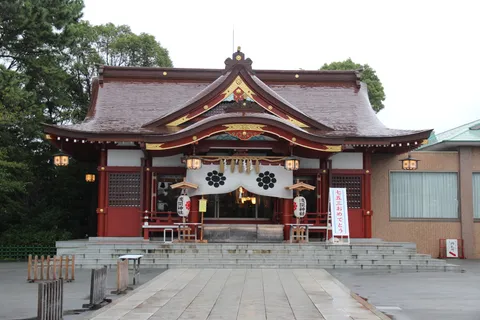
The core of the grounds is the main hall, a city-designated tangible cultural property (architecture). According to the city, it was designated on February 21, 1967 (Showa 42), and is a three-bay “nagare-zukuri” building with a copper-plate roof, with the pillars and main members lacquered in vermilion. The bracket system under the eaves is the Chinese-style “mitesaki” type, said to be unusual for shrine architecture. Shrine tradition dates its construction to the Enpo era (1673–81), but the city explains that major repairs appear to have been made later, and that some of the carved frog-leg struts (kaerumata) on the front and back appear to have come from an older shrine.
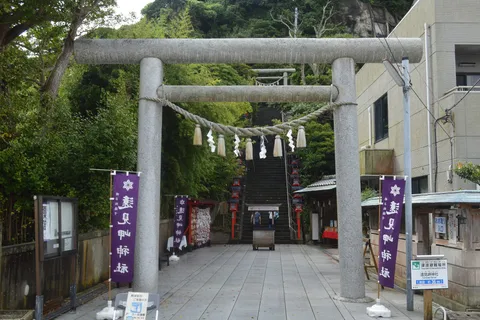
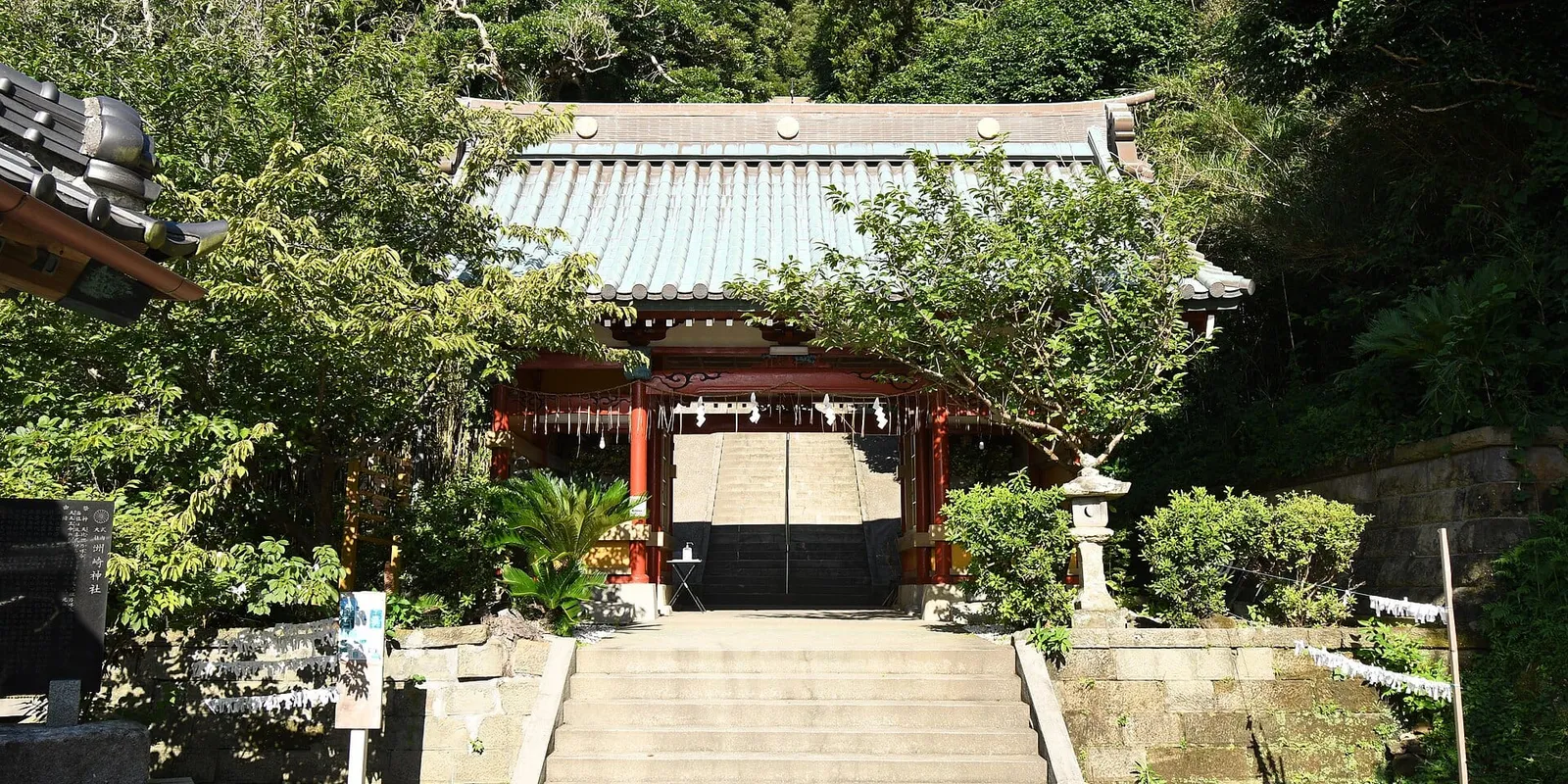
On the way to the main hall, a steep flight of steps rises beyond the Zuijin gate. Tateyama Field Museum (run by Tateyama City Museum) and Chiba Prefecture’s guide call it the “Yakubarai-zaka” (Misfortune-Warding Slope) with 148 steps, while another travel site says 150 (probably a difference in counting). According to the museum, portable shrines go up and down these steps during the festival, and supports have been placed on both sides at the midpoint and at the top.
The mountain behind the grounds is the Chiba Prefecture natural monument “Susaki Jinja Natural Forest” (designated September 29, 1972). The prefecture’s record gives an area of 54,261.9 square meters, extending from near the main hall up to the summit (110 m above sea level), with a stable stand of Castanopsis (sudajii) in the lower part.
On the seaward side stands the Hama-torii (beach torii). The travel site maruchiba.jp says that on clear, crisp days you can see Mt. Fuji through the torii, and tabi-mag says Diamond Fuji can be seen from the beach torii around July 15. The same site also says that before the war sailors offered many votive plaques (ema) here praying for safe voyages.
Yoro-ji, a Shingon temple next to the shrine, served as the shrine’s Buddhist priests until the Edo period, according to Tateyama Field Museum.
Visiting Tips
No official site for the shrine was found, and visiting hours, shrine-office hours, prayer services and goshuin information could not be confirmed. If you would like a goshuin, we recommend checking before your visit, for example with the Tateyama City tourism division (0470-22-2544).
The travel site maruchiba.jp introduces the shrine as one worshiped for safe childbirth, maritime safety, good fishing, bountiful harvests and protection from misfortune. The benefits listed on this page are based on this.
According to tabi-mag, it is about 30 minutes by JR Bus (toward Susaki) from JR Tateyama Station, then about a 5-minute walk from “Sunosaki Jinja-mae.” By car it is about 16 km from the Tomiura IC on the Futtsu-Tateyama Expressway, though another guide says about 25 minutes. Parking is described as free, and tabi-mag says there are 7 spaces, but as this is not official information, please allow extra time on busy days. The address is given as 1344 Susaki, following Tateyama City. The tabi-mag article gives 1334, so sources differ; searching for the shrine’s name in a map app is the surest way.
Because the grounds involve a long flight of steps, comfortable walking shoes are recommended.
Annual Festivals
- Annual festival (August 21 in a typical year): tabi-mag gives it as August 21 each year, saying the “Ohamaide” rite, in which the portable shrine goes down the 148 steps (30-degree slope) to the beach, takes place around 3:00 PM in a typical year, with offerings in the grounds from around 2:00 PM. Japanese Wikipedia gives the annual festival as August 20 (the main festival as August 20–21), and Tateyama Field Museum as August 21–22, so the dates differ by source.
- Susaki no Minoko Odori (first-horse day in February / August 21): A Chiba Prefecture intangible folk cultural property, designated on June 9, 1961 (Showa 36), with the Susaki district as holder, according to the prefectural list. tabi-mag says it is offered in the grounds on the first-horse day in February and on August 21, and Tateyama Field Museum describes it as the “Susaki Odori,” made up of the Miroku dance and the Kashima dance.
- Making the shimenawa (January 8): According to Tateyama Field Museum, a great shimenawa rope for the torii is made on January 8.
Dates and content can change by year. Please check before your visit, for example with the Tateyama City tourism division (0470-22-2544).
Nearby Food & Sightseeing
- Susaki Lighthouse: According to tabi-mag, a lighthouse first lit in 1919 (Taisho 8); it is not a lighthouse open for tours. The same site says that on clear days you can see the Miura Peninsula, Mt. Fuji and Izu-Oshima.
- Yoro-ji: A Shingon temple next to Susaki Shrine, said to have served as the shrine’s Buddhist priests until the Edo period (Tateyama Field Museum).
- 洲宮神社 (Shrine): Also in Tateyama, a shrine that has been discussed alongside Susaki Shrine as a candidate (ronsha) for a shrine listed in the Engishiki register (per Japanese Wikipedia).
Frequently Asked Questions
- Q. What are the visiting hours of Susaki Shrine?
- A. No official site for the shrine was found, and visiting hours and shrine-office hours could not be confirmed. The grounds are reached by climbing a steep flight of steps, so visiting in daylight is the safer choice. The tabi-mag article lists the Tateyama City tourism division's phone number, 0470-22-2544, as an inquiry contact.
- Q. Can I get a goshuin?
- A. The official and municipal pages I could confirm do not say whether goshuin are offered, or give a fee or hours. Please check before your visit, for example with the Tateyama City tourism division (0470-22-2544).
- Q. How do I get there, and is there parking?
- A. According to the travel site tabi-mag, it is about 30 minutes from JR Tateyama Station by JR Bus toward Susaki; get off at "Sunosaki Jinja-mae" and walk about 5 minutes. By car it is about 16 km from the Tomiura IC on the Futtsu-Tateyama Expressway (tabi-mag), though another guide says about 25 minutes. Parking is described as free, and tabi-mag says 7 spaces (neither is official information).
- Q. What cultural properties does Susaki Shrine have?
- A. According to Tateyama City, the main hall is a city-designated tangible cultural property (architecture), and shrine tradition dates its construction to the Enpo era (1673–81). Chiba Prefecture's list also names the shrine's "Susaki Jinja Natural Forest" as a prefectural natural monument and the "Susaki no Minoko Odori" dance as a prefectural intangible folk cultural property.
- Q. When are the festival and the Minoko Odori dance?
- A. The travel site tabi-mag gives the annual festival as August 21 each year, with the "Susaki no Minoko Odori" offered on that day and on the first-horse day (Hatsuuma) in February, and a rite called Ohamaide in which the portable shrine goes down the stone steps. Japanese Wikipedia, however, gives the annual festival as August 20 (the main festival as August 20–21), and Tateyama Field Museum gives August 21–22, so sources differ. Dates can change by year, so check beforehand.
Plan Your Visit
Before you go, you can book a stay and get your shrine-visit items ready.
Amazon links open Amazon.co.jp (Japan) in English; whether an item ships overseas depends on the product.
※ Contains ads (PR). Links open external sites such as Amazon, Rakuten, Trip.com and Booking.com.