History
Toyokuni Shrine (read “Hokoku Jinja”) stands in the middle of the town of Nagahama in Shiga Prefecture, about a 3-minute walk from JR Nagahama Station. It enshrines Toyotomi Hideyoshi, who laid the foundations of the castle town as lord of Nagahama Castle. It is a different shrine from Toyokuni Shrine in Kyoto (read “Toyokuni Jinja”): this one was kept alive by the townspeople of Nagahama out of their attachment to Hideyoshi. The official site of the Kita-Omi Toyotomi Exposition notes that the town he built is still affectionately known locally as “Hideyoshi-san.”
According to the history on the shrine’s official site, Hideyoshi began building Nagahama Castle and its merchant townscape in the spring of 1574 and governed the town well for about ten years. When he died in 1598, the people of Nagahama are said to have built a shrine modeled on the Toyokuni mausoleum in Kyoto, with the founding given as 1600. Under the Tokugawa shogunate, however, deifying Hideyoshi was forbidden and the shrine was torn down. After that, ten town officials hid images of him in their homes, and in 1793 they asked the Hikone domain for permission to build an “Ebisu Shrine,” enshrining Hideyoshi secretly behind the Ebisu deity. This is said to be the beginning of the Toka Ebisu festival. The shrine is also said to have written “Toyo Shrine” and read it “Minori Jinja” to carry on the faith (a trace of which remains in the “Minori Bridge” over the eastern outer moat), and in 1920 it was at last able to call itself “Toyokuni Jinja” openly.
The enshrined deities are Toyotomi Hideyoshi, Kato Kiyomasa, Yae Kotoshironushi no Mikoto (the Ebisu shrine), and Kimura Nagato-no-kami Shigenari. The official site explains that Kiyomasa was enshrined as Hideyoshi’s trusted retainer and Shigenari as the man who protected Toyotomi Hideyori to the end, while Ebisu is the deity who stood in front of Hideyoshi through the difficult Edo period.
Highlights
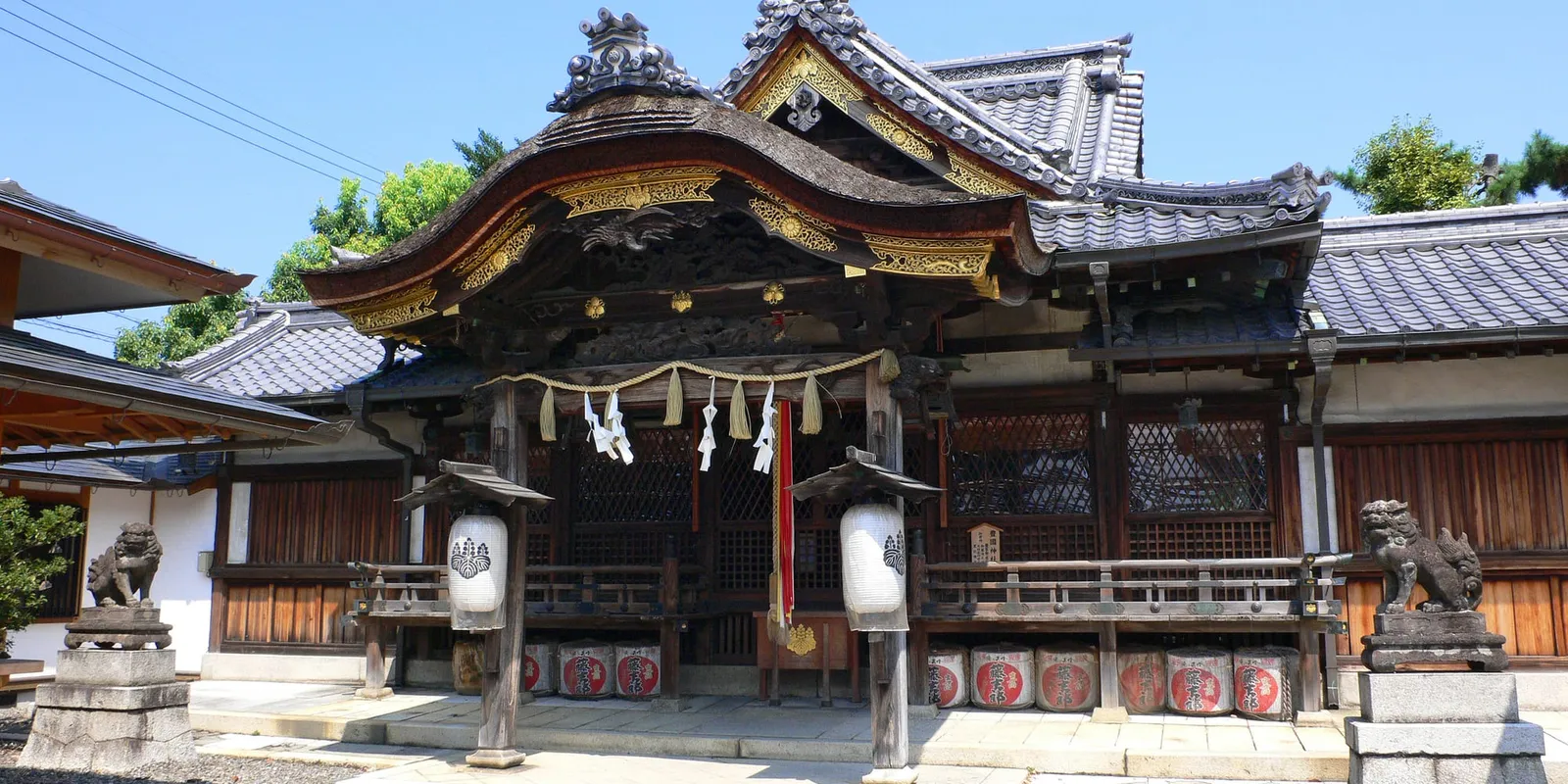
The official precinct guide describes the main shrine as having a cypress-bark-roofed karahafu front porch and a haiden (worship hall) with a chidori-hafu gable and tiled roof, and a shinmei-zukuri sanctuary from the mid-Edo period. The Inari shrine (Shusse Inari) to the right of the haiden has a coffered ceiling painted with seasonal flowers and birds by the Kyoto artist Tokuriki Tomikichiro, and is built so that visitors can make the “ohyaku-meguri” circuit of repeated prayers.
The grounds also hold a gourd-shaped pond (after Hideyoshi’s battle standard), the “Tora-ishi” (Tiger Stone), said to be a garden stone donated by Kato Kiyomasa, a statue of Kiyomasa, and the “Fuku Mannen Kame” spirit stone said to bring good luck. The official site tells how the Tiger Stone was moved to Daitsuji Temple when Nagahama Castle was dismantled but cried out every night, so it was returned to the shrine, where it quieted down.
The NHK drama “Toyotomi Kyodai!” and the Kita-Omi Toyotomi Exposition: The exposition’s official site says that, to coincide with the NHK Taiga drama “Toyotomi Kyodai!” (Toyotomi Brothers!), the “Kita-Omi Toyotomi Exposition” is being held mainly in Nagahama from Sunday, February 1 to Sunday, December 20, 2026. One of its centerpieces, the “Toyotomi Kyodai! Kita-Omi Nagahama Taiga Drama Museum,” is housed in the Sokaisho hall of Nagahama Betsuin Daitsuji Temple (32-9 Motohama-cho, Nagahama). According to the official site, it is open 9:00 AM–5:00 PM (last entry 4:30 PM), generally without closing days, with admission of ¥600 for adults and ¥300 for elementary and junior high school students. In its introduction to the Nagahama castle-town area, the exposition’s site features Toyokuni Shrine as “the setting of the Hoko Matsuri.” The shrine’s own site announces a limited-edition “Four Shrines Pilgrimage” goshuin book based on the world of the drama (a joint project among the Toyokuni shrines of Owari-Nakamura, Omi-Nagahama, Kyoto and Osaka Castle, announced May 2026) and a clear-sheet goshuin (¥500) with the shrine’s official characters inspired by Hideyoshi and Hidenaga. We could not find an official announcement that the drama was filmed at the shrine. Dates, prices and availability may change, so please check each official site before you go.
Visiting Tips
The shrine is a short walk through town: about 3 minutes on foot from JR Nagahama Station on the JR Hokuriku Line (per the official site). By car, it is about 15 minutes from Nagahama IC on the Hokuriku Expressway; there is dedicated parking for 10 cars (free), and nearby paid parking is available when it is full.
The visiting hours of the grounds are not stated on the official site and could not be confirmed. Prayer services (first shrine visits, protection from misfortune, Shichi-Go-San, corporate visits, car purification) run 9:00 AM–4:30 PM (reception until 4:00 PM), by reservation, with offerings starting at ¥5,000.
Goshuin: The official site announces monthly limited-edition goshuin (¥500 each, limited quantity). The October 2026 edition is “Hoko Matsuri – Seven Spears of Shizugatake,” available from October 1. Whether regular goshuin are offered and their hours could not be confirmed on the official site, so we recommend contacting the shrine office (tel. 0749-50-4796) before your visit.
Annual Festivals
The main events from the “Festivals and Events” page of the official site are listed below. Dates may change, so please check before visiting.
- Toka Ebisu (January 9, 10 and 11): The grand festival of the Ebisu shrine, with a Hoe-kago palanquin procession and a rice-cake scattering. It is the shrine’s signature event and traces back to townspeople who kept worshipping Hideyoshi in the guise of Ebisu during the Edo period.
- Shusse Inari Hatsuuma Festival (early February)
- Spring Grand Festival (March 18)
- Nagoshi no Oharae (June 30) and the chinowa grass-ring purification (about June 20 to early July)
- Hokoki Festival (August 18): Held on the anniversary of Hideyoshi’s death.
- Autumn Grand Festival (Hoko Matsuri / first and second Sundays of October): In 2026, a children’s mikoshi procession and rice-cake scattering takes place on Sunday, October 4, followed on Sunday, October 11 by the autumn grand ritual at 8:30 AM and then the Hoko Matsuri. The Hoko Matsuri (Nagahama Shusse Matsuri) is known for its samurai procession re-creating Hideyoshi’s triumphant return from the Battle of Shizugatake, including the Seven Spears of Shizugatake, and for a children’s procession. It leaves the shrine around noon, walks to Nagahama Hachimangu Shrine and returns (the route changes every other year). It is said to have begun in 1983 to mark the rebuilding of Nagahama Castle after about 400 years, and rice cakes are scattered during and at the end of the procession (per the Nagahama Shusse Matsuri Executive Committee and the Nagahama-Maibara Tourism Association).
Nearby Food & Sightseeing
- Nagahama Betsuin Daitsuji Temple: The venue (Sokaisho hall) of the “Toyotomi Kyodai! Kita-Omi Nagahama Taiga Drama Museum,” which is announced to run until December 20, 2026.
- Nagahama Castle Historical Museum: A museum named for Hideyoshi’s Nagahama Castle, in a corner of Hokoen Park. According to its official site, it is about a 7-minute walk from JR Nagahama Station, open 9:00 AM–5:00 PM (last entry 4:30 PM), and generally closed on Mondays (the next weekday if Monday is a holiday).
- Kurokabe Square: A sightseeing area of Nagahama known as the “glass town” (as described on the Kurokabe official site).
- Nagahama Hachimangu Shrine: The shrine visited by the Hoko Matsuri procession, and also the setting of the Nagahama Hikiyama Matsuri held each April. The Hikiyama Matsuri is a festival of that shrine, not of Toyokuni Shrine.
Frequently Asked Questions
- Q. What are the visiting hours and is there an admission fee?
- A. The official site does not state visiting hours or an admission fee for the grounds. Prayer services run 9:00 AM–4:30 PM (reception until 4:00 PM), by reservation, with offerings starting at ¥5,000. For the latest information, contact the shrine office (tel. 0749-50-4796).
- Q. Can I get a goshuin here?
- A. The official site announces monthly limited-edition goshuin (¥500 each, limited quantity). The October 2026 edition is "Hoko Matsuri – Seven Spears of Shizugatake," available from October 1. Whether regular goshuin are offered, and their hours, could not be confirmed on the official site, so please contact the shrine office beforehand.
- Q. Is there parking?
- A. According to the official site, there is dedicated parking for 10 cars (free). If it is full, use a nearby paid lot. The shrine is also about a 3-minute walk from JR Nagahama Station, so arriving by train is convenient.
- Q. When is the Hoko Matsuri (Nagahama Shusse Matsuri)?
- A. In 2026 it takes place on Sunday, October 11. The shrine's autumn grand ritual starts at 8:30 AM, and the festival procession leaves the shrine around noon, walks to Nagahama Hachimangu Shrine, and returns. The procession route changes every other year.
- Q. How is the shrine connected to the NHK drama "Toyotomi Kyodai!"?
- A. To coincide with the NHK Taiga drama "Toyotomi Kyodai!" (Toyotomi Brothers!), Nagahama City is hosting the "Kita-Omi Toyotomi Exposition" from February 1 to December 20, 2026, and the exposition's official site introduces Toyokuni Shrine as the setting of the Hoko Matsuri. We could not find an official announcement that any filming took place at the shrine.
Plan Your Visit
Before you go, you can book a stay and get your shrine-visit items ready.
Amazon links open Amazon.co.jp (Japan) in English; whether an item ships overseas depends on the product.
※ Contains ads (PR). Links open external sites such as Amazon, Rakuten, Trip.com and Booking.com.