History
Toyokuni Shrine in Nagoya stands inside Nakamura Park in Nakamura Ward and enshrines Toyotomi Hideyoshi. Nakamura is regarded as Hideyoshi’s birthplace, and Nakamura Park includes a “Hokō Tanjō no Chi” birthplace monument (the exact birthplace is a matter of some debate, as the City of Nagoya itself notes). There is another Toyokuni Shrine in Higashiyama Ward, Kyoto, but this is a separate shrine, built in Hideyoshi’s home area of Nakamura. Like the Kyoto shrine, which honors Hideyoshi as the farmer’s son who served Oda Nobunaga and went on to unify the country, the Nagoya shrine is revered by people who admire Hideyoshi’s rise from a farming family to ruler of Japan.
According to the shrine’s official website, it was founded in 1885 (Meiji 18). The then prefectural governor, lamenting the neglected state of Hideyoshi’s birthplace, issued an order, and local volunteers built the shrine. In 1901, the volunteers who had planned the shrine donated the land around the grounds to Aichi Prefecture, and the prefecture developed it into Nakamura Park, which the website describes as the oldest park in the city. The main deity is Toyotomi Hideyoshi, and, according to the goshuin page on the shrine’s website, Kita-no-Mandokoro (Hideyoshi’s wife, Ne / One) is also enshrined alongside him in the main sanctuary. The subsidiary shrine Kiyomasa-ko-sha enshrines Kato Kiyomasa, who is also said to have been born in Nakamura.
The “Toyotomi Kyodai!” Drama and Nakamura
The 65th NHK Taiga drama, “Toyotomi Kyodai!,” began broadcasting on January 4, 2026, with Hideyoshi’s younger brother Toyotomi Hidenaga as its protagonist (per NHK’s official website). The City of Nagoya presents the “Toyotomi Museum” in Nakamura Park as a complex in “Nagoya Nakamura,” the birthplace of the brothers Hideyoshi and Hidenaga. Inside it is the “Toyotomi Kyodai! Nagoya Nakamura Taiga Drama Hall,” scheduled to run from Saturday, January 24, 2026 to Monday, January 11, 2027. The venue is the Toyotomi Museum (23-1 Nakamura-cho Kinoshita-yashiki, Nakamura Ward, Nagoya, inside Nakamura Park), open 9:00 AM–5:00 PM (last entry 4:30 PM) and generally every day. Same-day admission to the drama hall is listed as ¥800 for high school students and older and ¥400 for elementary and junior high students, with free admission for preschoolers (per Nagoya city and Aichi tourism information; periods and prices may change).
Please note that what is described here is only that Nagoya and others present Nakamura as the brothers’ birthplace and that the Taiga drama hall is open. We could not confirm any information about the drama having been filmed at Toyokuni Shrine.
Highlights
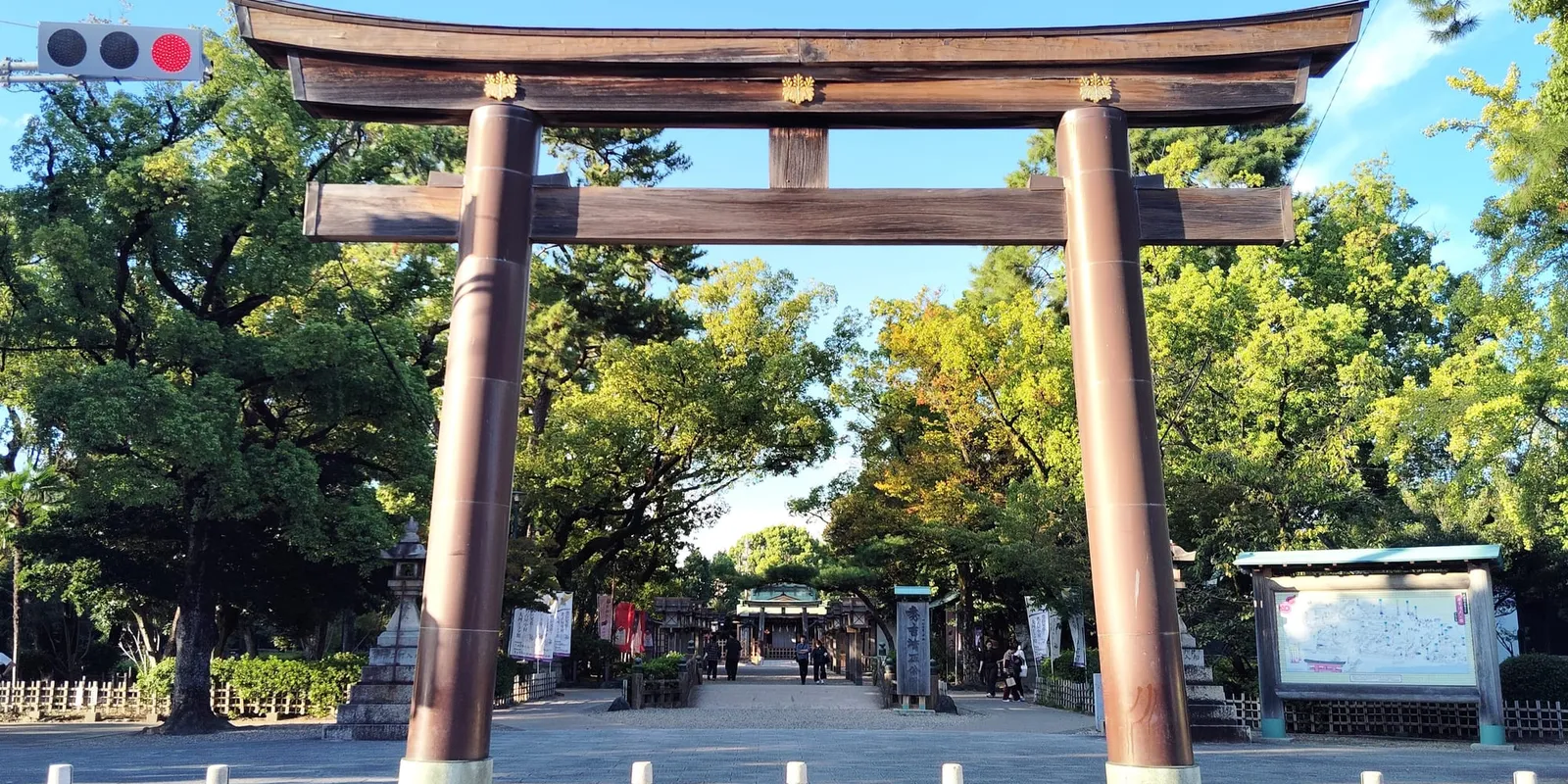
The Great Torii of Nakamura: According to the shrine’s website, this torii was planned to commemorate Nakamura Ward’s incorporation into Nagoya in 1921. It was completed in 1929 and is made of reinforced concrete, with an overall length of about 24.5 m and pillars 2.5 m in diameter (figures as given on the shrine’s website). The website says it was “the largest in Japan at the time of its completion,” but we have not verified how it ranks today. It is said to have been repaired twice and repainted since.
Worship hall and other buildings: According to Nagoya city tourism information, a group of stone lanterns, the third torii, and the gate doors were newly built in 2019 to celebrate the 30th year of the retired Emperor’s reign and the accession of the current Emperor, and the worship hall (haiden) was completed in 2020.
Nakamura Park and the birthplace monument: According to the website, Nakamura Park has a large pine tree planted by the future Emperor Taisho during a visit as crown prince, and a statue commemorating the birth of the first Nakamura Kanzaburo. As for the “Hokō Tanjō no Chi” monument, the City of Nagoya explains that a wooden marker was erected in 1883 and replaced with a stone monument in 1911.
Amulets: According to the website, besides ordinary amulets such as Nishiki-mamori, Kaiun Yakuyoke (good fortune and protection from misfortune), academic, traffic safety, and safe childbirth charms, there are items themed on Hideyoshi, including the gourd good-fortune charm, the career-success charm, the victory charm, and the “dream” charm.
Visiting Tips
The grounds are open for worship and there is no admission fee. The shrine office hours are listed as 9:30 AM–4:30 PM on the website’s top page, but the Nagoya city tourism site lists 8:30 AM–4:30 PM, so allow some leeway. Prayer services (first shrine visit for babies, protection from misfortune, exam success, career success, Shichi-Go-San, and more) are by reservation; the website says to reserve by phone (052-411-0003) or in person, and as you enter the sanctuary, men are asked to wear a suit and tie and women to dress equivalently.
For goshuin, there is the regular goshuin (¥500); the limited-edition “Toyotomi Commemorative” goshuin, offered from January 1, 2026 to December 31, 2027 (¥600, pre-written sheet only); the Kita-no-Mandokoro goshuin (¥500); the goshuin of the subsidiary Kiyomasa-ko-sha (¥500); limited goshuin on the monthly festival day (the 18th); and limited goshuin at the Taiko Festival and New Year (per the shrine’s website). We could not confirm from the shrine’s official information whether the Toyotomi Commemorative goshuin is tied to the Taiga drama. The website is not consistent about whether goshuin are pre-written sheets or written in your book, so please check on the day.
There is no dedicated parking, so a visit by subway (about 10 minutes on foot from Exit 3 of Nakamurakoen Station on the Higashiyama Line) or city bus is recommended. The Toyotomi Museum with the Taiga drama hall, the Nagoya City Hideyoshi Kiyomasa Memorial Museum, and Josenji Temple are all in the same area and can be visited on foot.
Annual Festivals
- Reisai / Taiko Festival (Sunday just before May 18; May 16–17 in 2026): According to the shrine’s website, a tea-offering ceremony is held the day before. On the festival day there is a “Shusse Chigo Gyoretsu” children’s procession, praying for children’s healthy growth and success in life, open to the public by pre-registration (registration for 2026 ran from March 9 to May 6). Limited-edition goshuin are also offered.
- Monthly service (18th of every month): Held on the monthly anniversary of Hideyoshi’s death, with a limited-edition goshuin.
- Birthday festival (1st day of the first lunar month): A ceremony celebrating Hideyoshi’s birth.
- New Year’s Day service and first visit (January): According to the website, the shrine office pauses services between 3:00 and 6:00 AM on New Year’s Day, but worship is possible 24 hours a day (2026 notice). Limited-edition New Year goshuin are also prepared.
- Great Purification (June 30 and December 31): The summer and year-end purification rites are held.
Nearby Food & Sightseeing
- Toyotomi Museum (Taiga Drama Hall): A complex inside Nakamura Park housing the “Toyotomi Kyodai! Nagoya Nakamura Taiga Drama Hall” and a museum shop (open until January 11, 2027, per Nagoya city and Aichi tourism information).
- Nagoya City Hideyoshi Kiyomasa Memorial Museum: On the second floor of the Nakamura Park Culture Plaza, presenting the era of Hideyoshi and Kiyomasa and Owari’s Sengoku warlords through paintings, crafts, documents, and video (per the City of Nagoya; open 9:30 AM–5:00 PM, with closing days).
- Josenji Temple: A Nichiren-sect temple known as Hideyoshi’s birthplace, said to have been built by Kiyomasa on the site of Hideyoshi’s residence (per the Aichi tourism site; the birthplace is a matter of debate).
- Nakamura Park: A city park developed around the shrine grounds, with the Hideyoshi birthplace monument, the Hyotan (gourd) Pond, and the Taiko Pond.
Frequently Asked Questions
- Q. How is the Nagoya Toyokuni Shrine different from the Toyokuni Shrine in Kyoto?
- A. They are separate shrines. The Nagoya shrine, inside Nakamura Park, was founded in 1885 by local volunteers in Nakamura, the area traditionally regarded as Hideyoshi's birthplace. The Toyokuni Shrine in Higashiyama Ward, Kyoto, was founded in 1599 on Hideyoshi's will and restored on its present site in 1880; it has its own page on this site.
- Q. Can I get a goshuin at the Nagoya Toyokuni Shrine?
- A. Yes. According to the shrine's official website, the regular goshuin is ¥500, and the limited-edition "Toyotomi Commemorative" goshuin, available from January 1, 2026 to December 31, 2027, is ¥600 (pre-written sheet only). There are also a Kita-no-Mandokoro goshuin (¥500), a goshuin for the subsidiary Kiyomasa-ko-sha shrine (¥500), and limited-edition goshuin on the 18th of each month. The website is not consistent about whether goshuin are handed over as pre-written sheets or written in your book, so please check on the day.
- Q. Is there parking?
- A. There is no dedicated parking for the shrine (per the Nagoya city tourism and Aichi tourism sites). Getting there from Exit 3 of Nakamurakoen Station on the Higashiyama Line (about 10 minutes on foot) or by city bus is recommended. A shared paid lot for the Nakamura Park Culture Plaza (26 spaces) is mentioned on the Hideyoshi Kiyomasa Memorial Museum's page, but rates and hours may change, so check beforehand.
- Q. Is the "Toyotomi Kyodai!" Taiga drama exhibition nearby?
- A. According to the City of Nagoya, the "Toyotomi Kyodai! Nagoya Nakamura Taiga Drama Hall" is located inside the Toyotomi Museum in Nakamura Park and is scheduled to run from January 24, 2026 to January 11, 2027 (9:00 AM–5:00 PM, last entry 4:30 PM, generally open daily; same-day tickets ¥800 for high school students and older, ¥400 for elementary and junior high students). Dates and hours can change, so check the official information.
- Q. When is the shrine's main annual festival?
- A. The shrine's official website says the Reisai (Taiko Festival) is held on the Sunday just before May 18 each year, with a tea-offering ceremony the day before and a pre-registration "Shusse Chigo Gyoretsu" children's procession on the festival day. In 2026, the Taiko Festival was held on Saturday, May 16 and Sunday, May 17. A monthly service is also held on the 18th, the monthly anniversary of Hideyoshi's death.