History
Ueno Toshogu is a shrine in Ueno Park in Taito, Tokyo. Its name is read “Ueno Toshogu” (the official site gives no kana reading; this follows Japanese Wikipedia). The official site explains that a Toshogu is a shrine enshrining Tokugawa Ieyasu (as Tosho Daigongen), and that there are many across Japan besides Nikko and Kunozan. The enshrined deities are Tokugawa Ieyasu, Tokugawa Yoshimune and Tokugawa Yoshinobu, and the shrine has long been worshipped for career success, victory, and health and longevity.
According to the official history, on February 4, 1616 (Genna 2), the priest Tenkai and Todo Takatora were summoned to the bedside of the dying Ieyasu, who asked that a place be made where the three of them could rest together for ages to come. Tenkai received the land of what is now Ueno Park, formerly the residence of Todo Takatora and others, and founded Kan’eiji Temple (Toeizan). In 1627 (Kan’ei 4), the shrine “Toshosha” was built as one of the many halls within its grounds, and this is the beginning of Ueno Toshogu. In 1646 (Shoho 3) the imperial court formally granted it the title of “Toshogu.”
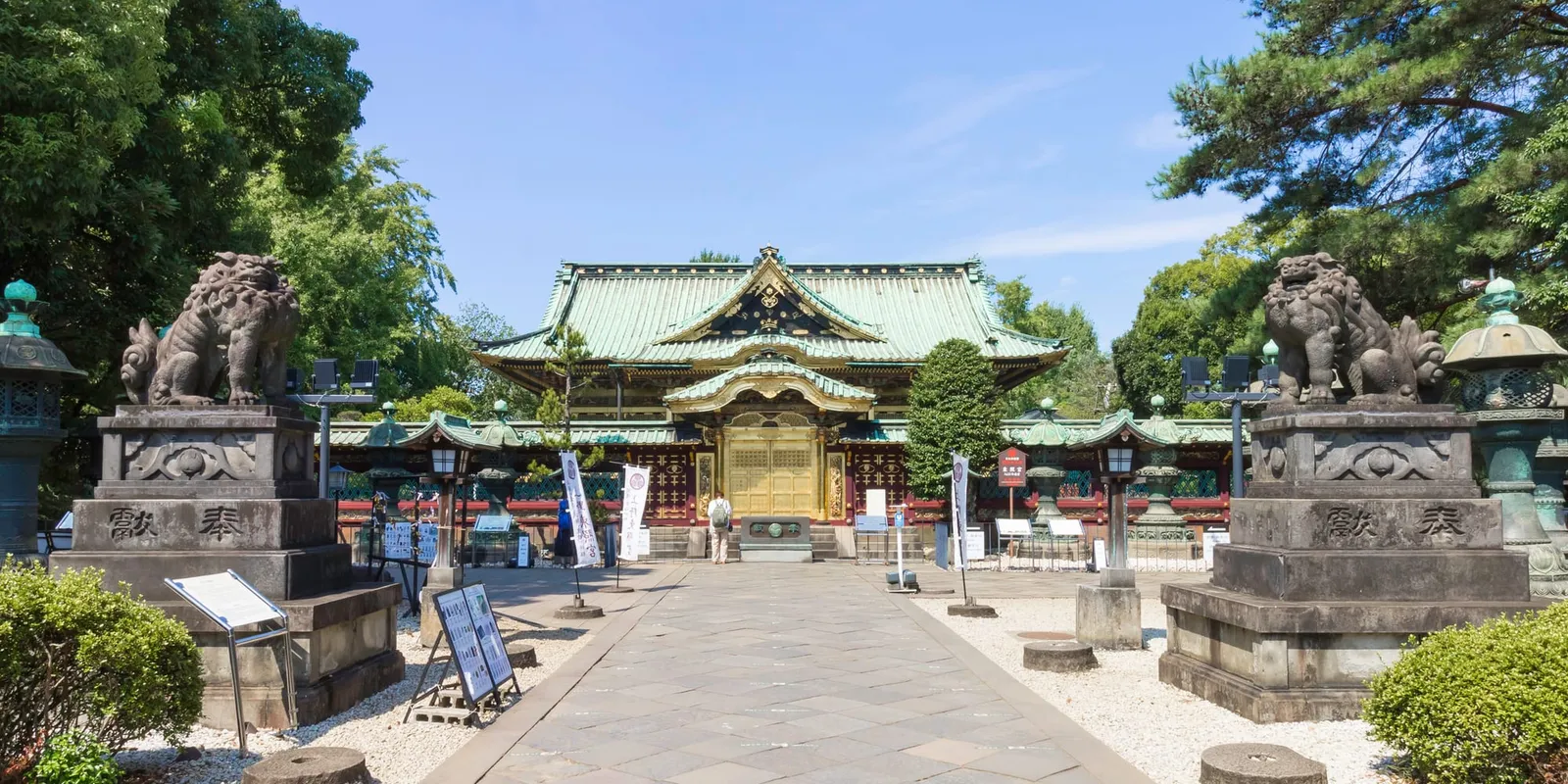
The present Golden Hall, openwork fence and Karamon were rebuilt in 1651 (Keian 4) by the third shogun, Tokugawa Iemitsu, and the official site says the Golden Hall was built on the model of Nikko Toshogu for the people of Edo who could not travel to Nikko. On that occasion about 250 lanterns were reportedly donated by daimyo from across the country. During the Battle of Ueno at the end of the shogunate, many of Kan’eiji’s halls were lost, but the fire did not reach Ueno Toshogu, and it did not fall in the Great Kanto Earthquake. The site also says an incendiary bomb dropped just behind the Golden Hall in the Tokyo air raids of World War II turned out to be a dud. In the Meiji era the five-story pagoda in the grounds was transferred to Kan’eiji (it is now under Tokyo Metropolitan Government management) under the order separating Shinto and Buddhism. All of this is the shrine’s own account.
Highlights
The shrine hall, the “Golden Hall,” was built in 1651 and is a nationally designated Important Cultural Property. It is in the gongen-zukuri style, with the worship hall, the intermediate hall (ishi-no-ma) and the main hall running in three rooms from the approach. The official site describes carvings of hawks on the front, peonies around it, and phoenixes on the sides, with paired open- and closed-mouthed lions (a-un) at the corners. The carvings are finished with the “ikezaishiki” technique of mineral pigments over gold leaf. The interior is closed to the public to protect it.
The “Karamon” (formally a four-legged gate with a karahafu gable) was also built in 1651 and is an Important Cultural Property. Its pillars carry ascending and descending dragons attributed to Hidari Jingoro, and legend says they go to drink from Shinobazu Pond every night. The “Sukashibei,” the openwork fence around all four sides of the Golden Hall, gets its name because you can see through its diamond lattice. Over 250 carvings of animals and plants of the fields and mountains, and of sea and river creatures, decorate both faces.
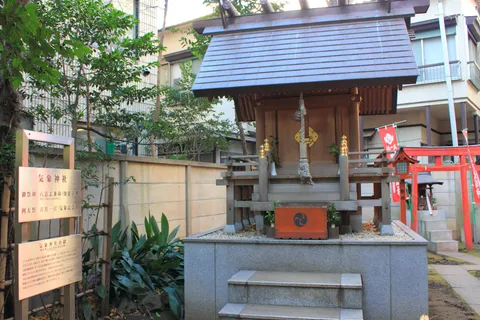
The grounds also hold the Great Stone Torii (donated by Sakai Tadayo in 1633 and made of Bizen granite, said not to have tilted in the Great Kanto Earthquake; an Important Cultural Property), 48 bronze lanterns donated by daimyo (Important Cultural Properties), and a 6.8-meter stone lantern that the official site says is counted among Japan’s three great stone lanterns. Beside the Golden Hall stands the Eiyo Gongen-sha, also called “Otanuki-sama,” which the official site says is worshipped as a god of strong luck, exams, employment and victory, on the wordplay of “tanuki” and “outdoing others.” The Great Camphor Tree, said to be over 600 years old, is a sacred tree that watched over this ground before the shrine was founded.
Visiting Tips
Entry to the grounds to worship is free, from 9:00 AM to 4:30 PM in winter (Oct–Feb) and 9:00 AM to 5:30 PM in summer (Mar–Sep). The “viewing” area inside the openwork fence, where you can see the Golden Hall and other buildings up close, charges ¥700 for adults and ¥300 for elementary school children. The Eiyo Gongen-sha and the sacred tree are inside this viewing area. Hours may shift with the weather, and the gate may close in severe weather.
Goshuin, charms and talismans are given out 9:30 AM–4:00 PM in winter and 9:30 AM–5:00 PM in summer, every day. The fee for the regular goshuin is not stated on the official pages I could confirm, and the items page lists a February-only double-page goshuin (Kisaragi) at ¥1,000.
It is about a 10-minute walk from the Park Exit of JR Ueno Station, about 12 minutes from Keisei Ueno Station, and about 10 minutes from Tokyo Metro Ueno Station. There is no parking lot, so go by public transport.
Annual Festivals
These are the main events and seasons confirmed on the official site. For exact dates and times, check the official site’s news page.
- New Year’s visit and winter peonies (January 1 to mid-February): The official site says the shrine is busy at New Year with worshippers and winter peony viewers. The winter peonies in the Botan Garden run from January 1 to mid-February.
- Setsubun Festival Lucky Black Soybean-Throwing (February): Held at the Kaguraden hall each year, as an occasion to share the history, nutrition and taste of black soybeans, according to the official site.
- Spring Peony Festival (mid-April to mid-May): The Botan Garden’s spring opening. The official site describes spring as a famous season for peonies and cherry blossoms. Garden admission is ¥700 for adults (official site).
- Dahlia and Ayanasu Autumn Garden (late September to early October): The Botan Garden’s autumn opening.
- Black Soybean Offering Ceremony (December): Following the Edo-period custom of Sasayama Domain presenting black soybeans to the shogunate, a ceremony reports the new harvest and prays for a good harvest and good health the next year, according to the official site.
The official site also says traditional performances such as kagura and biwa are offered at the Kaguraden (no dates given).
Nearby Food & Sightseeing
The official site’s access page introduces these nearby attractions.
- Ueno Zoo: Described by the official site as Japan’s oldest zoo, opened in 1882 (Meiji 15). It is said to keep more than 500 species, with the giant panda especially famous.
- National Museum of Nature and Science: Founded in 1877 and described as the only comprehensive science museum among national museums. It has a Japan Gallery and a Global Gallery presenting the history of nature and living things.
- Tokyo Metropolitan Art Museum: Described as founded in 1926 as Japan’s first public art museum. It hosts special exhibitions, planned exhibitions and open-call group shows.
- Shinobazu Pond: The pond the Karamon dragons are said to drink from every night, as named in the official site’s history and highlights. A good stop on a stroll through Ueno Park.
Frequently Asked Questions
- Q. What are the visiting hours and admission fee?
- A. Per the official site, the grounds are open 9:00 AM–4:30 PM in winter (Oct–Feb) and 9:00 AM–5:30 PM in summer (Mar–Sep), and entering the grounds to worship is free. The paid viewing area inside the openwork fence, where you can see the shrine buildings up close, is open 9:30 AM–4:00 PM in winter and 9:30 AM–5:00 PM in summer (it may change with the season and weather). Admission is ¥700 for adults (junior high school and up), ¥300 for elementary school children, and ¥600 per person for groups of 20 or more. The gate may close in severe weather for safety.
- Q. Can I get a goshuin at Ueno Toshogu?
- A. Yes. According to the official site, goshuin, charms and talismans are given out 9:30 AM–4:00 PM in winter (Oct–Feb) and 9:30 AM–5:00 PM in summer (Mar–Sep), every day. The fee for the regular goshuin is not stated on the official pages I could confirm. The items page lists a February-only double-page goshuin (Kisaragi; a design of peonies in the snow and folding fans) at ¥1,000, while supplies last. Offerings can change, so check the official site beforehand.
- Q. How do I get there, and is there parking?
- A. The official site gives about a 10-minute walk from the Park Exit of JR Ueno Station, about 12 minutes from Keisei Ueno Station, and about 10 minutes from Ueno Station on the Tokyo Metro Ginza and Hibiya lines. There is no parking lot, and nearby car parks are crowded, so public transport is recommended.
- Q. What is the Eiyo Gongen-sha (the "Tanuki" shrine)?
- A. According to the official site, it is a small shrine enshrined beside the Golden Hall and also called "Otanuki-sama." It is said to have caused trouble at places such as the Ooku (the shogun's inner quarters) where it was kept in the Edo period, but after it was donated to Toshogu in the Taisho era it caused no more harm and became a deity that grants strong luck. Because of the pun on "tanuki" and "outdoing others" (ta wo nuku), it is worshipped as a god of strong fortune and of success in exams, employment and victory, and many exam candidates visit each year. It stands inside the paid viewing area.
- Q. Can I go inside the Golden Hall?
- A. No. The official site says the interior of the shrine building is closed to the public to protect it. However, in the paid viewing area inside the openwork fence you can see the Golden Hall (a nationally designated Important Cultural Property) up close. The Karamon gate and the openwork fence were built in the same year, 1651 (Keian 4), and are also Important Cultural Properties.
Plan Your Visit
Before you go, you can book a stay and get your shrine-visit items ready.
Amazon links open Amazon.co.jp (Japan) in English; whether an item ships overseas depends on the product.
※ Contains ads (PR). Links open external sites such as Amazon, Rakuten, Trip.com and Booking.com.