History
Yaizu Shrine stands in Yaizu, Shizuoka Prefecture, a 13-minute walk from JR Yaizu Station (per the official site). It is read “Yaizu-jinja” (the reading is from Japanese Wikipedia; no kana reading appears on the official site’s pages). According to the official site, the principal deity is Yamato Takeru no Mikoto, and Kibi no Takehiko no Mikoto, Otomo no Takehimurajji no Mikoto and Nanatsukahagi no Mikoto are enshrined alongside him.
The official history says the shrine is said to have been founded in 409 (the 4th year of Emperor Hanzei), when Yamato Takeru was enshrined as the guardian deity of Yaizu in praise of his wisdom, courage and kindness. The site also notes that a roughly 1,600-year-old site known as the Miyanokoshi remains has been excavated in the area around the shrine, with ritual tools and traces of daily life. In the Muromachi period, when the Imagawa clan governed Suruga Province, the area was also called “Irie-no-sho,” and the shrine was known as “Irie Daimyojin.” A stone lantern in the grounds dating from the Edo period is said to be carved with the words “入江大明神廣前” (Irie Daimyojin).
The name “Yaizu” is also tied to the enshrined deity. In the official site’s account, Yamato Takeru, on his way to subdue the eastern lands, was set upon by an enemy who set fire to the grass on all sides. He is said to have cut the grass down with the sword Ame-no-Murakumo no Tsurugi, received from Yamatohime no Mikoto, and set a counter-fire with his flint to escape. The sword later came to be called Kusanagi no Tsurugi, and the place came to be called “Yakitsu.” The official site says this story is written in the Kojiki (compiled in 712). All of this is the shrine’s own tradition.
Highlights
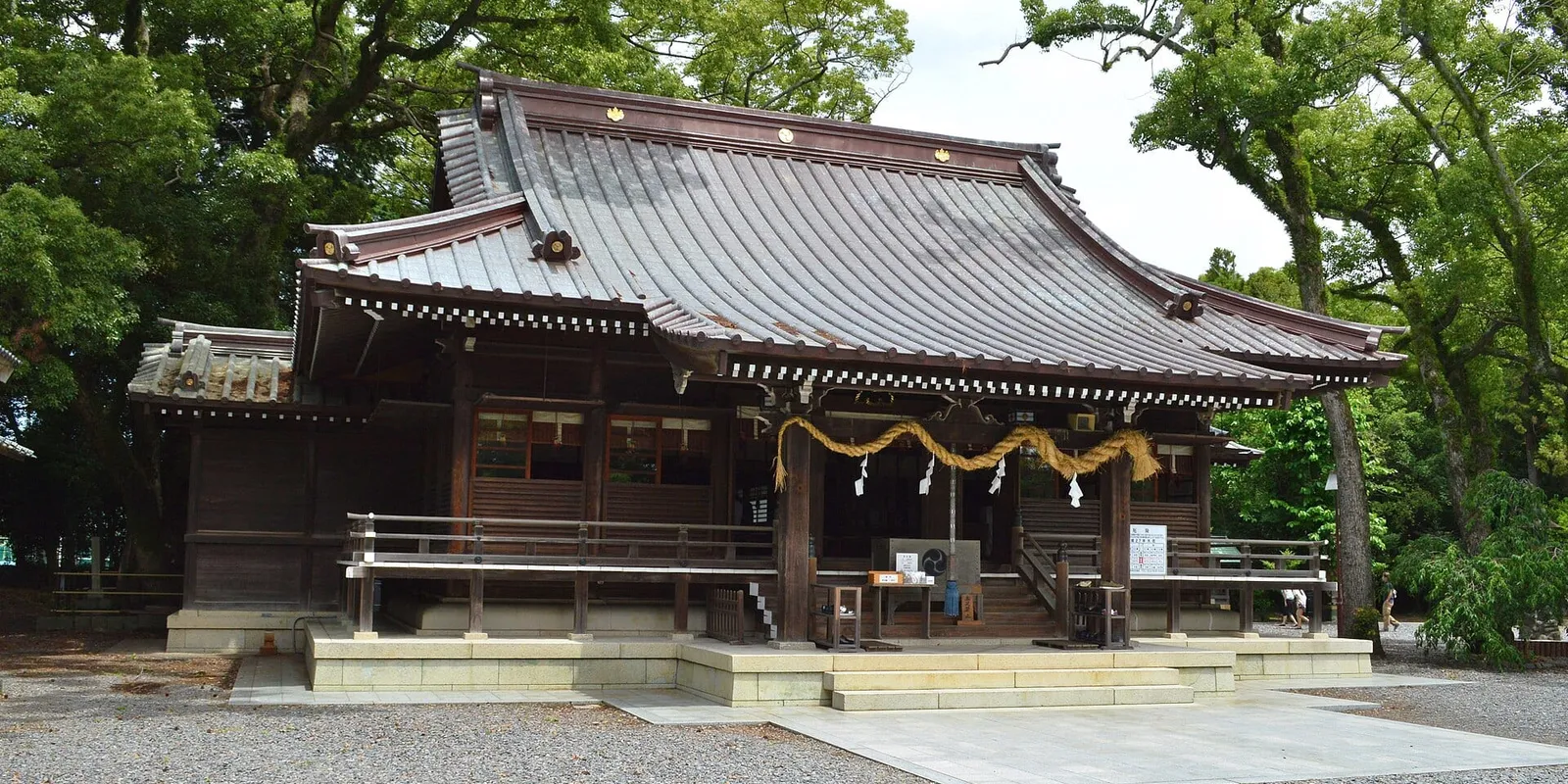
According to the history page of the official site, the present main hall was built in 1603 (Keicho 8) by Tokugawa Ieyasu and is in the nagare-zukuri style. Ieyasu is said to have donated shrine lands, and later shoguns issued vermilion-seal documents guaranteeing them. The offering hall (heiden) and worship hall date from 1944. They were first roofed with cypress bark, replaced with copper plate in the 1960s, and re-roofed in 2010 as part of the 1,600th-anniversary project, so the roofs are now red and are expected to turn blue over time.
The grounds hold the Ichikishimahime Shrine, Gosha Shrine, Shichisha Shrine, Inari Shrine, Yaizu Tenmangu, Goryo Shrine and Kyokonshi, among others (per the official site’s guide to the grounds). The Ichikishimahime Shrine honors a sea goddess; there is a tradition that Yamato Takeru enshrined her after landing at Yaizu, placing his fire stone and water stone in a small shrine, and some say it is older than the main hall. The Tachibanahime shrine within the Shichisha Shrine enshrines Yamato Takeru’s consort, Oto-Tachibanahime, and many women visit it. Yaizu Tenmangu enshrines Sugawara no Michizane, and the official site says calligraphy has long flourished in Yaizu, with Tenmangu calligraphy exhibitions held in autumn and in the new year.
Intangible folk cultural properties are another highlight. The official site describes the “Shishi Kiyari” that leads the Aramatsuri procession as a nationally selected and prefecturally designated intangible folk cultural property. On the Shizuoka Prefecture cultural property navigation site, the Shishi Kiyari is listed as prefecturally designated (designated March 24, 1978). The “Kami-korogashi” rite on August 12 is marked on the official site as a nationally selected intangible folk cultural property.
Visiting Tips
The official site says the shrine is open for worship at any time, with prayer services accepted 9:00 AM–4:00 PM and the amulet counter open 9:00 AM–4:45 PM. Prayer services cannot be booked in advance, and the offering is ¥5,000 or more per request. Services include safe childbirth, first shrine visit, Shichi-Go-San, protection from misfortune, traffic safety, maritime safety and a good catch. Applications are taken at any time, but some time slots are unavailable because of ceremonies and weddings, so it is safest to phone ahead. Prayer services are not accepted from August 10 to 14.
A July 2026 notice on the official site says goshuin are available as pre-written sheets only from August 10 to 14, but the official site gives no fee or reception hours. Go earlier in the day, using the amulet counter hours (until 4:45 PM) as a guide. The site introduces amulets for traffic safety, love, academic success, safe childbirth and more.
It is a 13-minute walk from Yaizu Station (official site). By car there are about 40 parking spaces, but there is no public parking for the Aramatsuri festival on August 12 and 13. See the official site’s access page for detailed directions.
Annual Festivals
- Nobori Festival (New Year’s Day through the first three days): Fishermen raise each boat’s big-catch flag in front of the worship hall and pray for a good catch and safety at sea for the year, together with the Saitan-sai (official site).
- Aramatsuri (August 12–13): Known as the “foremost Aramatsuri in the Tokai region.” The portable shrine leaves at 10 AM with the call “An’etton,” visits four resting places in the city, and returns around 11 PM (about 6.5 km in total). The procession includes shrine roles such as Sarutahiko, Ichikko, Onkusasage and Yabusame, and is led by girls in tekomai costume singing the Shishi Kiyari. The official site explains the “ara” (荒) of Aramatsuri not as “rough” but as facing the deity with a plain, pure and clean heart. Participants wear white.
- Nobori-katsugi prayer and Kami-korogashi (morning of August 12): For three years from birth, children carry a banner bearing their name to the shrine and pray for healthy growth. In Kami-korogashi, a first-year baby is turned three times; the offering is ¥1,000 (registration on the day). Advance registration for the nobori-katsugi prayer opens on July 1 each year (see the latest news for details).
- Kamado Shrine Festival (December 17): A festival held each year-end to pray for protection from fire (official site).
- Goryo Shrine monthly festival (15th of each month) and annual festival (October): Services at the shrine honoring Yaizu’s war dead (official site).
Dates and registration vary from year to year, so check the “News” page of the official site for the latest.
Nearby Food & Sightseeing
- Yaizu Koizumi Yakumo Memorial Museum: A facility inside the Yaizu City Cultural Center. According to the Yaizu City page, it is open 9:00 AM–5:00 PM with free admission, and closed on Mondays (the next weekday if Monday is a holiday) and over the year-end and New Year period (December 29–January 3), among other days.
- Yaizu Sakana Center: Described on tourist-information sites as a facility with shops selling Yaizu seafood. Hours differ between sources, so check before you go.
Frequently Asked Questions
- Q. What are the visiting hours?
- A. The official site says the shrine is open for worship at any time. Prayer services are accepted 9:00 AM–4:00 PM and the amulet counter is open 9:00 AM–4:45 PM. Prayer services cannot be booked in advance; you apply on the day. From August 10 to 14, prayer services are not accepted because of the grand festival.
- Q. Can I get a goshuin at Yaizu Shrine?
- A. Yes. A July 2026 notice on the official site says that from August 10 to 14, goshuin are available as pre-written sheets only, which shows that goshuin are offered. However, the fee and separate hours for goshuin are not given on the official site. The amulet counter is open until 4:45 PM, so it is best to go earlier in the day. For details, contact the shrine office (054-628-2444).
- Q. How do I get there, and is there parking?
- A. According to the official site, it is a 13-minute walk from JR Yaizu Station and a 2-minute walk from the JA Yaizu Shiten bus stop. By car it is 10 minutes from Yaizu IC and 3 minutes from Yaizu Station, and there are about 40 parking spaces. Large buses can have a space reserved if they contact the shrine in advance. There is no public parking for the Aramatsuri festival on August 12 and 13, and public transport is advised.
- Q. What is the connection between Yamato Takeru and the name "Yaizu"?
- A. According to the enshrined-deity page of the official site, when Yamato Takeru was heading east to subdue the eastern lands, an enemy tricked him and set fire to the grass on all sides at this place. He is said to have cut the grass down with the sword Ame-no-Murakumo no Tsurugi and set a counter-fire with his flint, escaping danger, and the place came to be called "Yakitsu," the origin of today's name "Yaizu." The site says this story is written in the Kojiki and presents the name as having more than 1,300 years of history.
- Q. What are Aramatsuri and Kami-korogashi?
- A. Aramatsuri is the shrine's grand festival, held every year on August 12 and 13, which the official site calls the "foremost Aramatsuri in the Tokai region." The portable shrine leaves at 10 AM with the call "An'etton," visits four resting places in the city, and returns around 11 PM (a procession of about 6.5 km in total). Kami-korogashi is a rite on the morning of August 12 in which the shrine's representatives (sodai) turn a baby who has received the nobori-katsugi prayer in the first year three times; the official site marks it as a nationally selected intangible folk cultural property. The offering is ¥1,000 (registration on the day).
Plan Your Visit
Before you go, you can book a stay and get your shrine-visit items ready.
Amazon links open Amazon.co.jp (Japan) in English; whether an item ships overseas depends on the product.
※ Contains ads (PR). Links open external sites such as Amazon, Rakuten, Trip.com and Booking.com.