History
Yusuhara Hachimangu stands at the foot of Mt. Futaba (八幡柞原山) in the west of Oita City. The official site reads the name “Yusuhara Hachimangu” (ユスハラハチマングウ) and calls the shrine the “Ichinomiya of Bungo (former Kokuhei Shosha).” According to the official history, it was raised to the rank of Kokuhei Shosha in 1916 (Taisho 5).
The shrine says it began in 827 (Tencho 4), when the Enryaku-ji monk 金亀和尚 received a divine message while in retreat at Usa Jingu and enshrined the deity on Mt. Yusuhara. The official site names Emperor Ojin (Homutawake no Mikoto), Emperor Chuai (Tarashinakatsuhiko no Mikoto) and Empress Jingu (Okinagatarashihime no Mikoto) as the enshrined deities, and says Emperor Ojin is revered as “a god of warding off misfortune and good fortune, and guardian of all industries.” The annual events page also says that “武内大神” is enshrined in the middle hall (申殿).
The official history cites the building of the shrine halls in 836 (Jowa 3) when the Minister of the Right Kiyohara no Natsuno, acting on an imperial order, had the provincial governor Oe no Uku construct them; an imperial envoy’s visit in 1108 (Kasho 3); Retired Emperor Toba’s prayer on his 60th birthday in 1153 (Ninpei 3), when he fixed the shrine’s lands; and Minamoto no Noriyori’s prayer for victory over the Taira in 1184 (Genryaku 1). It adds that Minamoto no Yoritomo and warrior lords such as the Otomo, Takenaka and Hineno also held it in deep reverence, and that in the early modern period it counted more than 200 shrine families and 30 temple lodgings. An official article dated December 15, 2025 says the shrine will mark 1,200 years since its enshrinement in 2036.
Highlights
According to the official message from the head priest, on June 20, 2011 (Heisei 23) the main hall, middle hall (申殿), worship hall, two-story gate (Romon), east and west treasure halls, east and west corridors, west gate and south gate (with the treasure storehouse and Hachioji shrine 八王子社 attached) were designated national Important Cultural Properties. The same message says the treasure hall also holds treasures that are national and prefectural Important Cultural Properties. The description on the official top page names a tachi sword, a naginata-naoshi sword and a bronze Buddha (銅造佛) as national Important Cultural Properties.
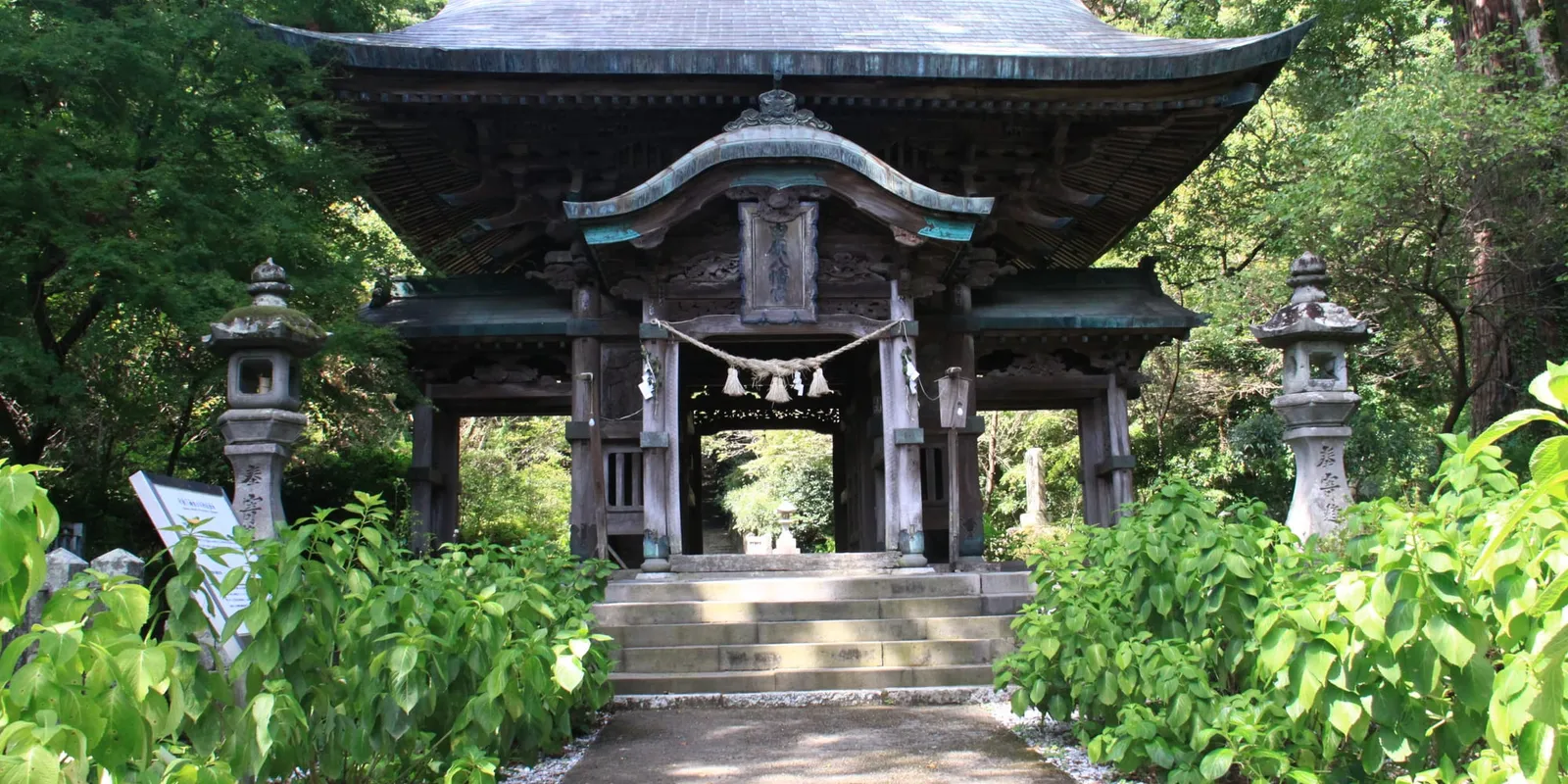
The south gate, standing partway along the long approach, is also called “Higurashi-mon,” and the official site says it carries carvings including the Twenty-Four Paragons of Filial Piety. Beside it stands a giant camphor tree, a nationally designated Natural Monument. According to the official site it is over 3,000 years old, was designated by the state in March 1922 (Taisho 11), and ranked seventh in Japan in a 1989 Environment Agency survey of giant trees; the lower part of the trunk is hollow. The grounds also hold the “Horuto tree” (a designated notable tree of Oita City), said to have been brought by Portuguese visitors in the Otomo era, and the “lucky fan stones,” said from long ago to grant a wish to whoever steps on them (the shrine office steps and the east gate are the hints for finding them).
The layout is unusual. According to the official grounds guide, visitors take off their shoes, step up onto the corridor that leads from the two-story gate, and pray kneeling in front of the worship hall. The main hall is a connected two-building Hachiman-zukuri structure painted mainly in vermilion lacquer and is said to have been rebuilt in the Kaei era (1848–1854).
Visiting Tips
Prayer requests are accepted 8:30 AM–4:00 PM. According to the official site, reservations cannot be made in advance and you apply directly at the amulet office, with offerings starting from ¥6,000 for individuals and ¥15,000 for companies and groups. The goshuin costs ¥500–¥1,500 and is handed out 8:30 AM–4:30 PM; the official site calls it a proof of worship.
Phase 1 of the conservation project (the main hall and four other buildings) was completed in March 2026, according to an official notice of March 29, 2026, and a special viewing was announced for May 3–5. The status of Phase 2 is not stated on the official pages I checked. The official site also says the shrine plans to hold a special viewing, special amulets, a special goshuin and more as 1,200th-anniversary projects, starting in New Year 2026 and running until 2036 (December 15, 2025).
Opening and closing times for the grounds, travel directions and parking are not stated on the official site. According to the guide site Walkerplus, it is about 35 minutes by bus from JR Oita Station (get off at “Yusuhara”) or about 15 minutes by car from the Oita IC, and parking is available, though the number of spaces and fee are unknown. The official site itself gives the address in two forms: “上八幡三組, Oita” (top page) and “Oaza Hachiman 987” (contact page).
Annual Festivals
Main events from the official annual events page:
- Saitan-sai (January 1): On New Year’s Day, prayers for the prosperity of the Imperial Family and the people, good harvests and the growth of all industries.
- Kinen-sai (February 17): Prayers for a good harvest of the five grains and the prosperity of all industries in the coming year.
- Rei-taisai (March 15): Once called “Hatsu-u-sai,” the most important ceremony of the shrine, attended by an offering envoy from the Association of Shinto Shrines.
- Minazuki no Oharae (June 30): A rite that removes the sins and impurities of the first half of the year using kirinusa (cut hemp and paper).
- Nagoshi-sai (July 31): A “shiokaki” rite is held at the beach at 生石, and after the procession returns, a “chi-no-wa” rite is held in the grounds.
- Procession of 武内大神 (September 1–7): 武内大神, enshrined in the middle hall, travels to his main shrine, Kaku Shrine, and the festival is also called “Kaku no Ichi.”
- Chushu-sai and Hama no Ichi (mid-September): Originating from a hojo-e rite. In 2026 it ran September 18–22.
- Niiname-sai (November 23): New rice is offered before the deity in thanks for the fulfillment of the prayers made at the Kinen-sai.
- Shichi-Go-San (November): Accepted as you arrive. In 2026 there are times when prayers cannot be accepted (see the FAQ above). The official site says photographers may take photos freely for those receiving prayers.
Nearby Food & Sightseeing
No nearby restaurants are listed because we found no primary source for them. The official site does name the “shikishi mochi” and “Ichimon dolls” as specialties of the Autumn Festival.
- Kaku Shrine: Named on the official annual events page as the “main shrine” that 武内大神 travels to during his September procession.
- Futabayama Inari Shrine: According to the official grounds guide, it is enshrined on the left just past the south gate, beyond which the approach splits into two paths, to the two-story gate and to the Shinmon gate.
Frequently Asked Questions
- Q. What are the visiting and prayer hours?
- A. The official site lists prayer requests at 8:30 AM–4:00 PM and goshuin and amulets at 8:30 AM–4:30 PM. Opening and closing times for the grounds are not stated on the official site. The official Shichi-Go-San notice dated October 20, 2026 says prayer requests cannot be accepted at certain times because of ceremonies and weddings: from 2:00 PM on November 3 and 23, 10:00 AM–noon on December 6 and 11, and from 2:00 PM on December 19.
- Q. Can I get a goshuin at Yusuhara Hachimangu?
- A. Yes. The official "Amulets and Goshuin" page lists the goshuin at ¥500–¥1,500, handed out 8:30 AM–4:30 PM, and describes it as a proof of worship. An official notice says that at the 2026 Autumn Festival and Hama no Ichi (September 18–22), a limited-time goshuin stamped with an Ichimon doll (written ahead of time, not written on the spot) was available.
- Q. How do I get there, and is there parking?
- A. The official site gives only the address (987 Oaza Hachiman, Oita) and a phone number, with no travel directions. According to the guide site Walkerplus, it is about 35 minutes by bus from JR Oita Station (get off at "Yusuhara"), or about 15 minutes by car from the Oita IC on the Oita Expressway. That site only says parking is available, with no number of spaces or fee, so it is safest to call the shrine (097-534-0065) before you go.
- Q. Which buildings are Important Cultural Properties, and is restoration still going on?
- A. According to the official site, on June 20, 2011 (Heisei 23) the main hall, middle hall (申殿), worship hall, two-story gate (Romon), east and west treasure halls, east and west corridors, west gate and south gate (with the treasure storehouse and Hachioji shrine 八王子社 attached) were designated national Important Cultural Properties. Phase 1 of the conservation project (the main hall and four other buildings) was completed in March 2026 (Reiwa 8), according to an official notice dated March 29, 2026. The buildings of Phase 2 are listed in the official project overview, but the pages I checked do not say how far it has progressed.
- Q. What is Hama no Ichi (the Autumn Festival)?
- A. According to the official annual events page, the Autumn Festival (Chushu-sai) is held in mid-September, originates from a hojo-e rite of releasing living creatures, and is also called "Hama no Ichi." Three portable shrines are carried to a temporary shrine at the otabisho, fireworks, kagura and other festival events are offered during the period, and a market fills the grounds. Its origin is said to date to the early Kamakura period, when Otomo Yoshinao became protector (shugo) of Bungo Province, and local specialties are "shikishi mochi" and "Ichimon dolls." In 2026 it ran from September 18 to 22 (official notice).
Plan Your Visit
Before you go, you can book a stay and get your shrine-visit items ready.
Amazon links open Amazon.co.jp (Japan) in English; whether an item ships overseas depends on the product.
※ Contains ads (PR). Links open external sites such as Amazon, Rakuten, Trip.com and Booking.com.