History
The hill on which Achi Jinja now stands, Mount Tsurugata, was once known as “Kameshima” or “Tsurugatajima” — small islands in what was then a shallow sea called the Kibi-no-Ana-Umi, before the Takahashi River’s sediment built up the surrounding plain. Shrine tradition holds that the ground itself was originally laid out as a garden by the clan of Achi-no-Omi, a naturalized immigrant leader who, according to the Nihon Shoki’s account of Emperor Ojin’s reign, led people from seventeen districts of the Korean peninsula to settle in Japan. Achi-no-Omi is traditionally regarded as the ancestor of the Yamato-no-Aya clan, who went on to serve the Yamato court in scribal, financial, and textile administration for generations. His own clan is said to have settled in this area and introduced advanced sericulture, silk-weaving, tailoring, and ironworking techniques — and Kurashiki’s old place name, “Achi,” is traditionally traced to this same clan.
As for the shrine itself, tradition holds that Empress Jingu, sailing home from her legendary campaign against the three Korean kingdoms, lost her way in the darkness and prayed to the three Munakata sea goddesses for guidance. Three swords are said to have fallen from the sky amid peals of thunder, glowing with light, and come to rest among the great rocks on this hill. In the reign of Emperor Ojin, the site was consecrated as “Myoken-gu,” a shrine that would later be known as Myoken-gu (妙見宮). Centuries later, in 1594, this Myoken-gu — until then enshrined within a neighboring temple compound — was relocated to its present site, and the shrine buildings were constructed in 1620. Following the Meiji-era separation of Buddhism and Shinto in 1869, the shrine was renamed Achi Jinja, and its object of worship changed from the Myoken (North Star) deity to the three Munakata goddesses, guardians of maritime safety, who remain its principal deities today. The shrine’s associate hall (aidono) still enshrines nineteen further deities, including Emperor Ojin, Izanagi, Izanami, Amaterasu, Susanoo, and Okuninushi. Ever since, Achi Jinja has been venerated as the guardian shrine (sochinju) of Kurashiki’s twenty-seven historic districts, the Bikan Historical Quarter among them.
Highlights
Traces of the shrine’s ancient garden survive throughout the grounds, in a style shrine literature calls “Tsurukame” (crane-and-turtle), including a cluster of sacred rocks known as the Amatsu Iwasaka and a yin-yang rock arrangement in front of the Saikan purification hall — physical remnants, tradition says, of the garden the Achi-no-Omi clan built on this hill. Local tourism guides describe this rock garden as the oldest surviving example in Japan of the “Shinsen-Horai” style, modeled on the Taoist paradise of Mount Penglai, underscoring just how far back the site’s spiritual associations reach.
Equally unmissable is the wisteria arbor on the north side of the main hall, known as the “Achi Fuji.” Of the Akebono-fuji variety, it is said to be the largest and oldest specimen of its kind in Japan, with an estimated age of 300 to 500 years, and was designated an Okayama Prefecture Natural Monument in 1956; it has since become the official flower of Kurashiki City. Having once come close to dying out, the tree was nursed back to health through a dedicated restoration project and now blooms in dense cascades of pale purple each spring, typically from late April.
The Zuishinmon gate is carved with a distinctive rabbit motif, a detail popular enough with visitors that it has been worked into a limited-edition goshuin book design alongside the wisteria. The shrine’s ema hall, meanwhile, is built in the dramatic “kake-zukuri” cantilevered style — jutting out over the hillside in a manner reminiscent of Kyoto’s Kiyomizu-dera — and offers one of the best panoramic views over the Bikan Historical Quarter’s canal townscape below.
Visiting Tips
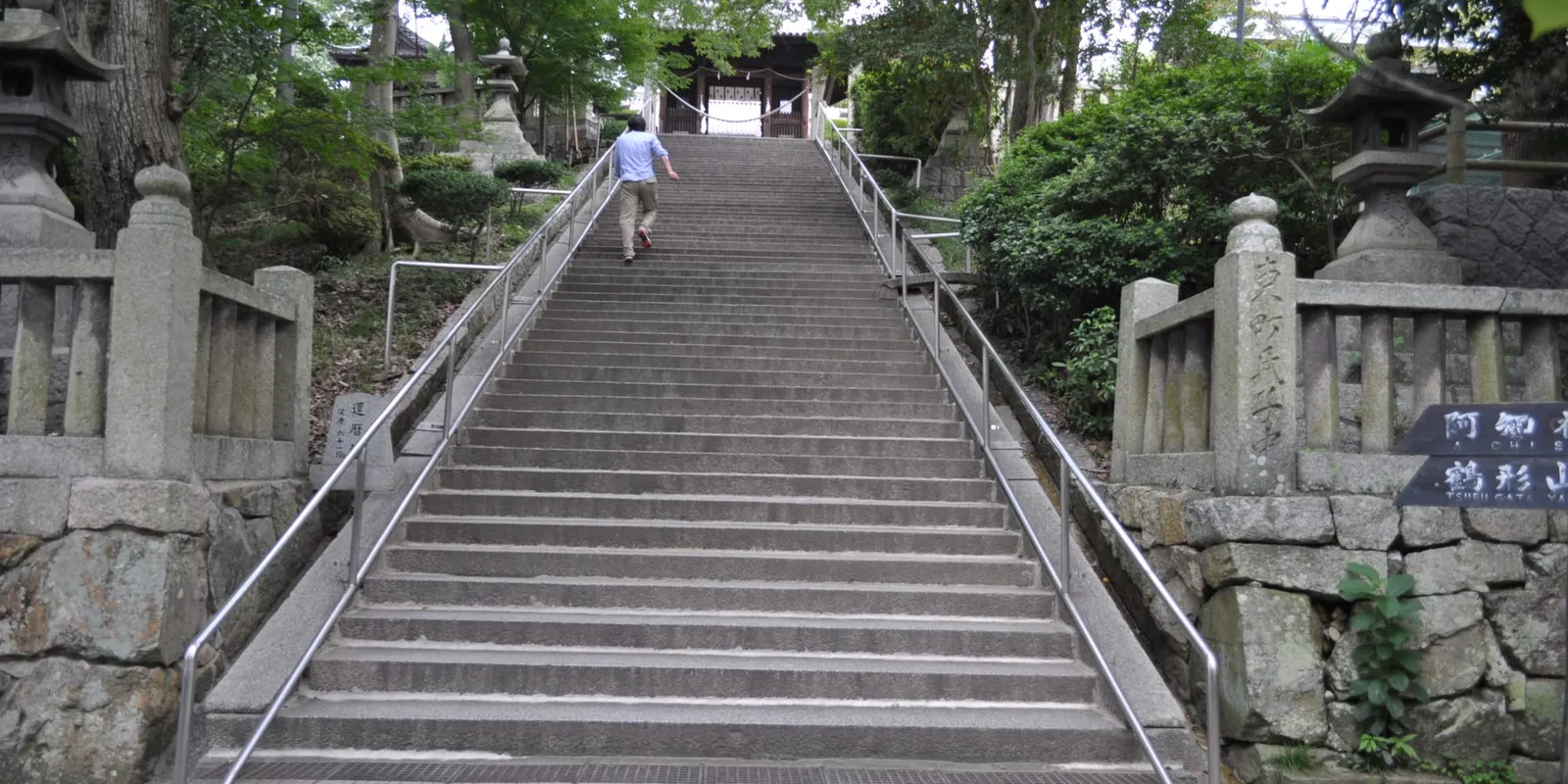
The shrine grounds themselves are open at all times, but the office where goshuin and amulets are available closes at 5:00 PM, so it’s worth allowing time. From the Bikan Historical Quarter’s Honmachi Street, the East Approach climbs three consecutively named stone stairways — the 88-step Beiju-zaka, the 61-step Kanreki-zaka, and the 33-step Yakuyoke-zaka just before the Zuishinmon gate — each named for an auspicious life milestone, making for a steep but characterful ten-to-fifteen-minute climb. Visitors who prefer a gentler grade can instead take the longer West Approach, which passes north of Koryu-ji Temple and rewards the extra distance with sweeping views from the cantilevered ema hall along the way.
Many visitors combine a shrine visit with a stroll through the white-walled canal townscape of the Bikan Historical Quarter directly below, climbing up to Achi Jinja either before or after exploring the shops and museums at street level. On-site parking is limited to about 15 spaces and inaccessible to large vehicles, so during busy seasons or the autumn festival, using one of the parking areas near the Bikan Quarter and walking up is the more reliable option.
Annual Festivals
- Wisteria Festival (May 3–5): Timed to the peak bloom of the celebrated “Achi Fuji,” this festival lets visitors admire the wisteria — reputed to be Japan’s largest and oldest of its kind — up close.
- Spring Grand Festival (3rd Saturday–Sunday of May): The shrine’s spring rite, celebrating the changing season.
- Autumn Grand Festival and Divine Procession (3rd Sunday of October and the preceding Saturday): Kurashiki’s guardian-shrine autumn festival, held since the Edo period. On Saturday evening, following rites at the worship hall, the mikoshi (portable shrine) is carried by vehicle through the parish in a “vehicle procession.” On Sunday, a costumed procession of roughly 200 people accompanies the mikoshi on a “divine progress” (goshinko) covering some 14-15 kilometers through the town. A beloved local custom sees masked figures called “Suinkyo,” dressed as an old man and woman, tapping onlookers on the head with paper fans for good luck. The “Kurashiki Folding Screen Festival,” in which old merchant houses in the Bikan Quarter display antique folding screens, is held on the same weekend.
Nearby Food & Sightseeing
- Kurashiki Bikan Historical Quarter: Spreading out at the southern foot of Mount Tsurugata, this is one of Japan’s best-preserved Edo- and Meiji-era canal townscapes, lined with white-walled storehouses and willow trees along the Kurashiki River. Exploring it before or after climbing to the shrine is the classic way to see both together.
- Kurashiki River Boat Ride: A traditional wooden-boat cruise along the Bikan Quarter’s canal, offering a rare water-level view of the white-walled townscape with Achi Jinja’s greenery visible on the hill above.
- Ohara Museum of Art: One of Japan’s earliest museums of Western art, and the centerpiece of the Bikan Quarter’s cultural scene — a popular stop for visitors combining sightseeing with a visit to the shrine.
- Kurashiki Ivy Square: A red-brick, ivy-covered complex of shops, restaurants, and a hotel converted from a Meiji-era textile mill, just a short walk from the foot of the shrine’s East Approach.
Frequently Asked Questions
- Q. What kind of shrine is Achi Jinja?
- A. Achi Jinja stands atop Mount Tsurugata, directly north of Kurashiki's famous Bikan Historical Quarter, and has long been venerated as the guardian shrine of Kurashiki's historic 27 districts, including the Bikan Quarter itself. Kurashiki's old place name, "Achi," is said to derive from Achi-no-Omi, a naturalized clan leader who settled here from the Korean peninsula in the reign of Emperor Ojin, and the shrine grounds are traditionally said to have originated as that clan's own garden. Today the shrine's principal deities are the three Munakata sea goddesses (Tagirihime, Tagitsuhime, and Ichikishimahime), guardians of maritime safety.
- Q. Can I receive a goshuin here?
- A. Yes, at the shrine's office, open 9:00 AM–5:00 PM, for a fee of ¥500 (all goshuin were standardized to this fee in February 2021). Goshuin books featuring the rabbit carving on the Zuishinmon gate and the shrine's famous "Achi wisteria" are also available.
- Q. How do I walk up from the Bikan Historical Quarter?
- A. The most direct route, the East Approach from Honmachi Street, climbs three named stone stairways in a row — the 88-step Beiju-zaka, the 61-step Kanreki-zaka, and the 33-step Yakuyoke-zaka just before the Zuishinmon gate. It's a fairly steep 10-15 minute climb. A longer, gentler West Approach runs past Koryu-ji Temple and includes a cantilevered ema hall with sweeping views over the Kurashiki townscape. It's about a 15-minute walk from JR Kurashiki Station.
- Q. Is parking available?
- A. Yes, there are two worshippers' parking lots on the shrine grounds, with about 15 spaces combined. However, the access road is narrow and cannot accommodate anything larger than a microbus, so visitors on a large tour bus should park near the Bikan Historical Quarter and walk up instead.
- Q. What is the "Achi wisteria," and when can I see it?
- A. The wisteria arbor on the north side of the main hall, known as the "Achi Fuji," is said to be the largest and oldest example of the Akebono-fuji variety in Japan, with an estimated age of 300 to 500 years. It was designated an Okayama Prefecture Natural Monument in 1956 and is now the official flower of Kurashiki City. It typically blooms in late April, and a Wisteria Festival is held each year from May 3 to 5.
Related Shrines
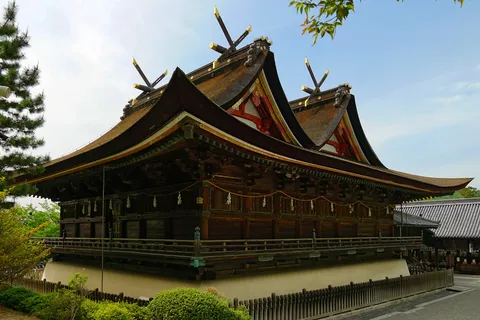
Okayama, Okayama (Kita-ku)
Kibitsu Jinja
Kibitsu-jinja
- Household Safety
- Business Prosperity
- Victory in Competition
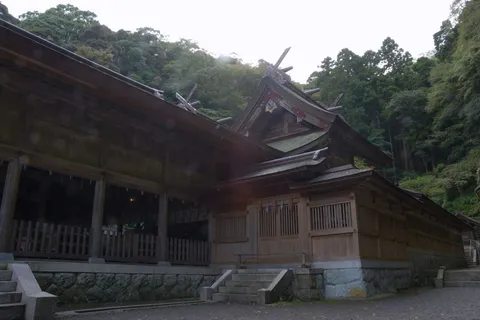
Shimane, Matsue
Miho Jinja
Miho-jinja
- Business Prosperity
- Maritime Safety
- Success in the Arts
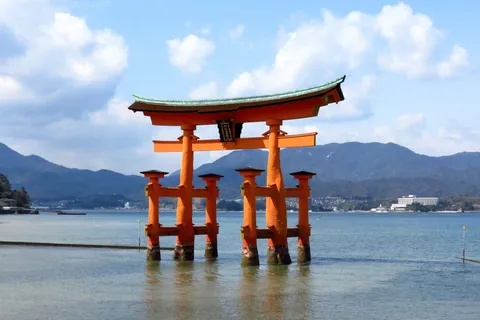
Hiroshima Prefecture, Miyajima, Hatsukaichi
Itsukushima Shrine
Itsukushima-jinja
- Maritime Safety
- Wealth
- Success in the Arts