History
Awashima Jinja stands in Kada, Wakayama City. The official site writes the name as 淡嶋神社 (and sometimes 淡島神社 in its logo), and it is read “Awashima Jinja.” However, this reading is not given on the Wakayama Prefecture tourism page or on the official site, and this page follows Japanese Wikipedia for it. The address is Kada 118, Wakayama City on the tourism page but Kada 116 on Japanese Wikipedia, so sources differ.
According to the “Origin” page of the official site, long ago Empress Jingu met a violent storm on the waters of Seto on her way back from the Three Han campaign. She received an oracle: “Throw the boat’s thatch cover into the sea and sail wherever it drifts.” Following it, she reached an island, Tomogashima, where Sukunahikona no Mikoto and Onamuji no Mikoto were enshrined, and she is said to have offered treasures in gratitude. Later her grandson Emperor Nintoku came to hunt on Tomogashima, heard the story, and, thinking the island inconvenient, moved the shrine to Kada on the opposite shore and built a hall. This is regarded as the origin of Kada Awashima Shrine.
The enshrined deities are Sukunahikona no Mikoto, Onamuji no Mikoto and Okinagatarashihime no Mikoto (Empress Jingu). The official site describes Sukunahikona as a god of medicine, said to be especially effective for women’s recovery from illness, safe childbirth and fertility. The shrine is known for needle memorial services, the Hina Nagashi and doll memorial services, and the Wakayama Prefecture tourism page says dolls offered from all over Japan fill the grounds and that the shrine is widely worshipped as one for women. It was also introduced as a stop in a TV Tokyo-network travel program broadcast on May 30, 2026 (according to the program’s official page).
Highlights
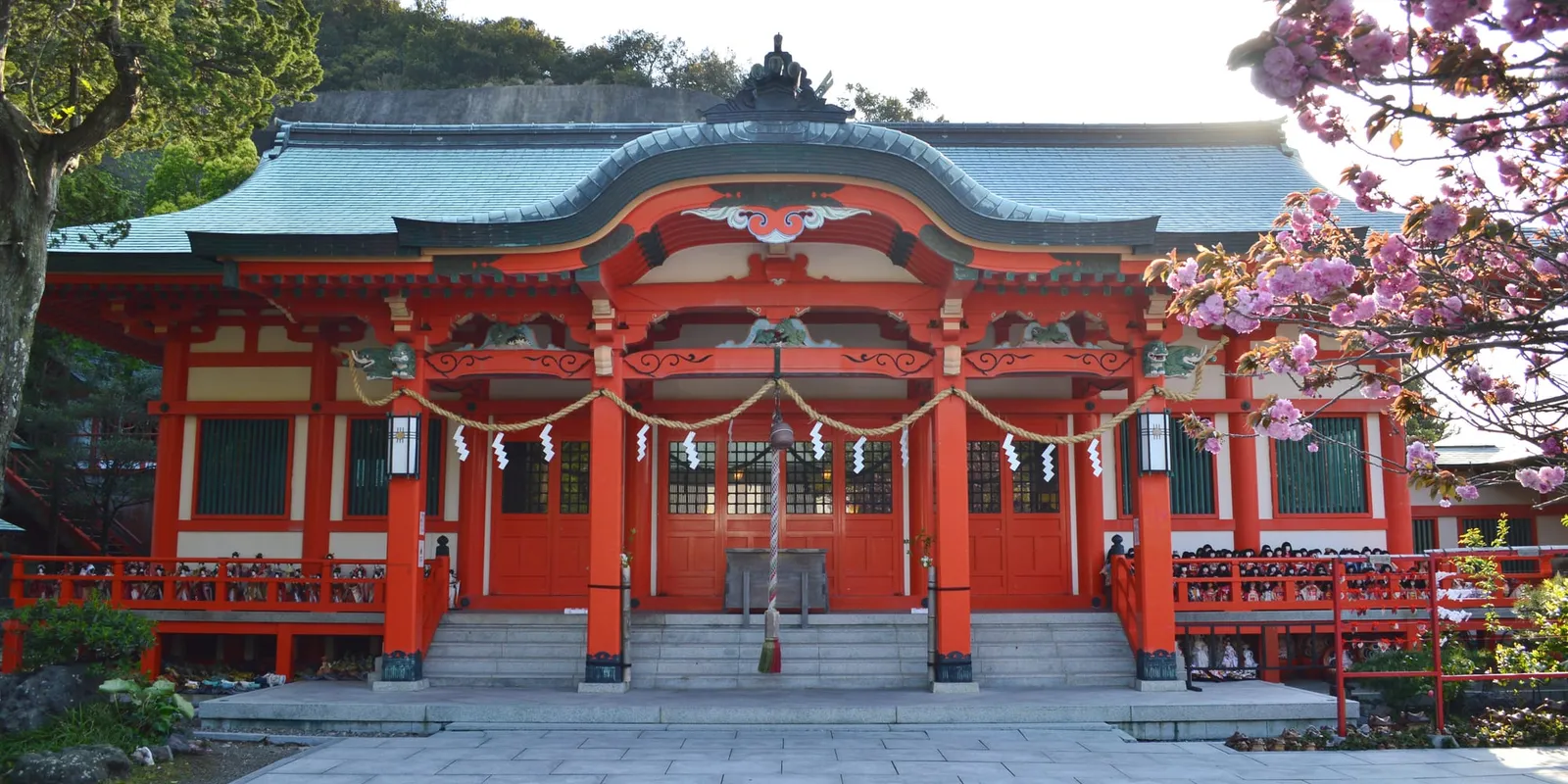
A large vermilion torii stands on the approach, and the worship hall is a vivid vermilion too. According to the Wakayama Prefecture tourism page, the grounds are packed with dolls offered from all over Japan.
The official site’s grounds map points out several features. The Senshiden enshrines the frog, the messenger of the deity, and visitors entrust it with relaying their prayers from the main hall. There is the Haridzuka (needle mound), where needles are placed after the needle memorial service on February 8 each year, and the Shiotsubo (“salt jar,” popularly called “Ohaguro-ishi”), whose water is said to cure a toothache when applied to the teeth, or any painful part of the body. The Okuninushi-sha enshrines Onamuji no Mikoto (Okuninushi), who built the land together with Sukunahikona.
The official site explains that the Kibun Inari Shrine was dedicated by Kinokuniya Bunzaemon, who was born near the shrine and made a vast fortune, before he moved to Edo. The “Kibun’s mast” is said to be the mast of Kinokuniya Bunzaemon’s mandarin-orange boat, and it is said that passing through the hole in the post while reciting a wish makes it come true. The Hinakura holds a white building described as built by Tokugawa Harutomi, the tenth lord of the Kishu domain, and it now stores only old hina dolls. Hina dolls and treasures dedicated by the Tokugawa family are exhibited and stored in the Treasure Hall, which the official site says is open by group reservation only (adults ¥300, children ¥200).
On hina dolls, the official site states that “the origin of the male and female hina dolls is said to be the paired male and female sacred images of Sukunahikona and Empress Jingu,” and that “Hina Matsuri falls on March 3 because the transfer from Tomogashima to Kada took place on March 3 of Nintoku’s 5th year.” These are the shrine’s own traditions. Separately, Japanese Wikipedia says the shrine holds two national Important Cultural Properties, a gilt-bronze sword with a round scabbard and a helmet (both Kamakura period), which this page has not confirmed from a primary source.
Visiting Tips
The official site lists visiting hours and amulet-office hours of 9:00 AM–5:00 PM. Purification rites are by reservation at 11:00 AM and 1:00 PM, covering safe childbirth, fertility, health, protection from misfortune, good relationships, business, study, first shrine visits, traffic safety and more.
The official site lists amulets for women’s health, good health, safe childbirth, fertility, good relationships, children, protection from misfortune and traffic safety. As for goshuin, an original goshuin book, goshuin-only, a goshuin holder and acrylic goshuin are introduced, but the fee and hours are not stated on the official site.
Doll memorial services are accepted from 9:00 AM–4:00 PM, but not on any Butsumetsu day, from December 20 to January 3, or from February 20 to March 3. Only the dolls are accepted, nothing by post or courier, and a memorial offering and an incineration fee are charged (official site).
To get there, take the Nankai Kada Line from Wakayama-shi Station to Kada Station and walk about 20 minutes (Wakayama Prefecture tourism page). There is paid parking, and showing your parking ticket at the amulet office gets 30 minutes off. The official site says three souvenir shops line the approach, selling the local specialty tsubo-yaki yomogi mochi and seafood, and they may close in rainy weather.
Annual Festivals
The following is from the official site’s events page (it gives no year, and dates may change, so check with the shrine office for the latest).
- Hari Matsuri / needle memorial (February 8, from 11:00 AM): Because the deity Sukunahikona is said to have first taught the way of sewing, needles offered over the year are purified in the main hall, placed in the needle mound and covered with salt before returning to the earth. It thanks the needles for their work and prays for improvement.
- Hina Matsuri / Hina Nagashi (March 3, from noon): A rite in which dolls bearing written wishes are placed on a boat, and a boat of plain wood loaded with purified dolls heads out to sea. Visitors are asked not to come by car that day.
- Tanabata Festival (mid-June to July 7): Though not directly related to the deity, the shrine provides free tanzaku strips to give children a little dream.
- Nagoshi Festival (July 31, from sunset): Passing through a ring of reeds (chinowa) to pray for health through the summer; take-home reed rings are provided free.
- Amazake Festival (October 3, from 11:00 AM): Amazake made from new rice is offered to Sukunahikona, regarded as the ancestral god of sake brewing, and given free to worshippers for good health through the winter.
Nearby Food & Sightseeing
- Tomogashima Island: The island across the water from Kada, named on the shrine’s official site as where Sukunahikona and Onamuji were originally enshrined.
- Souvenir shops on the approach: According to the official site, three shops on the approach sell the local specialty tsubo-yaki yomogi mochi and seafood (they may close in rainy weather).
- Kada Station (Nankai Kada Line): The nearest station, about a 20-minute walk from the shrine (Wakayama Prefecture tourism page). If you walk from the station, check the return train times too.
Frequently Asked Questions
- Q. What are the visiting hours?
- A. The official site lists visiting hours of 9:00 AM–5:00 PM, and the amulet office is also open 9:00 AM–5:00 PM. Purification rites (for safe childbirth, fertility, health, protection from misfortune, good relationships, business, study, first shrine visits, traffic safety and more) are by reservation, at 11:00 AM and 1:00 PM. For details, contact the shrine office (tel. 073-459-0043, 9:00 AM–5:00 PM).
- Q. Can I get a goshuin at Awashima Jinja?
- A. The official site's amulet page lists an original goshuin book, a goshuin-only item (noted as having no brush calligraphy), a goshuin holder and acrylic goshuin (two kinds). However, the fee and the hours for goshuin alone are not stated on the official site. The amulet office is listed as 9:00 AM–5:00 PM, so allow plenty of time and confirm details with the shrine office.
- Q. How do I get there, and is there parking?
- A. According to the Wakayama Prefecture tourism page, take the Nankai Kada Line from JR or Nankai Wakayama-shi Station to Kada Station, then walk about 20 minutes. By car it is about 45 minutes from Sennan IC on the Hanwa Expressway. Paid parking is available, and the official site says visitors who show their parking ticket at the amulet office get 30 minutes off. On March 3 (the Hina Nagashi), the official site asks visitors to avoid coming by car.
- Q. Tell me about the Hina Nagashi and doll memorial services.
- A. According to the official site, the Hina Matsuri (Hina Nagashi) begins at noon on March 3, when dolls bearing written wishes are placed on a boat and sent out to sea. Dolls are accepted from 9:00 AM–4:00 PM, but not on any Butsumetsu day, from December 20 to January 3, or from February 20 to March 3. Only the dolls themselves are accepted (no glass cases, boxes, accessories, and nothing by post or courier). A memorial offering and an incineration fee are charged; the amounts are not stated on the official site.
- Q. What is the shrine known for?
- A. The official site says the enshrined deity Sukunahikona is a god of medicine, said to be especially effective for women's recovery from illness, safe childbirth and fertility. Its amulet page lists amulets for women's health, safe childbirth, fertility, good relationships, children, traffic safety, protection from misfortune and more. The Wakayama Prefecture tourism page also describes it as widely worshipped as a shrine for women.
Plan Your Visit
Before you go, you can book a stay and get your shrine-visit items ready.
Amazon links open Amazon.co.jp (Japan) in English; whether an item ships overseas depends on the product.
※ Contains ads (PR). Links open external sites such as Amazon, Rakuten, Trip.com and Booking.com.