History
Azabu Hikawa Shrine (Azabu Hikawa-jinja) stands on a hilltop in Motoazabu 1-chome, Minato Ward, Tokyo, an area with many embassies. The official site names Susanoo no Mikoto and Yamato Takeru no Mikoto as the enshrined deities, and the shrine is regarded as the chief guardian shrine of Azabu. The benefits it lists include victory, business prosperity, protection from misfortune, good fortune, career advancement, wealth, safe childbirth, academic progress, exam success and good relationships.
According to the official history, in 938 (the Tengyo era, during the reign of Emperor Suzaku) Minamoto no Tsunemoto, an ancestor of the Seiwa Genji, is said to have founded the shrine at “Asabu-kanmuri no Matsu” in Toshima District, Musashi Province (now Azabu Ippon-matsu), when he marched east to put down the rebellion of Taira no Masakado. The site also introduces another account, in which Ota Dokan, builder of Edo Castle, so revered Hikawa shrines as protectors of Edo that the shrine was enshrined in the Bunmei era (1469–1487). It explains that the “Ippon-matsu” (lone pine) was treated as the sacred tree from the Toyotomi period, and that an 1825 large map records the shrine as “Azabu Ippon-matsu Shrine.” Because accounts of the founding differ, the dates are best read as the shrine’s own account.
The official site says that the shrine was revered by the Tokugawa shoguns in the Edo period: Asai Go, wife of the second shogun Hidetada, is said to have prayed here for a safe birth and the third shogun Iemitsu was born, and the fifth shogun Tsunayoshi is said to have visited often. It also quotes the Minato Ward history as calling the shrine “one of the seven Hikawa shrines of Edo.” It became a village-rank shrine (“Gosha Hikawa Jinja”) in 1872. Wartime bombing in 1945 destroyed the main hall, but the kagura hall, mikoshi storehouse and purification pavilion survived, and the present hall was rebuilt in 1948. According to the official site, the shrine is said to be the model for the “Hikawa Shrine” (火川神社) where the shrine maiden Rei Hino lives in the 1992 anime Sailor Moon.
Highlights
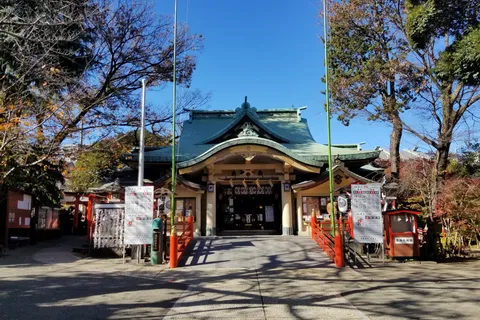
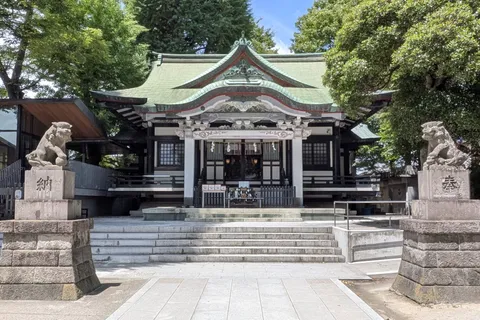
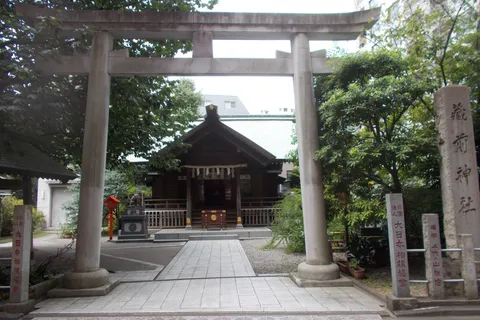
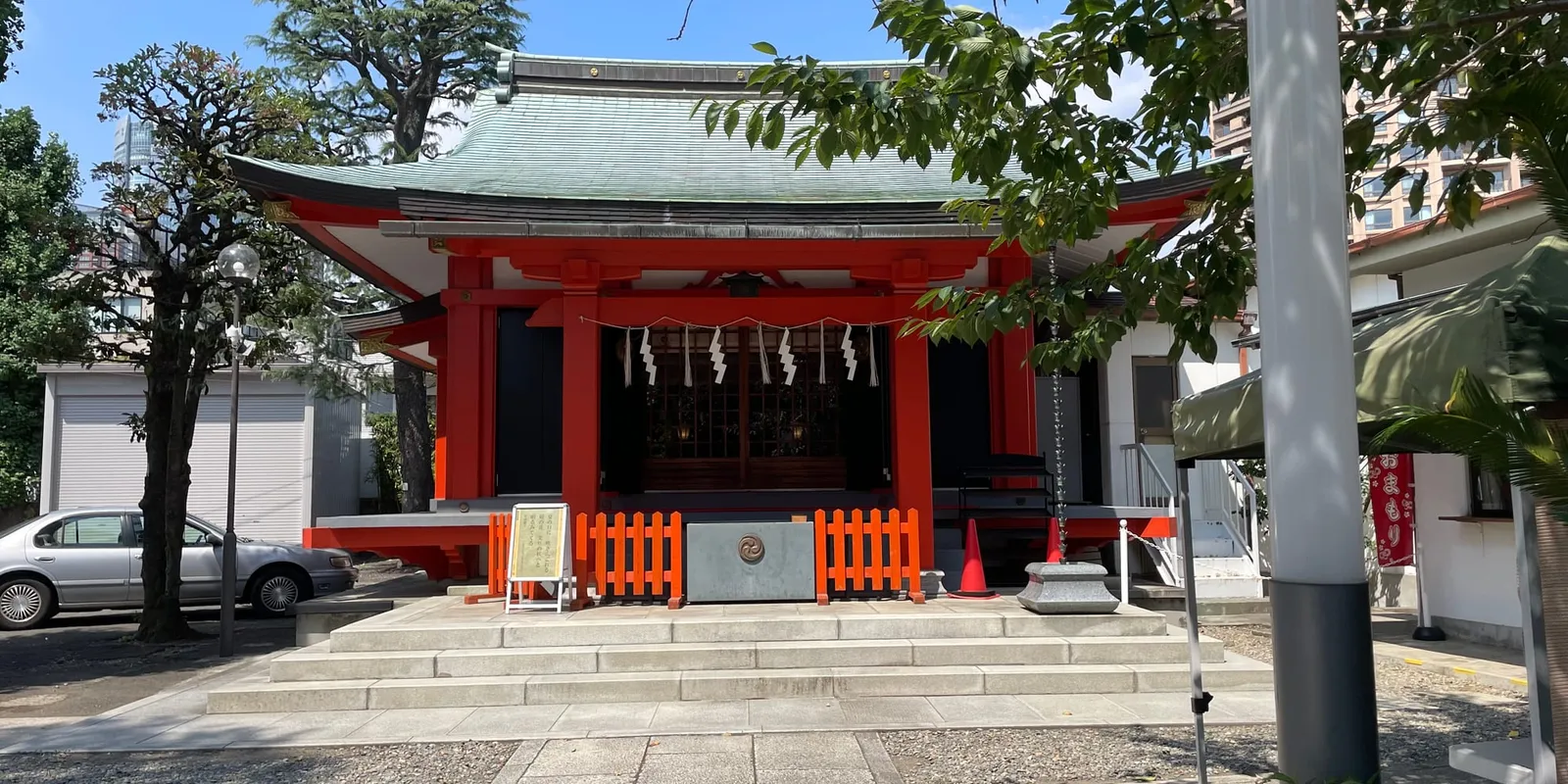
The vermilion-lacquered worship hall is the visual centerpiece. A stone torii stands at the entrance to the approach, beside a stone marker reading “Hikawa Jinja.” The official site says that the kagura hall, mikoshi storehouse and purification pavilion that escaped the wartime fire remain in the grounds, giving a sense of history in a quiet residential neighborhood.
The auxiliary shrines are Oukyo Inari (business prosperity, bountiful harvests, good fortune), Takao Inari (beauty, progress in the arts, fulfillment of wishes, good fortune) and Bishamonten (wealth, victory, courage, protection from ill-omened directions). Bishamonten is one of the Minato Seven Lucky Gods, and the official site presents it as a deity of courage, victory and wealth, recalling how the warlord Uesugi Kenshin considered himself an incarnation of Bishamonten and raised the “Bi” banner in his many victories. The grounds also hold an Inari shrine linked to the Date family, lords of Sendai, which the official site describes as a small but wonderfully efficacious shrine.
The great mikoshi used in the Azabu Hikawa Festival stopped being carried in procession after the war, but per the official site its restoration was completed in January 2021 (Reiwa 3), the first in about 90 years. In January 2020 the NPO “Azabu Hikawa no Kai” was founded to maintain and preserve the great mikoshi and the ox-cart float.
Visiting Tips
The official site lists the amulet counter at 9:00 AM–4:00 PM and prayer requests at 9:00 AM–3:30 PM. Prayers in the hall and off-site ceremonies can be booked at any time, with application pages for individuals and for companies and groups. The amulet counter sometimes has temporary closure days, so check the news section before you visit.
Offerings include shrine talismans such as the Azabu Hikawa talisman, business-prosperity talisman and household-safety talisman, plus a wide range of charms: victory, wealth, relationships, safe childbirth, exam success, academic success, traffic safety, and dog and cat charms. Talismans and charms can also be reserved on the official site and sent by post. For goshuin, the official site has no entry on regular issuance; it states only that the Bishamonten (Minato Seven Lucky Gods) goshuin is available from New Year’s Day to about the 10th. If you want one, a phone call (03-3446-8796) is the safest way to check.
It is about a 7–8 minute walk from Azabu-Juban Station on the Tokyo Metro Namboku Line and the Toei Oedo Line. Parking is limited, and coin parking nearby is noted; driving routes are explained on the official access page.
Annual Festivals
The official “Seasonal Worship” and “Azabu Hikawa Festival” pages introduce the following (check the news section for each year’s schedule).
- Monthly festival (1st and 15th): A monthly ritual.
- Saitan-sai (January 1): The New Year ritual. Genshi-sai (January 3) and the Coming-of-Age ritual (second Monday of January) are also held.
- Hatsu-uma-sai (first Horse day in February) and Setsubun-sai (February 3): The first prays for business prosperity and the like, the second for health.
- Nagoshi no Oharae (June 30): A rite to purify the first half of the year.
- Tanabata-sai (July 7): Described as including special charms and a somen-noodle flume.
- Azabu Hikawa Festival (September): The main festival is given as September 17, held on the Saturday or Sunday around the 17th each year. However, the “Seasonal Worship” page lists September 15 and 16, so the official site differs within itself. In the Edo period the festival is said to have been held on August 17.
- Niiname-sai (November 23): A ritual of thanks for the new harvest.
- Thanksgiving festival (first Saturday of December): Includes a rice-cake pounding event.
- Oharae (December 17) and New Year’s Eve ritual (December 31): Year-end rites.
Dates may change, so check the news section of the official site for the latest.
Nearby Food & Sightseeing
- Azabu-Juban Shopping Street: A shopping street around Azabu-Juban Station, the nearest station, handy for a meal or shopping before or after your visit.
- Arisugawa-no-miya Memorial Park: A Minato Ward park in Motoazabu, a green spot for a stroll through the residential area.
- Sendaizaka: A slope near the shrine; the official access page gives the “Sendaizaka-ue” bus stop as about a 1-minute walk away.
Frequently Asked Questions
- Q. What are the visiting hours?
- A. The official site does not give opening hours for the grounds. It lists the amulet counter at 9:00 AM–4:00 PM and prayer requests at 9:00 AM–3:30 PM (these may change). The amulet counter sometimes has temporary closure days, announced in the news section, so it is safest to check the official site before you go.
- Q. Can I get a goshuin at Azabu Hikawa Shrine?
- A. Information on regular goshuin or their fee could not be found on the official site. It does say that Bishamonten in the grounds is one of the Minato Seven Lucky Gods and that its goshuin is available from New Year's Day to about the 10th. For other times, check with the shrine by phone (03-3446-8796) or at the amulet counter.
- Q. How do I get there, and is there parking?
- A. It is about an 8-minute walk from Exit 4 or Exit 1 of Azabu-Juban Station on the Tokyo Metro Namboku Line, or about 7 minutes from the Toei Oedo Line station (official site). Buses stop at "Sendaizaka-ue," about a 1-minute walk away. There is a limited number of parking spaces for worshippers (number and fee not stated), and the official site notes coin parking nearby.
- Q. What is the connection to the anime Sailor Moon?
- A. According to the shrine's official site, it served as the model for the "Hikawa Shrine" (火川神社), where the shrine maiden Rei Hino lives, in the 1992 anime Sailor Moon (Bishoujo Senshi Sailor Moon). This page only relays the shrine's own account.
- Q. When is the annual festival (Azabu Hikawa Matsuri)?
- A. The official "Azabu Hikawa Festival" page gives September 17 as the main festival date, held on the Saturday or Sunday around the 17th each year. However, the "Seasonal Worship" page lists September 15 and 16, so the official site differs within itself. Each year's schedule is announced in the news section, so check before you go.
Plan Your Visit
Before you go, you can book a stay and get your shrine-visit items ready.
Amazon links open Amazon.co.jp (Japan) in English; whether an item ships overseas depends on the product.
※ Contains ads (PR). Links open external sites such as Amazon, Rakuten, Trip.com and Booking.com.