History
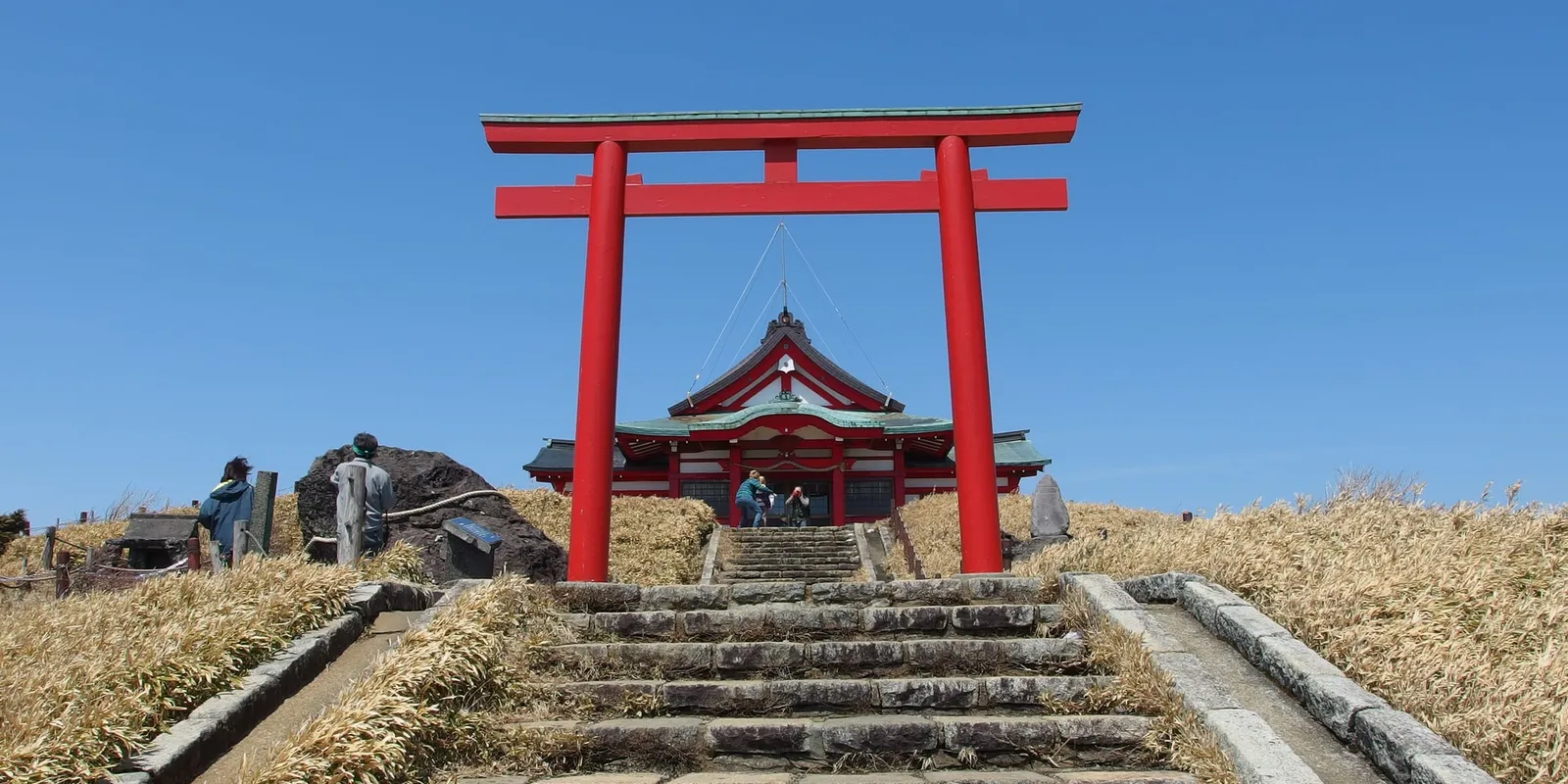
Hakone Motomiya (read “Hakone Mototsumiya”) is the inner shrine of Hakone Jinja, standing on the summit of Mt. Komagatake on the Hakone outer rim. According to the Hakone Jinja official site, Komagatake faces the sacred peak Kamiyama to the north and has been a place of ancient mountain worship. Its origin is traced to about 2,400 years ago, when the hermit Shozen Shonin, sensing the power of the mountain deity of Kamiyama, opened a “Shinsen-gu” on the summit. Later, after Buddhism arrived, Shinto and Buddhism blended, and the mountain became known as a training ground for mountain ascetics.
In the Nara period, the monk Mangan Shonin received a divine revelation from Hakone no Okami and, in 757 (Tenpyo-hoji 1), built a shrine at the foot of the mountain on the shore of Lake Ashi as its village shrine. That is today’s Hakone Jinja. The summit shrine, by contrast, continued as the inner shrine, and the official site says that its present building was rebuilt in 1964 through a donation from Tsutsumi Yasujiro. The enshrined deity is Hakone no Okami: Ninigi-no-Mikoto, Konohanasakuya-hime-no-Mikoto and Hikohohodemi-no-Mikoto.
On TV Tokyo’s “Shutsubotsu! Ad-machic Tengoku,” broadcast on January 10, 2026 (the “Hakone Ashinoko” episode), the three shrines Hakone Jinja, Hakone Motomiya and Kuzuryu Jinja Hongu were described as the “Hakone Sansha” and as a “triangle of power spots,” and the “Hakone Sansha Mairi” was introduced as No. 1 (according to the program’s official page). The same episode also featured the Hakone Komagatake summit at No. 19.
Highlights
Within the precincts stands the Bakoseki, a rock wrapped with a sacred rope. The Hakone Jinja official site says it is told to be the rock onto which the deity descended riding a white horse; the hollow in its top is said to be the hoofprint from the dismounting, and the water that collects in it is said never to have dried up even in drought. Beside the approach on the right is the Bajoseki (“horse-mounting stone”), which preserves the tradition of white-horse worship. The TV program’s official page also introduces the Bakoseki and its hoofprint hollow.
The view is another draw. The official page of the ropeway operator, Seibu Prince Hotels Worldwide, gives the summit elevation as 1,356 m and describes a viewpoint overlooking Lake Ashi and the Hakone outer rim, with Mt. Fuji, Sagami Bay and Suruga Bay beyond (what you can see depends on the weather). Outside the summit station is the observation facility “Hakone Komagatake Ashi-no-Sora,” with a roughly 400 sq. m deck and a giant photo frame, “Fuji no Gaku,” for photos with Mt. Fuji; it reopened in a renewed form in April 2025.
The Hakone Jinja site lists a “Hakone Motomiya Good Luck Amulet” (¥1,000; the page notes the shrine is also called the “shrine in the sky”) and a “Sansha Fukuun Omamori” (¥1,000) for the blessings of the three shrines. It says these amulets and the goshin-in seals are always available at Hakone Jinja.
Visiting Tips
To reach the shrine, take the Hakone Komagatake Ropeway from Hakone-en on the shore of Lake Ashi up to the summit. According to the operator’s official page (checked on October 12, 2026), the ride takes about 7 minutes one way, the first ascent is at 9:00 AM, the last ascent at 4:30 PM, and departures are every 20 minutes (at :00, :20 and :40 past each hour). Fares are ¥2,200 round trip for adults (junior high school and older) and ¥1,100 for children (elementary school), or ¥1,300 and ¥650 one way. The last descent is given inconsistently on the operator’s own pages (4:50 PM and 5:00 PM), so confirm your return time on site or on the official page. Service may be suspended in strong wind, lightning or other bad weather, and the operator’s Hakone-en operating status page shows the current situation (fares and times can change).
According to the Hakone Jinja official site, prayer services and goshin-in at the shrine are available on its “open days”: generally the 1st, 13th, 15th and 24th of each month plus other Saturdays, Sundays and holidays (some months change because of annual festivals). The prayer reception is on the right as you enter the shrine, from 9:45 AM to 2:45 PM (the first prayer starts at 10:00, and the last at 3:00 PM). Prayer offerings are ¥5,000 or more, ¥10,000 or more, or ¥30,000 or more depending on the type. The goshin-in is pre-written only; it is issued at Motomiya on open days, or at Hakone Jinja on other days if you ask. We could not find official guidance on summit clothing or temperature; at 1,356 m, dress for the weather.
Hakone Jinja recommends a “ryosha-mairi” visit to Hakone Jinja and Kuzuryu Jinja, followed by Hakone Motomiya, the inner shrine, as a “sansha-mairi” (three-shrine pilgrimage), and says each visit may be made on whichever day suits you, within each shrine’s hours. For those making the three-shrine pilgrimage, the official site also says that a discount ticket for the Hakone Komagatake Ropeway is given at the Motohakone Boat Office of Hakone Sightseeing Cruise when you register for the monthly festival on the 13th.
Annual Events and Festivals
- Monthly festival (24th of each month, 10:00 AM): held before the deity at Hakone Motomiya. If the ropeway is out of service because of bad weather, it is held at Hakone Jinja (per the Hakone Jinja official site).
- Goshinka-sai and Reisai (October 24): the autumn grand festival at Motomiya. According to the official site, the Goshinka-sai begins at 10:00 AM, when sacred fire made by traditional fire-making is lit in a brazier; the Reisai follows at 11:00 AM, and at noon the sacred fire is carried down to Hakone Jinja in a procession. Times can vary from year to year, so check the official site.
- Kuzuryu Jinja Hongu monthly festival (13th of each month): the Hakone Jinja site announces this festival at 10:00 AM on the 13th. The discount ticket for the three-shrine pilgrimage is handed out when you register on this day.
Nearby Food and Sights
- Hakone-en: the lakeside facility with the ropeway’s lower station. Its official page lists an aquarium at 723 m above sea level and combined ropeway-and-aquarium tickets (as of October 12, 2026).
- Hakone Jinja: the village shrine and guardian shrine of the Kanto region at the foot of the mountain, the heart of the three-shrine pilgrimage. Motomiya’s amulets and goshin-in are also available here, and the Torii of Peace on the lakeshore is nearby.
- Kuzuryu Jinja Hongu: one of the three shrines, in the Kuzuryu Forest across Lake Ashi. A combined ticket for the ropeway and the motorboat to Kuzuryu Jinja is listed from Hakone-en.
- Ryuguden Honkan Day-Trip Hot Spring: a day-use hot spring with views of Lake Ashi and Mt. Fuji beyond the outer rim. The official page lists a set of a bath ticket and a round-trip ropeway ticket (¥3,500 for adults, as of October 12, 2026).
Frequently Asked Questions
- Q. What is Hakone Motomiya, and how is it pronounced?
- A. The Hakone Jinja official site gives the reading as "Hakone Mototsumiya." It is the inner shrine (okumiya) of Hakone Jinja, standing on the summit of Mt. Komagatake on the Hakone outer rim, and enshrines Hakone no Okami (Ninigi-no-Mikoto, Konohanasakuya-hime-no-Mikoto and Hikohohodemi-no-Mikoto). Hakone Jinja recommends visiting it together with Hakone Jinja and Kuzuryu Jinja as a "three-shrine pilgrimage."
- Q. How do I get there, and what does the ropeway cost?
- A. Take the Hakone Komagatake Ropeway from Hakone-en on the shore of Lake Ashi (about 7 minutes) to the summit station. According to the operator's official page (checked on October 12, 2026), a round trip costs ¥2,200 for adults and ¥1,100 for elementary school children, and a one-way ticket ¥1,300 and ¥650. The first ascent is at 9:00 AM, the last ascent at 4:30 PM, with departures every 20 minutes. Service may be suspended in strong wind or lightning. Fares and times can change, so check the official page before you go.
- Q. Can I get a goshuin (goshin-in) at Hakone Motomiya?
- A. On the Hakone Jinja official site these seals are called "goshin-in," and there are four: Hakone Jinja, Kuzuryu Jinja, the Hakone Shichifukujin Ebisu shrine and Hakone Motomiya. The Motomiya seal is pre-written only; it is issued at Motomiya on its open days, and at Hakone Jinja if you visit Motomiya on another day. The goshin-in book costs ¥1,500 (including one shrine's seal); the official site does not list a separate fee for the Motomiya seal alone.
- Q. When can I visit, and when is the monthly festival?
- A. According to the official site, the shrine's open days are generally the 1st, 13th, 15th and 24th of each month plus other Saturdays, Sundays and holidays (some months change because of annual festivals). The monthly festival is held on the 24th at 10:00 AM; if the ropeway is not running because of bad weather, it is held at Hakone Jinja instead.
- Q. Has it been featured on TV?
- A. On TV Tokyo's "Shutsubotsu! Ad-machic Tengoku" (aired January 10, 2026, episode "Hakone Ashinoko"), the "Hakone Sansha Mairi" (three-shrine pilgrimage) of Hakone Jinja, Hakone Motomiya and Kuzuryu Jinja Hongu was introduced as No. 1, according to the program's official page. That page describes Hakone Motomiya as the inner shrine of Hakone Jinja on the summit of Komagatake.
Plan Your Visit
Before you go, you can book a stay and get your shrine-visit items ready.
Amazon links open Amazon.co.jp (Japan) in English; whether an item ships overseas depends on the product.
※ Contains ads (PR). Links open external sites such as Amazon, Rakuten, Trip.com and Booking.com.