History
Zeniarai Benzaiten Ugafuku Shrine stands in a wooded fold of the hills in Sasuke, Kamakura, and is commonly called “Zeniarai Benten” (Money-Washing Benten). According to tradition and tourism guides, in 1185 (Bunji 1) Minamoto no Yoritomo received a message from the deity Ugafukujin in a dream: if he made offerings to the gods and Buddhas with water from a spring to the northwest, peace would return to the land. He is said to have found the spring and built a shrine beside it (a tradition, not documented fact). Later, in 1257 (Shoka 1), the fifth Hojo regent, Hojo Tokiyori, is said to have washed coins in the spring while praying for his family’s prosperity, which is how the money-washing custom is said to have begun.
The Kanagawa Shinto Association lists the enshrined kami as Ichikishimahime no Mikoto, a water deity, while tourism guides say that a deity combining Ugajin (Ugafukujin) and Benzaiten is enshrined at the Okumiya in the cave; accounts differ. The shrine was once a subsidiary shrine of Yasaka Shrine in Ogigayatsu (also called Soma Tenno) and is said to have become independent in 1970 (Showa 45). It is also listed among the constituent cultural properties of the Agency for Cultural Affairs’ Japan Heritage story “Iza, Kamakura” (Japan Heritage No. 025).
Highlights
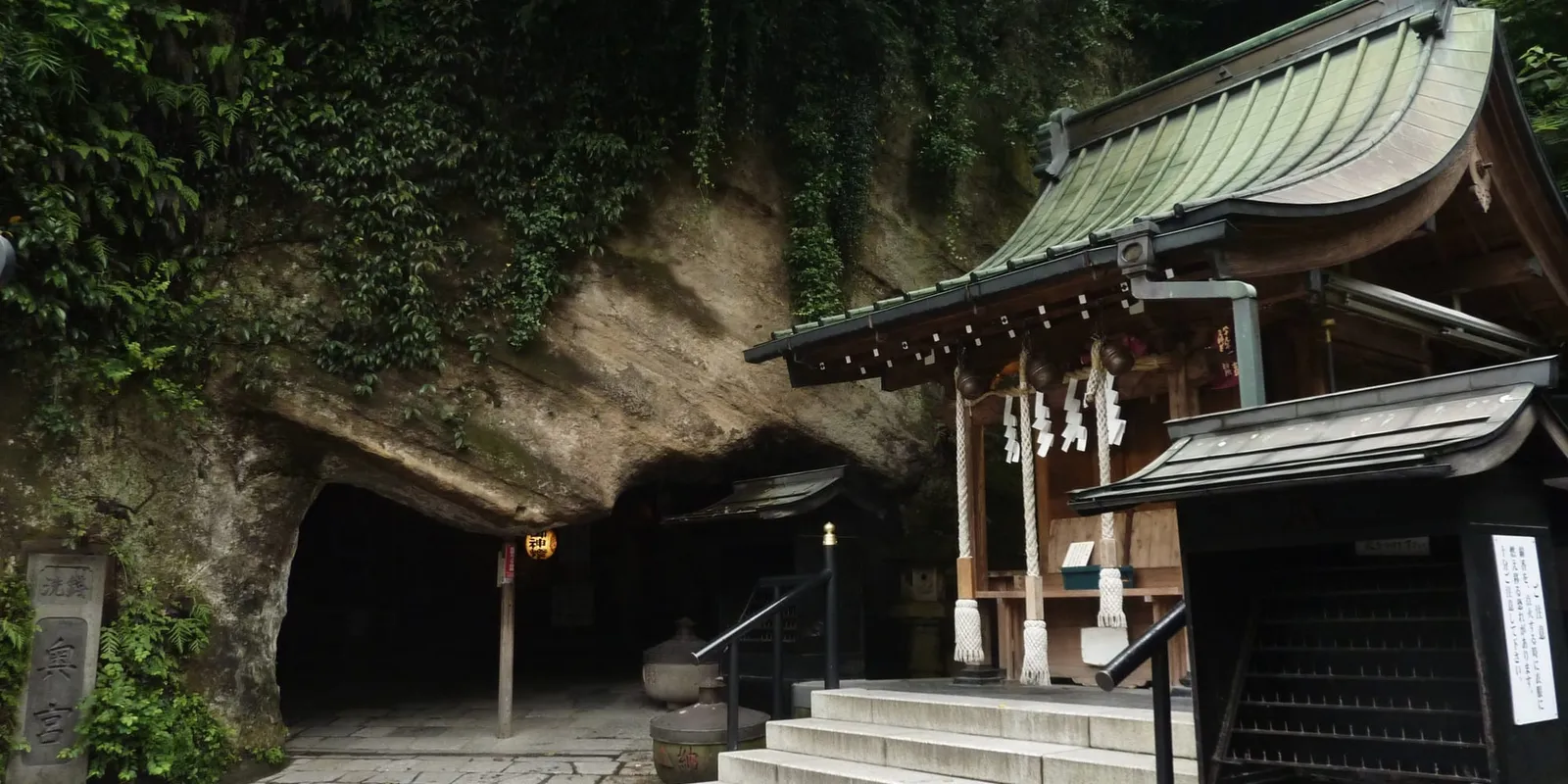
The entrance is a short tunnel cut through a rock wall. Beyond it are a temizuya, a path lined with donated torii, the main shrine, and the Okumiya, which opens into a cave in the rock face. Inside the cave is the spring called Zeniarai-mizu, counted among Kamakura’s Five Famous Waters. The grounds also hold small shrines, including Kaminomizu and Shimonomizu shrines (for the water deity Mizuhanome) and Shichifuku Shrine. The ritual with a basket, ladle, candle, and incense is what makes the shrine distinctive.
It is said that money washed here will come back multiplied, but this is a folk saying only. Guides differ on what to do with the washed money: some say to spend it soon, others to keep it as a talisman. Tea stalls on the grounds sell eggs (guides give five for ¥300) as an offering to the snake, Benzaiten’s messenger.
Visiting Tips
It is about a 20-minute walk from the west exit of Kamakura Station (guides say 18–25 minutes), and the last stretch is steep, so wear comfortable shoes. A taxi takes about 5–6 minutes.
The grounds are listed as open about 8:00 AM–4:30 PM, though some guides advise arriving by 4:00 PM, and it gets dark after sunset. Crowds gather at New Year and on Snake Days, which come every 12 days; early mornings and weekdays are said to be calmer. The small lot (about 10 spaces) is closed to vehicles on weekends, holidays, and Snake Days, so go by train and on foot.
Guides generally describe the order as: (1) purify your hands at the temizuya; (2) get a candle-and-incense set (¥100) at the shrine office and borrow a basket; (3) light the candle, offer the incense, and pray at the main shrine; (4) in the cave of the Okumiya, put your money in the basket and pour water over it with a ladle; (5) wipe the money dry and put it away. Many people wash only the edges of banknotes. Follow the signs in the cave, such as where to place the baskets.
Goshuin are given at the shrine office for ¥300 according to several guides (reportedly as pre-written sheets; please confirm). The office is listed as closing at 4:00 PM or 4:30 PM, so go early.
Annual Festivals
- Hatsumi Festival (first Snake Day of January): The first Snake Day of the year, also called the Zeniarai Benten Festival.
- Chusai (first Snake Day of April): The April festival, held on the first Snake Day of the month.
- Taisai (Snake Day around Hakuro in September): The September festival, held on the Snake Day around Hakuro (early September).
- Saitansai (January 1): The New Year’s Day ritual.
Dates change every year; please confirm with the shrine office (0467-25-1081) or the Kamakura tourism association.
Nearby Food & Sightseeing
- Genjiyama Park: A park near the shrine, listed as a nearby spot in the Kamakura tourism association’s guide. It is also known as a starting point for hiking trails.
- Kuzuharagaoka Shrine: A shrine in the Genjiyama area, on the Kuzuharagaoka–Daibutsu hiking course.
- Kewaizaka Kiridoshi: An old cut-through pass near Genjiyama Park, counted among the Seven Passes of Kamakura.
- Sasuke Inari Shrine: A shrine in the same Sasuke area, sometimes recommended as a pairing with Zeniarai Benzaiten. Reports mention typhoon damage in 2019, so please check conditions before visiting.
Frequently Asked Questions
- Q. How does the money washing work, and what does it cost?
- A. After purifying your hands at the temizuya, pick up a candle-and-incense set at the shrine office (guides give ¥100) and borrow a basket (zaru), which is reportedly free. Offer the candle and incense at the main shrine and pray, then in the cave of the Okumiya put your money in the basket and pour spring water over it with a ladle. Prices may differ over time, so please check the signs on site.
- Q. What are the visiting hours and is there an admission fee?
- A. The grounds are listed as open about 8:00 AM–4:30 PM, though some guides advise arriving by 4:00 PM. Entry is free (some guides mention a voluntary donation). It gets dark after sunset, so an earlier visit is best; early mornings and weekdays are said to be less crowded.
- Q. Can I get a goshuin?
- A. Yes. Several guides give ¥300 and say the goshuin is generally issued as a pre-written sheet. The shrine office is listed as closing at 4:00 PM or 4:30 PM, and some visitors report missing out after it closed, so go early.
- Q. What is a Snake Day (Mi no Hi)?
- A. It is a day of the zodiac Snake that comes around every 12 days and is regarded as Benzaiten's festival day, considered especially auspicious at this shrine. It is tied to the tradition that Minamoto no Yoritomo's dream came in a Snake year, month, and day, and to the story that Hojo Tokiyori washed coins on a Snake Day. Expect crowds, and note that vehicles cannot enter.
- Q. Which deities are enshrined here?
- A. The Kanagawa Shinto Association registers Ichikishimahime no Mikoto, a water deity, as the enshrined kami. The name "Ugafuku" refers to Ugajin, a snake-bodied water deity merged with Benzaiten, who is said to be enshrined at the Okumiya in the cave. Sources differ on the details.
Plan Your Visit
Before you go, you can book a stay and get your shrine-visit items ready.
Amazon links open Amazon.co.jp (Japan) in English; whether an item ships overseas depends on the product.
※ Contains ads (PR). Links open external sites such as Amazon, Rakuten, Trip.com and Booking.com.