History
Kuzuryu Jinja consists of two shrines: the “Hongu” on the shore of Lake Ashi, and the “Shingu” within the grounds of Hakone Jinja. Both enshrine Kuzuryu Okami, regarded as the guardian deity of the lake. According to Hakone Jinja’s official site, a Kamakura-era chronicle, the “Hakoneyama Engi Narabi ni Jo,” records that the priest Mangan Shonin, empowered by the great deity of Hakone, subdued a nine-headed poisonous dragon that was tormenting people around the lake and enshrined it as the lake’s guardian, Kuzuryu Okami. This is regarded as the beginning of the Kuzuryu faith.
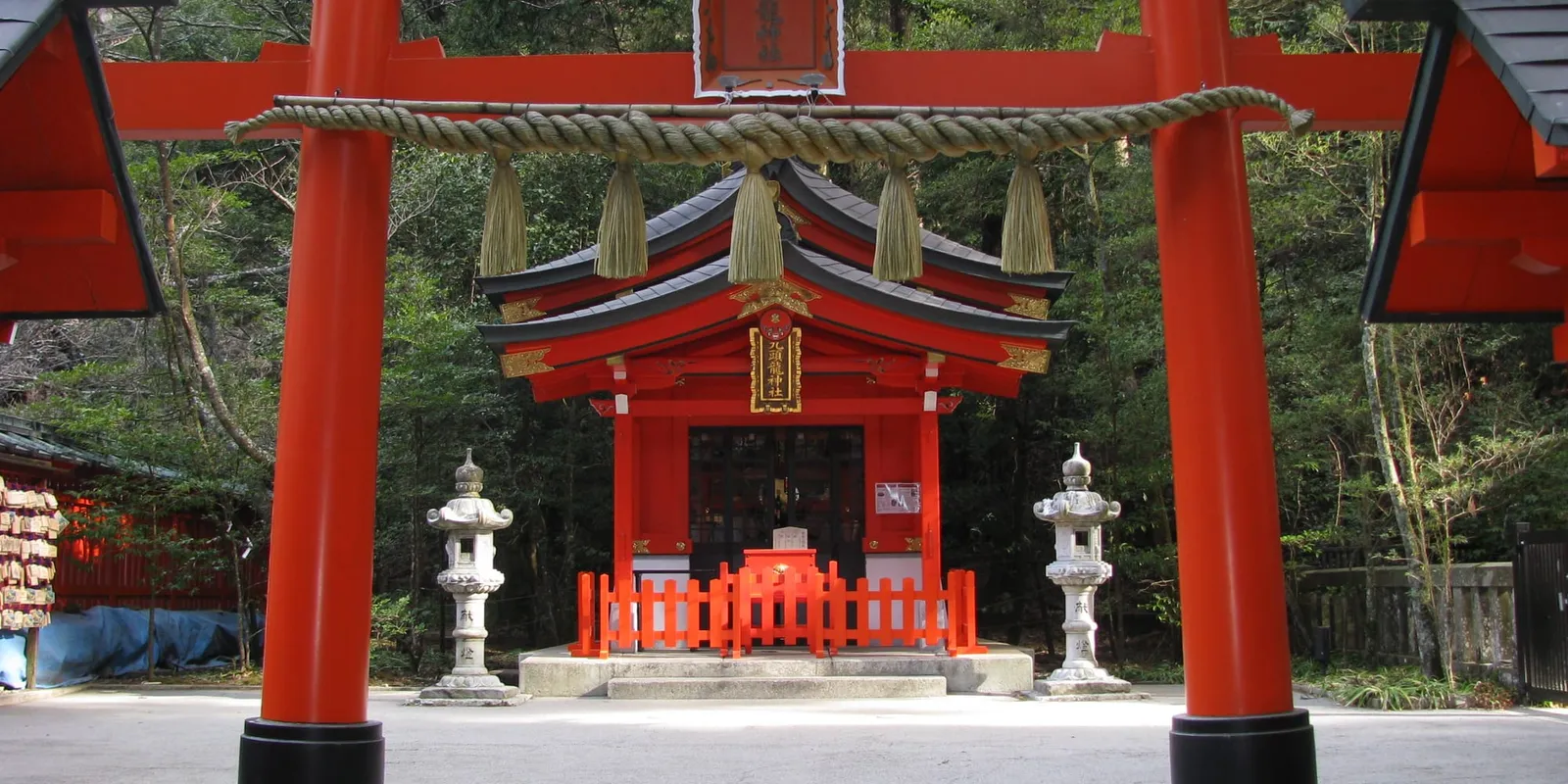
The Hongu stands inside Hakone Kuzuryu-no-Mori on the lakeshore and is described as the sacred birthplace of Kuzuryu Okami. The Shingu was enshrined within the Hakone Jinja grounds in 2000 (Heisei 12) by dividing the Hongu’s deity, so the two shrines are regarded as enshrining the same spirit. The official site says that Kuzuryu Okami governs the lake through the power of the great deity of Hakone, and recommends visiting Hakone Jinja and Kuzuryu Jinja together in a “two-shrine visit.”
Highlights
The Shingu stands just to the right of Hakone Jinja’s worship hall, a small vermilion hall set behind a vermilion torii. In front of it, beside the Ryujin-sui (dragon water), is the “Jojusuiban” basin, where visitors float away a “seigan-fu” (wish paper, ¥500). The official site says the Ryujin-sui is not sold and is given as an “osagari” (blessed offering) to those who receive a prayer service.
The Hongu is a quiet shrine nestled in a lakeside forest. At its monthly festival, priests perform the “Kosui Shinji” (lake water rite), offering rice, sake, dried squid, and eggs to the lake, and the festival also includes the monthly rite at the Benzaiten shrine and a visit to Hakuryu Shrine.
Visiting Tips
The Shingu is within the Hakone Jinja grounds, and goshuin (called “goshin-in”) are issued at the shrine office at the foot of the stone steps (8:15 AM–5:00 PM). Prayers to Kuzuryu Okami are accepted daily (reception 8:30 AM–4:00 PM, offering from ¥10,000). For matchmaking, Hakone Jinja offers the “Kuzuryu En-musubi Omamori” (¥1,000), described as a charm for ties in love, work, and life.
The Hongu is reached only by boat or on foot; cars cannot enter. On ordinary days, walk about 30 minutes along the lakeside path from Hakone-en (The Prince Hakone Lake Ashinoko) or Kojiri Terminal, passing the entrance of Hakone Kuzuryu-no-Mori (¥600 for adults, 9:00 AM–5:00 PM, last entry 4:30 PM). On the 13th of each month, a worshippers’ boat runs from Motohakone Port (per the October 2026 notice: departs 9:20 AM, ¥2,000 round trip). On the morning of the festival, admission to Kuzuryu-no-Mori is free for people attending the ceremony. The official site also notes that you can visit without booking a festival prayer. Boat times, fares, and entry conditions may change, so please check Hakone Jinja’s official site before you go.
Annual Festivals
- Hongu Monthly Festival (13th of every month, 10:00 AM): The ceremony includes a Shinto prayer, prayer services, tamagushi offerings, the Kosui Shinji (lake water rite), the monthly rite at the Benzaiten shrine, and a visit to Hakuryu Shrine. In bad weather or if the boat is cancelled, it is held at the Shingu beside Hakone Jinja.
- Shingu Two-Shrine Monthly Festival (15th of every month): The Shingu’s monthly festival follows Hakone Jinja’s monthly festival (starts at 8:00 AM, 9:00 AM in December only).
- Hongu New Year Festival (January 13): A ceremony at the Hongu at the start of the year.
- Shingu Annual Festival (April 29): Held following the Showa Festival.
- Hongu Annual Festival (June 13): Held together with the annual festivals of the Benzaiten and Hakuryu shrines, followed in the afternoon by a lake-safety prayer ceremony.
- Lake Water Festival (July 31): The eve festival of Hakone Jinja’s grand annual festival, with the “Teijo no Gi” at 6:00 PM and the “Kojo no Gi” on the lake at 7:00 PM.
- Kojiri Ryujin Festival (August 4): A Hongu festival in which sacred fire is kindled at 6:15 PM, followed by a lake water rite on the water before proceeding to Kojiri (torch procession 7:00 PM, lighting ceremony 7:20 PM).
Nearby Food & Sightseeing
- Hakone Jinja: The old lakeside shrine whose grounds hold the Shingu. The official site recommends visiting it together with Kuzuryu Jinja in a “two-shrine visit.”
- Heiwa no Torii (Torii of Peace): Hakone Jinja’s vermilion torii standing on the shore of Lake Ashi, one of Hakone’s most popular photo spots.
- Hakone-en: A lakeside leisure facility and one of the starting points for the walking path to the Hongu. Motorboat trips to the Hongu from its pier are also introduced on the official site (paid).
- Hakone Kuzuryu-no-Mori: The lakeside arboretum where the Hongu stands. Admission is ¥600 for adults and ¥300 for children.
Frequently Asked Questions
- Q. What is the difference between the Hongu and the Shingu?
- A. The Hongu stands on the shore of Lake Ashi inside Hakone Kuzuryu-no-Mori, and Hakone Jinja's official site describes it as the sacred birthplace of Kuzuryu Okami. The Shingu is within the Hakone Jinja grounds, just to the right of its worship hall. Both enshrine Kuzuryu Okami; the Shingu was enshrined later, within Hakone Jinja's precincts.
- Q. Can anyone attend the monthly festival on the 13th?
- A. The Hongu's monthly festival is held at 10:00 AM on the 13th of every month. According to the official notice for October 2026, the worshippers' boat runs only on the festival day: it leaves Motohakone Port at 9:20 AM, arrives at Kamiyama Pier at 9:45 AM, and costs ¥2,000 round trip (sign-up in front of the boat office at Motohakone, 8:00–9:05 AM). In bad weather or if the boat is cancelled, the festival is held at the Shingu next to Hakone Jinja. Schedules and fares can change, so check the official site beforehand.
- Q. How do I get to the Hongu, and what is the admission fee?
- A. The Hongu can be reached only by boat or on foot; cars cannot go there. On foot, walk about 30 minutes along the lakeside path from Hakone-en (The Prince Hakone Lake Ashinoko) and pass through Hakone Kuzuryu-no-Mori. Admission is ¥600 for adults and ¥300 for children (age 4 to elementary school), cash only, open 9:00 AM–5:00 PM with last entry at 4:30 PM (may vary by season). The official site says visitors arriving by motorboat enter free.
- Q. Can I get a goshuin (goshin-in)?
- A. Hakone Jinja's official site calls it a "goshin-in," and seals are offered for four shrines: Hakone Jinja, Kuzuryu Jinja, the Hakone Seven Lucky Gods Ebisu shrine, and Hakone Mototsumiya. The office is open 8:15 AM–5:00 PM, and the ¥1,500 goshin-in book includes one shrine's seal. No separate fee for Kuzuryu Jinja alone is listed on the official site, so please ask at the office.
- Q. Is the shrine known for matchmaking?
- A. Hakone Jinja's official site introduces Kuzuryu Okami as a deity whose virtue covers business prosperity, financial protection, fulfillment of heartfelt wishes, and good matches. Hakone Jinja also offers the "Kuzuryu En-musubi Omamori" (¥1,000), described as a charm for ties in love, work, and life.
Plan Your Visit
Before you go, you can book a stay and get your shrine-visit items ready.
Amazon links open Amazon.co.jp (Japan) in English; whether an item ships overseas depends on the product.
※ Contains ads (PR). Links open external sites such as Amazon, Rakuten, Trip.com and Booking.com.