History
Oyama Afuri Jinja venerates Mt. Oyama itself — also known as “Afuri-yama” or “Amefuri-yama,” the “rain-falling mountain” — as its sacred body, and shrine tradition places its founding in the reign of Emperor Sujin, more than 2,200 years ago. Visible across much of the Kanto Plain, Mt. Oyama has long been worshipped as a mountain that governs rain and water, drawing deep devotion from farming communities who depended on it. Recorded as a shikinaisha of Sagami Province in the Engishiki register of 927, the shrine has been venerated for centuries by the imperial court and successive warrior clans as one of the great sacred mountains of eastern Japan.
The principal deity is Oyamatsumi no Okami, the mountain god, worshipped together with Takaokami no Kami, deity of water and rain, and Oikazuchi no Kami, deity of thunder. In 755, the Todai-ji monk Ryōben is said to have entered the mountain and founded a temple, and for centuries afterward the mountain’s religious life centered on Oyama-dera in a fusion of Shinto and Buddhist practice. The Meiji-era separation of Shinto and Buddhism led to today’s Lower Shrine being built on the former site of Oyama-dera’s Fudo Hall, giving rise to the current arrangement of a summit shrine (Honsha/Okusha) and a Lower Shrine (Shimosha) partway up the mountain.
During the Edo period, a pilgrimage tradition known as “Oyama-mairi” became enormously popular among commoners, drawing an estimated 200,000 visitors a year. Alongside the vastly larger pilgrimage confraternities that traveled to Ise, Edo also had numerous “Oyama-ko” associations devoted to visiting Oyama, and in the Kanto region some accounts describe their fervor as rivaling that of the Ise pilgrimage groups, even though Ise itself drew a far greater number of pilgrims nationwide. Oyama-mairi combined faith with recreation as one of the great popular outings of the era, and its legacy survives today in place names like the old Oyama Kaido road and in various cultural properties connected to the pilgrimage.
Highlights
Most visitors center their pilgrimage on the Lower Shrine, reached by cable car from the base of the Koma-sando approach. From its grounds, a sweeping panorama opens over the Sagami Plain and Sagami Bay, with Mt. Fuji visible on clear days — one of the finest views in Kanagawa Prefecture. Beneath the Lower Shrine’s main hall runs a sacred spring known as “Oyama Meisui,” a popular stop for visitors.
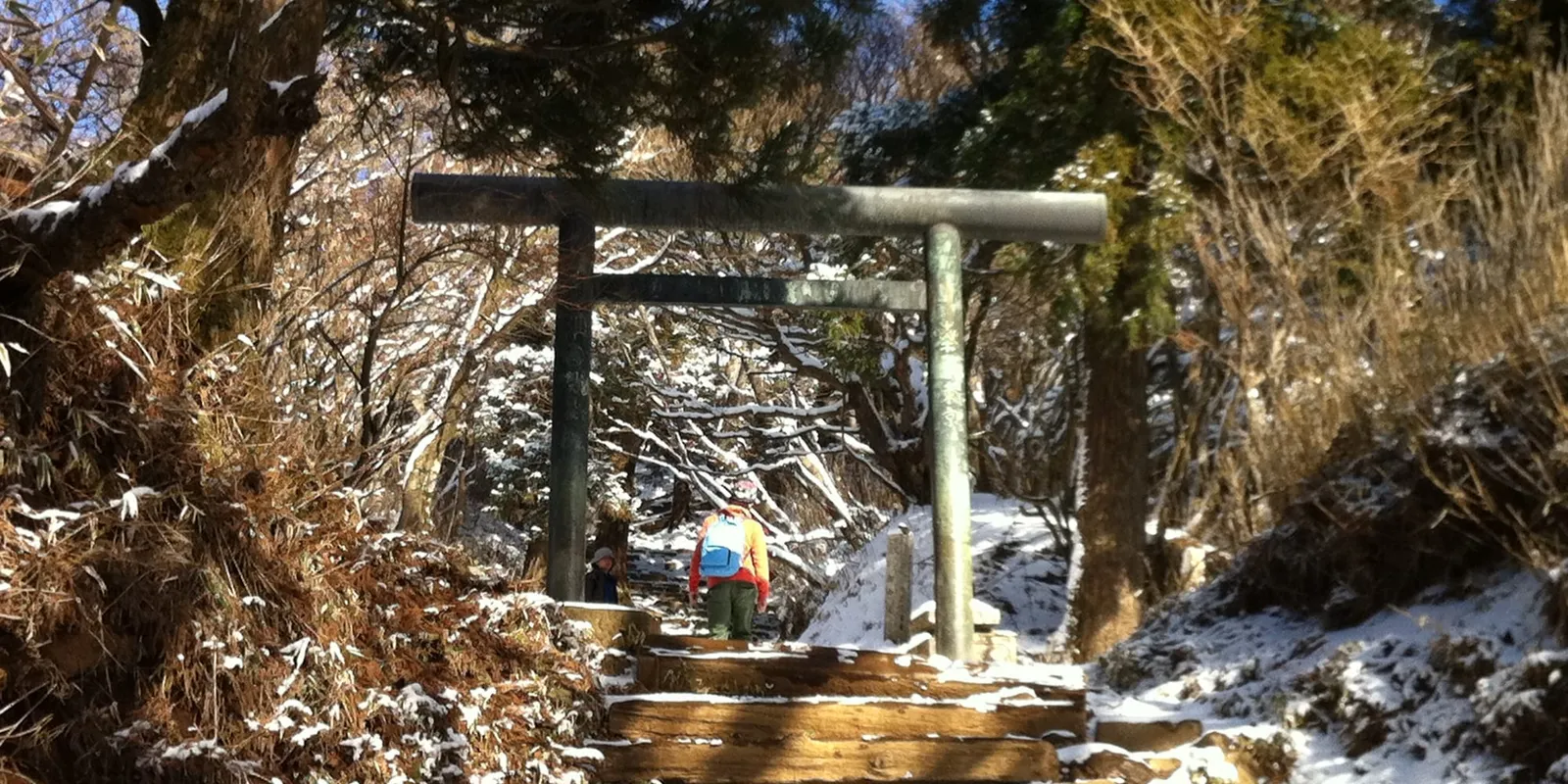
Those seeking a fuller pilgrimage can continue on foot for about 90 minutes from the Lower Shrine to reach the summit shrine. During the Edo-period Oyama-mairi boom, it was said that no true child of Edo could call themselves complete without having made the journey. Pilgrims traditionally brought home two distinctive local souvenirs: “Oyama-koma,” a wooden spinning top, and “Oyama-tokkuri,” a sake-barrel-shaped good-luck charm — traditions still very much alive in the shops lining Koma-sando today.
Visiting Tips
A visit to the Lower Shrine alone, combined with a stroll along Koma-sando, takes about 1–2 hours. Climbing to the summit shrine, even using the cable car partway, is a serious undertaking of roughly 3–4 hours round trip and calls for hiking shoes and clothing suited to a real climb. Because the cable car runs on a fixed schedule, be sure to plan your descent time carefully. Goshuin stamps come in four varieties — for the Lower Shrine, the summit shrine, the shamukyoku office, and Sengen-sha — all available at the Lower Shrine’s reception office.
Annual Festivals
- Setsubun Festival (February): A New Year rite for warding off misfortune and inviting good fortune, marked by a lively bean-scattering ceremony.
- Natsuyama Festival / Summer Grand Festival (July 27 – August 17): Said to date back to the Edo period, this mountain-opening festival draws large numbers of pilgrims who climb to the summit shrine during the period.
- Autumn Grand Festival (August 27–29): The shrine’s most important festival, in which all six districts of the Oyama community carry a portable shrine (mikoshi) down from the Lower Shrine to the town below in a dramatic descent known as “o-kudari.”
- New Year’s Visit (January 1–3): One of Kanagawa Prefecture’s most popular hatsumode destinations, drawing large crowds for the first three days of the year.
Nearby Food & Sightseeing
- Tofu-dokoro Ogawaya: A tofu-cuisine restaurant on Koma-sando serving multi-course kaiseki meals built around Oyama tofu, made with pure water flowing down from the Tanzawa mountains.
- Oyama-dera (Amefurisan Oyama-dera): The historic temple founded by the monk Ryōben, famed for its “kawarake-nage” clay-disc throwing ritual and for its autumn foliage; reachable on foot in about 2 minutes from the cable car’s midway station.
- Oyama Cable Car: Connecting Oyama-dera Station and Afuri-jinja Station, the cable car offers views over the mountainside and the Sagami Plain and is the essential link for most pilgrims heading to and from the Lower Shrine.
Frequently Asked Questions
- Q. What are the visiting hours?
- A. The grounds of the Lower Shrine are open to visitors at all times (office hours 9:00–17:00). The Upper Shrine at the summit is generally visited during the Oyama Cable Car's operating hours.
- Q. When is the goshuin office open?
- A. 9:00–17:00, for ¥500. Four types are available: Lower Shrine, Upper Shrine, shamukyoku office, and Sengen-sha.
- Q. Is there parking?
- A. Yes, the Oyama Daiichi parking lot (weekdays ¥900, weekends/holidays ¥1,000 for cars) and several Isehara municipal lots (¥600–¥1,500) are located near the entrance to Koma-sando.
- Q. What is the 'Oyama-mairi' pilgrimage tradition?
- A. A pilgrimage custom that became enormously popular among Edo-period commoners, drawing an estimated 200,000 visitors a year — it was said that no true child of Edo could call themselves complete without having made the journey.
- Q. How do I get there?
- A. About 25 minutes by bus from Odakyu Line Isehara Station to the Oyama Cable bus stop, then a 15-minute walk up Koma-sando to the cable car's base station, followed by a 6-minute cable car ride to Afuri-jinja Station (Lower Shrine).