History
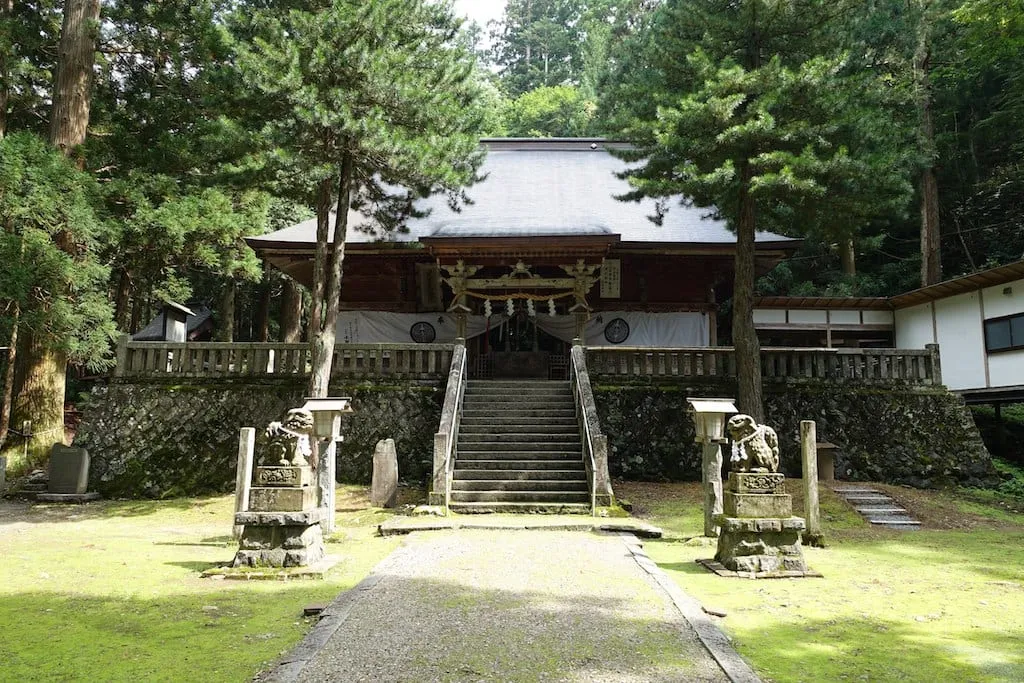
Hayachine Jinja venerates Mount Hayachine (1,917 meters), the highest peak of the Kitakami Mountains, as its sacred object of worship. According to shrine tradition, it was founded in 807 CE when Yamakage Hyobukyo Narifusa — said to be a descendant of the great courtier Fujiwara no Kamatari — built a shrine at the mountain’s summit and enshrined Seoritsuhime-no-Mikoto. This original summit shrine served as the “inner shrine” (okumiya), and in time a “village shrine” (satomiya) was established at the mountain’s foot in the Take district of Ohasama, becoming the Hayachine Jinja that stands there today.
Mount Hayachine historically had climbing trailheads and affiliated temples on its south, west, north, and east flanks, developing into a major center of Shugendo, the tradition of Japanese mountain asceticism, as devotees circled and climbed the sacred peak. On the southern, Ohasama-side trailhead, the Shingon-sect temple Myosen-ji served as the officiating temple, making this area a hub of Mount Hayachine worship that drew ascetics and pilgrims alike under the syncretic fusion of Shinto and Buddhism. Records even describe a protracted dispute between rival Myosen-ji temples on the Tono and Hienuki (Ohasama) sides over succession rights to the mountain’s main shrine — a sign of just how much religious authority and influence was at stake. The Meiji-era edict separating Shinto and Buddhism stripped away the site’s Buddhist elements, but the old ascetic traditions still surface vividly today, not least in the yamabushi who lead the great festival procession blowing conch-shell horns.
The shrine’s current main hall dates to 1612, and its central pillar framework and the carvings and bracket work around its eaves retain construction techniques from the Momoyama through early Edo periods so faithfully that it has been designated a Prefectural Tangible Cultural Property. In more recent centuries, the shrine received deep patronage from the lords of the Nanbu domain, whose backing repeatedly funded the construction and repair of its buildings.
Mount Hayachine’s Treasury of Alpine Flora
At 1,917 meters, Mount Hayachine isn’t a particularly tall mountain, yet it draws hikers and plant enthusiasts from across Japan as one of the country’s great “flower mountains.” The secret lies in the unusual rock — serpentinite and peridotite — that blankets its upper slopes. This rock is rich in magnesium and heavy metals but poor in the phosphorus and nitrogen that plants need, and it resists weathering into ordinary soil. Combined with thin winter snowfall that leaves the ground to freeze rather than stay insulated, the result is an exceptionally harsh growing environment.
Paradoxically, these harsh conditions have made the mountain a refuge for plants that would lose out to competition elsewhere, preserving a genuinely unique plant community. Around 200 species of alpine flora grow on Mount Hayachine, five of which — including Hayachine usuyukisou, Nanbu-toranoo, and Miyama-yamabukishoma — exist nowhere else on Earth. The most iconic of these is Hayachine usuyukisou, considered a sister species of the European edelweiss, its stems and blossoms cloaked in fine white down, blooming from June through August.
Mount Hayachine’s Shugendo Heritage
Worship of Mount Hayachine goes back to an ancient tradition of mountain reverence, in which the peak itself was venerated as the dwelling place of a god. From the Heian period onward, climbing trailheads and affiliated temples were established on all four sides of the mountain, and it developed into a major training ground for Shugendo, the practice of mountain ascetics who sought through ritual and prayer to ward off disaster and bring bountiful harvests and good fortune. For the people of the Kitakami Mountains, who suffered recurring cold-weather crop failures, prayer at Mount Hayachine carried real, practical urgency.
On the southern, Ohasama-side trailhead, the Shingon temple Myosen-ji served as the officiating temple and became a central hub of Mount Hayachine worship. Records of a long-running institutional dispute between the Tono-side and Hienuki (Ohasama)-side branches of Myosen-ji, over rights to the mountain’s main shrine, hint at how far this devotion’s reach and influence extended. Buddhist elements were formally stripped away after the Meiji Restoration, but the old ascetic tradition still lives on vividly in shrine ritual today — most visibly in the yamabushi who sound conch-shell horns to lead the procession at the shrine’s great annual festival.
Hayachine Kagura: A UNESCO Intangible Cultural Heritage
What has made Hayachine Jinja famous nationwide is Hayachine Kagura, the collective name for two closely related sacred dance traditions: Take Kagura, performed at Hayachine Jinja’s own festival, and Otsugunai Kagura, performed in the neighboring Otsugunai community. Hayachine Kagura was inscribed, on its own, on UNESCO’s Representative List of the Intangible Cultural Heritage of Humanity on September 30, 2009.
Take and Otsugunai Kagura are considered sibling traditions sharing a common origin — a transmission document dated 1488 survives in the Otsugunai officiant’s family, and a lion-mask “gongen-sama” dated 1595 is preserved at Hayachine Jinja, together suggesting a lineage of at least 500 years. The two are often described as two sides of the same coin: Otsugunai Kagura’s mountain-god mask is carved with its mouth open in the sound “ah,” while Take Kagura’s mask closes its mouth on “un” — the paired opening and closing sounds of the Sanskrit syllable “aum.” Take Kagura is generally described as vigorous and masculine, danced to a five-beat rhythm, while Otsugunai Kagura is elegant and feminine, set to a seven-beat rhythm — together forming the fuller picture of Hayachine Kagura.
The two traditions aren’t always performed in the same place. Take Kagura holds its New Year “first dance” on January 3 and its year-end “final dance” in December at Hayachine Jinja’s own kagura hall, while Otsugunai Kagura holds its January 2 first dance and other performances at the Otsugunai community’s “Kagura no Yakata” hall. On top of these, a monthly public program called “Ohasama Kagura Day” is held on the second Sunday of each month at the Ohasama Community Revitalization Center (Hayachine Hall) in central Ohasama, where Take Kagura, Otsugunai Kagura, and the neighboring Yagimaki Kagura rotate month to month — meaning visitors can see Hayachine Kagura performed without necessarily visiting the shrine itself.
Worth noting: in November 2025, Japan’s Council for Cultural Affairs selected a broader “Kagura” proposal — bundling 40 nationally designated Important Intangible Folk Cultural Properties from across Japan — as its candidate for a future UNESCO nomination. If eventually inscribed, this would create a new group listing that folds in both Hayachine Kagura and Shimane’s Sada Shinno, which are already separately listed. This is only a domestic candidacy, however, and UNESCO’s actual deliberation isn’t expected until around December 2028. As of today, Hayachine Kagura’s only confirmed UNESCO designation is its individual 2009 inscription.
The Grand Festival and Sominsai
Hayachine Jinja’s grand annual festival (Rei Taisai) is held every August 1. The night before, on July 31, an eve festival (yoimiya) sees Take and Otsugunai Kagura performed together at the shrine’s kagura hall from around 6 PM to 11 PM — a full six hours of dance. On the day itself, a Shinto rite begins at 10 AM, followed by a mikoshi procession and a parade of more than forty lion-mask “gongen-sama” led through the community by yamabushi blowing conch-shell horns, with kagura performances resuming on the shrine grounds from around 1:30 PM — a festival in which Shugendo tradition and kagura culture merge into a single, striking event.
The shrine also holds its own Sominsai on March 17 — a purification rite tied to the legend of Somin Shorai, part of a lineage of Sominsai festivals found across the Tohoku region and still carefully preserved by the local community today.
Goshuin
Hayachine Jinja does offer a goshuin, but as a small shrine tucked into the mountains, it has no resident priest, and its office is usually unattended. A pre-written (kakioki) goshuin is sometimes left at the Yamatobo guesthouse directly across from the shrine, though what’s available and whether staff can assist varies by season — it’s worth confirming before you visit. Chances of receiving one are better on days when people gather, such as the August 1 festival or a kagura performance date.
Access & Visiting Information
Hayachine Jinja sits in the mountains about 50 minutes by car from Shin-Hanamaki Station on the Tohoku Shinkansen and JR Kamaishi Line. By public transport, the closest route is a JR Kamaishi Line train to Ishidoriya Station, an Iwate Kenko bus to the Ohasama Bus Terminal, and then another 25 minutes by car — in practice, a rental car is the realistic way to visit. The shrine grounds can be visited at any time free of charge, though the shrine office keeps no fixed hours. There’s no dedicated parking at the shrine itself, but the free Take Parking Area (about 94 spaces) is just a short walk away.
Nearby Food & Sightseeing
- Edel Wein (Wine Chateau Ohasama): Founded in 1962, Iwate’s original full-scale winery, made entirely from Iwate-grown grapes. Its name honors the sister-species bond between Mount Hayachine’s native Hayachine usuyukisou and the European edelweiss, and the shop offers free tastings.
- Ohasama Community Revitalization Center (Hayachine Hall): Hosts “Ohasama Kagura Day” on the second Sunday of every month, where Take Kagura, Otsugunai Kagura, and other local kagura traditions perform in rotation. Its attached exhibition hall also displays materials connected to the beloved local writer Kenji Miyazawa.
- Tono City (Home of the Tono Monogatari Folktales): On the far side of Mount Hayachine from the shrine, Tono is the setting of Kunio Yanagita’s classic folktale collection “The Legends of Tono.” Sites like the Kappa Pool and Denshoen open onto a folk culture that echoes, from the mountain’s other side, the same reverence for Mount Hayachine.
Frequently Asked Questions
- Q. Who is enshrined at Hayachine Jinja?
- A. The enshrined deity is Seoritsuhime-no-Mikoto, one of the four purification deities named in the ancient Oharae liturgy. She is said to dwell in the swift currents of rivers, sweeping sins and impurities out to sea. Because her name contains the character for 'weave' (織), she is sometimes spoken of in connection with weaving and textile work, but the core of worship here traces back to reverence for Mount Hayachine itself as a sacred, deified mountain.
- Q. What exactly is Hayachine Kagura's UNESCO status?
- A. Hayachine Kagura was inscribed, as its own individual entry, on UNESCO's Representative List of the Intangible Cultural Heritage of Humanity on September 30, 2009. It covers two related traditions: Take Kagura, performed at Hayachine Jinja's main festival, and Otsugunai Kagura, performed in the neighboring Otsugunai community — together said to preserve over 500 years of continuous transmission. Separately, in November 2025, Japan's Council for Cultural Affairs selected a broader 'Kagura' proposal (bundling 40 nationally designated kagura traditions) as its candidate for a future UNESCO nomination. If successful, this would fold Hayachine Kagura into a new group listing, but that is only a domestic candidacy — UNESCO's actual review isn't expected until around December 2028. As things stand today, Hayachine Kagura's only confirmed UNESCO designation remains its individual 2009 inscription.
- Q. How do I get to the shrine, and is there parking?
- A. It's about 50 minutes by car from Shin-Hanamaki Station, and difficult to reach by public transport alone — the closest route is a JR Kamaishi Line train to Ishidoriya Station, an Iwate Kenko bus to the Ohasama Bus Terminal, and then about 25 more minutes by car. In practice, plan on a rental car. The shrine has no dedicated parking, but the free Take Parking Area (about 94 spaces) is close by.
- Q. Can I receive a goshuin here?
- A. Yes, but this is a small shrine tucked away in the mountains with no resident priest, and the shrine office is usually unattended. A pre-written (kakioki) goshuin is sometimes left at the Yamatobo guesthouse just across from the shrine, though availability varies, so it's worth confirming in advance. Chances are better on days when people gather, such as the August 1 festival or kagura performance dates.
- Q. What makes Mount Hayachine's alpine flora so special?
- A. At 1,917 meters, Mount Hayachine isn't especially tall, but its upper slopes are made of serpentinite and peridotite — rock rich in magnesium and heavy metals but poor in the phosphorus and nitrogen plants need, which resists weathering into ordinary soil. Combined with thin winter snow cover that lets the ground freeze, these harsh conditions have preserved plant life found nowhere else. About 200 species of alpine flora grow on the mountain, five of which — including its signature Hayachine usuyukisou — exist only here. Hayachine usuyukisou is considered a sister species to the European edelweiss, and its name lives on in Edel Wein, a winery in the foothill town of Ohasama.