History
According to shrine tradition, Hikotake-gu’s origins trace back to 89 CE, the 18th year of the reign of Emperor Keiko, the 12th emperor. When Kumatsuhiko rose in rebellion in the province of Hyuga (present-day Miyazaki), the emperor personally led an army that landed in Kyushu and made camp at Yurugidake in Yamashiro district. There he prayed for victory, and it is said that divine power surged from the peak of Mt. Hikotake to Yurugidake, shaking the mountain so violently that the rebel forces fled at once. After subduing Kumatsuhiko and his ally, the earth-spider chieftain Tsutsura, the emperor, on his way home, built three shrines on the peak of Mt. Hikotake — the Upper, Middle, and Lower Shrines — in gratitude for the gods’ help. This is said to be the founding of Hikotake-gu, which has been worshipped in Yamaga for more than 1,900 years since.
The shrine has seen its share of decline and revival over the centuries. In 1579, the Ryuzoji clan of Hizen burned down the shrine buildings while returning from an attack on the allied Akahoshi clan, and in 1587 the shrine lost its lands under Toyotomi Hideyoshi’s pacification of Kyushu. Kato Kiyomasa, who later became lord of the Higo domain, donated shrine lands and support for the priesthood, and through the efforts of the Yoshida family of priests, the shrine buildings were rebuilt in 1671. The Yoshida family has served as Hikotake-gu’s hereditary priests ever since, a line that continues down to the present day.
The eraser-stamp goshuin: one priest’s challenge
In recent years, Hikotake-gu has drawn wide attention for its “eraser stamp” (keshigomu-hanko) goshuin, hand-carved by the head priest, Mitsuhiro Yoshida. About five years ago, Yoshida left a company job to take over the shrine from his aging father. At the time, Hikotake-gu was drawing only 20 to 30 visitors a month, and the shrine alone could not support him — he reportedly worked night shifts at a factory while serving as priest by day.
“Whether this becomes a shrine no one visits, or one that many people come to, depends on what I do from here,” Yoshida has said of his thinking at the time. With no prior training, he taught himself to carve eraser stamps, working the shrine’s komainu guardian lion-dogs, seasonal scenery from the grounds, and local wildlife into his designs. Each hand-carved, monthly-rotating design brought something new for repeat visitors to discover, and word spread through social media and the shrine’s online shop. The result was a roughly 100-fold increase in the number of people visiting Hikotake-gu.
This story — “the challenge of a priest protecting a shrine with 1,900 years of history” — was featured on an RKK Kumamoto Broadcasting news segment on September 18, 2026, under the theme of “unearthing a dormant appeal,” and was syndicated by Yahoo! News Japan the same day. A centuries-old shrine finding new visitors through one priest’s handmade, present-day idea has become a widely cited example of how a small rural shrine can confront the challenges of succession and depopulation head-on.
Highlights
Hikotake-gu is a shrine deeply rooted in mountain worship, with its Lower, Middle, and Upper shrines set in stages from the foot of Mt. Hikotake (355 meters) to partway up its slopes and near its summit. Most visitors stop at the Lower Shrine at the base, but those with the stamina and gear can follow the mountain trail up to the Middle and Upper Shrines. Near the summit, the view opens onto the farmland of Yamaga below — a landscape not unlike what ancient worshippers may have seen when they sensed divine power on this mountain.
A local legend still told today concerns the mountain’s connection to the nearby rock formation Fudo-iwa. Mt. Hikotake and Fudo-iwa are said to have been half-brothers whose mother offered a sacred treasure to whichever of them won a tug-of-war. Mt. Hikotake (in his role as a mountain deity) won the contest, and the ground pushed up by their combined effort is said to have formed the small peak known as Yurugidake. Fudo-iwa is itself one of Yamaga’s best-known scenic landmarks, and many visitors combine a trip there with a visit to Hikotake-gu.
Visiting Tips
Hikotake-gu’s shrine office, located at the Lower Shrine, is open 8:00–17:00. The grounds themselves can be visited at any hour, but goshuin and amulets are only available during office hours. Free parking is available near the Lower Shrine, but it holds only about 3–5 vehicles, and the approach road is narrow and lined with trees, so drivers of larger vehicles should take care, and visiting midday when the lot may already be full is best avoided. Since the shrine’s limited-edition goshuin began attracting attention, weekends in particular tend to draw larger crowds, so an early-morning visit is recommended. Anyone planning to climb to the Middle or Upper Shrine should come prepared with proper hiking gear and allow enough time.
Annual Festivals
- Reisai (November 25, Lower Shrine): Hikotake-gu’s most important annual festival.
- Kenkokusai (February 11, Lower Shrine): A festival celebrating the founding of the nation, tied to Japan’s founding mythology.
- Tanemakisai (March 15, Upper Shrine): Held at planting time, praying for a bountiful harvest of the five grains.
- Chugu-sai (April 8, Middle Shrine): A festival held at the Middle Shrine.
- Niinamesai (November 23, Lower Shrine): A festival of thanksgiving for the year’s harvest.
Beyond these, Hikotake-gu also observes Gantansai (New Year’s Day), Genshisai (January 3), Kinensai (February 17), and Oharae purification rites (June 30 and December 29), with ceremonies carried out at the Upper, Middle, and Lower Shrines throughout the year.
Nearby Food & Sightseeing
- Fudo-iwa: The rock formation featured in Hikotake-gu’s tug-of-war legend, and one of Yamaga’s signature scenic spots, also known as a viewpoint looking toward Mt. Hikotake.
- Hirayama Onsen: A well-known hot spring area about a 5-minute drive from Hikotake-gu, with day-trip bathing facilities perfect for relaxing after a visit.
- Yachiyoza Theater: A Meiji-era kabuki theater and Important Cultural Property, one of the highlights of sightseeing in central Yamaga.
Frequently Asked Questions
- Q. Who is enshrined at Hikotake-gu?
- A. Hikotake-gu consists of three shrines — Upper, Middle, and Lower — spread across Mt. Hikotake, together enshrining nineteen deities. The Lower Shrine honors Amaterasu Sumeoomikami and Ukanomitama no Kami, among others; the Upper Shrine honors the land-creating deities Izanagi and Izanami; and the Middle Shrine honors Tsukiyomi no Kami and Hikohohodemi no Kami. Each of the three shrines has its own distinct group of resident deities.
- Q. What is Hikotake-gu's "eraser stamp" goshuin?
- A. It's a monthly, seasonally rotating goshuin whose artwork is hand-carved by the head priest, Mitsuhiro Yoshida, using his own hand-cut eraser stamps depicting the shrine's komainu guardian lion-dogs, seasonal scenery around the grounds, and local wildlife. Yoshida left a company job to take over the shrine roughly five years ago, at a time when monthly visitors had dropped to only 20–30 people; he taught himself stamp carving as a way to draw people back, and the warm, colorful, individually hand-carved designs caught on, driving a roughly 100-fold increase in visitors. In September 2026, the shrine's story was featured on an RKK Kumamoto Broadcasting news segment as "the challenge of a priest protecting a shrine with 1,900 years of history," and the story was also syndicated by Yahoo! News Japan the same day.
- Q. When can I get a goshuin at Hikotake-gu, and how much does it cost?
- A. The shrine office at the Lower Shrine is open 8:00–17:00, and a standard goshuin costs ¥300. The monthly, seasonally limited eraser-stamp designs vary in availability period and fee by design, so it's best to check the shrine's official site, social media, or online shop for the latest lineup. Pre-written goshuin can also be requested and mailed out.
- Q. How do I get to Hikotake-gu?
- A. By car, it's about 5 minutes from Hirayama Onsen, about 20 minutes from either the Kikusuido or Ueki interchange on the Kyushu Expressway, and about 10 minutes from central Yamaga. By bus, it's about a 15-minute walk from the Yokobababa bus stop. Free parking near the Lower Shrine holds only about 3–5 vehicles on a narrow approach road, so an early-morning visit is recommended.
- Q. Can I climb up to the Upper Shrine at Hikotake-gu?
- A. Mt. Hikotake has three tiers — the Lower Shrine at the foot, the Middle Shrine partway up, and the Upper Shrine near the 355-meter summit — and the trail from the Lower Shrine up to the Middle and Upper Shrines is a genuine mountain hike requiring proper gear. A separate route also allows visitors to drive up to the Upper Shrine. The mountain is also the setting of a local legend in which Mt. Hikotake and the neighboring rock formation Fudo-iwa, said to be half-brothers, once competed in a tug-of-war; the strain of their contest is said to have pushed up the earth into the smaller peak known as Yurugidake.
Related Shrines
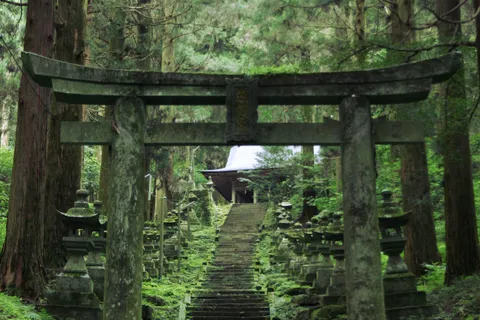
Kumamoto, Takamori, Aso District
Kamishikimi Kumanoza Jinja
Kamishikimi Kumanoza-jinja
- Good Relationships
- Business Prosperity
- Exam Success
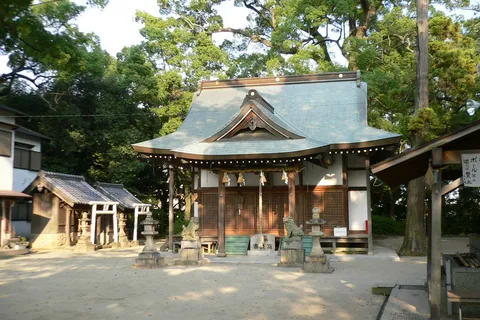
Hyogo, Nishinomiya
Namaze Kotai Jinja
Namaze Kōtai Jinja
- Household Safety
- Protection from Misfortune
- Business Prosperity
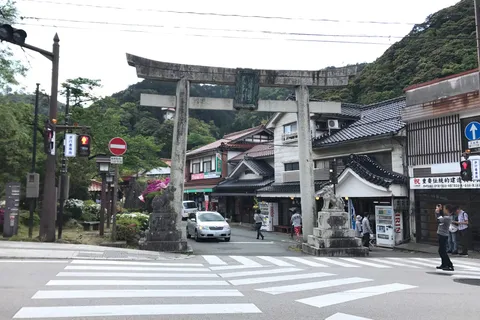
Shimane, Tsuwano
Taikodani Inari Jinja
Taikodani Inari-jinja
- Business Prosperity
- Bountiful Harvest
- Good Fortune