History
Hitsuji Shrine (ひつじじんじゃ) is a small shrine in Nakanoya, Annaka, Gunma. The reading follows Sakisaki Shrine’s official site. The enshrined deities are Amenokoyane no Mikoto and Tago Hitsuji Dayu Fujiwara no Munekatsu. It is an unstaffed shrine, looked after concurrently by the priest of Sakisaki Shrine.
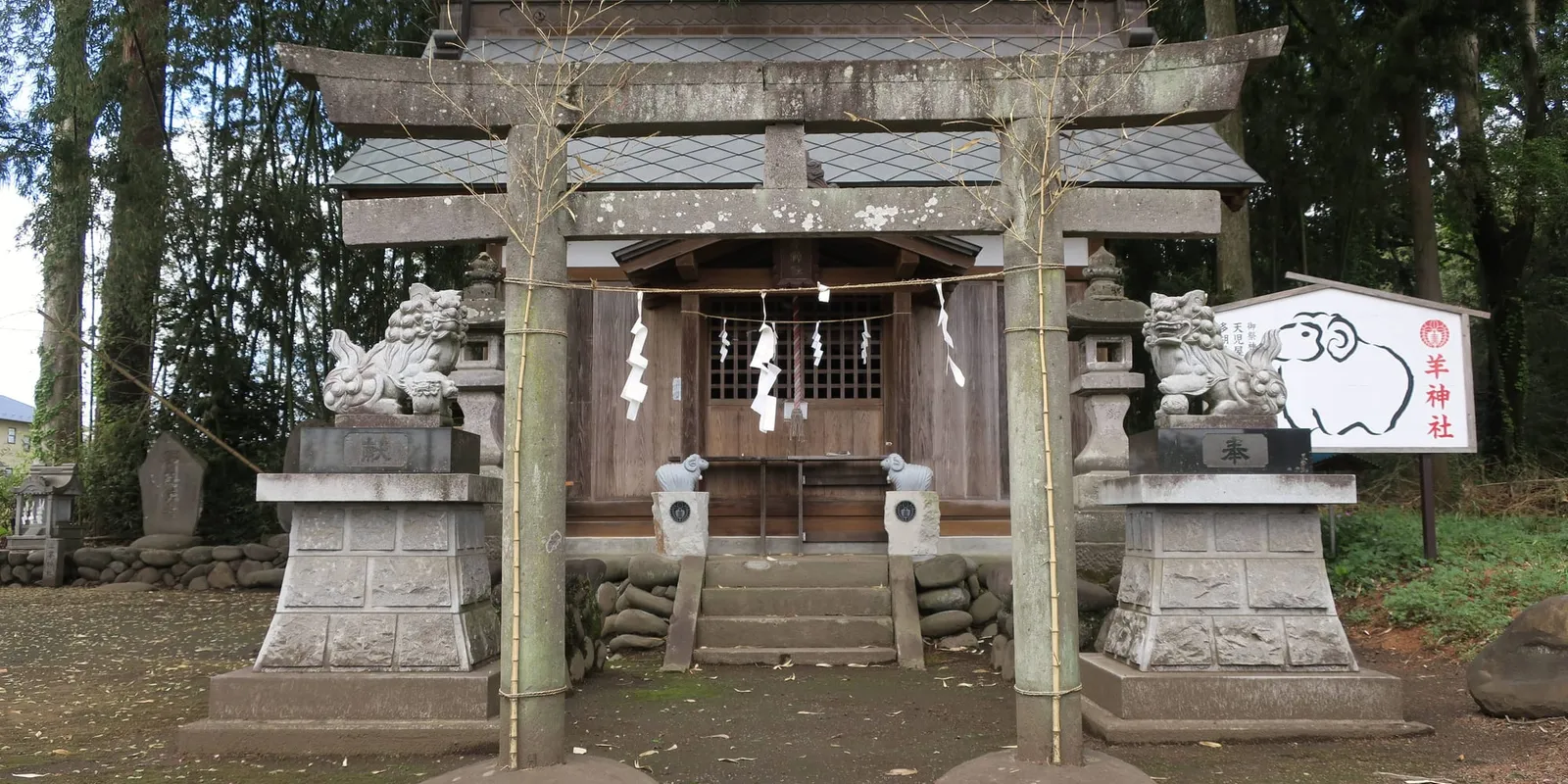
According to the Hitsuji Shrine page on Sakisaki Shrine’s official site, it was founded in the Enpo era (1673–81). Members of the Tago clan who moved from Tago District are said to have opened new fields and enshrined their ancestral deity Hitsuji Dayu, and the page also records a formal enshrinement in 1802. In 1997 the parishioners built a new main hall and a “twelve shrines” hall and held the transfer ceremony, and the following year the guardian dogs, the Mitsumine shrine and the torii were added, the same page says.
Hitsuji Dayu is a legendary figure from Gunma. According to the official site, he is said to have traveled to and from the capital in a single day, accompanied by a young man with wing-like growths at his sides and a famous horse. He received the Fujiwara surname for his service, but in the end flew away as a golden butterfly. He is also said to have discovered native copper in Chichibu, been granted Tago District, and raised the Tago Monument in commemoration. The Gunma tourism site’s article likewise links him to the Tago Monument and describes him as someone who brought copper mining and sericulture. All of this is tradition and has not been confirmed as history.
Highlights
Stone guardian dogs stand in front of the torii, and statues in the shape of sheep line the front of the main hall. The Gunma tourism article describes them as “sheep komainu” with fluffy coats, round eyes and a bell at the neck. The same article says a sheep ema with a red nose and a plump body hangs to the right of the main hall. Beside the hall stands a signboard with a sheep illustration (installed in 2015, a Year of the Sheep, according to Japanese Wikipedia) that catches the eye along with the shrine’s name.
The official site notes a monument inscribed “Tago-gu Hitsuji Dayu Munekatsu Shinzo-i” in the grounds. The shrine crest is “wisteria with a five-ring pagoda.” The hall was rebuilt in 1997, and the shrine sits quietly among trees in a residential area.
The Gunma tourism site says people born in Years of the Sheep often visit, calling it a guardian of the Year of the Sheep. The next Year of the Sheep is 2027 (Reiwa 9).
Visiting Tips
Hitsuji Shrine is unstaffed, with no shrine office or amulet counter. Goshuin, ofuda and omamori are all handled at the office of Sakisaki Shrine (3308 Sagimiya, Annaka), which looks after it. According to Sakisaki Shrine’s official site, reception is 9:00 AM–4:00 PM with irregular closing days. Goshuin for affiliated shrines cost ¥300, and the “Hitsuji Daruma goshuin” costs ¥1,500, available pre-written or written on the spot. The writer is sometimes absent, so it is safest to call 027-381-2726. The official site asks people who have not visited, or do not plan to visit, an affiliated shrine to refrain from requesting its goshuin, so visit Hitsuji Shrine first and then go on to Sakisaki Shrine.
The Hitsuji Shrine items listed on the official site include a sheep omamori (¥800), a fluffy sheep charm (¥700), a body-health charm (¥700) and a strap charm (¥600). No 2027-only items were announced on the official site as of October 2026. Limited items mentioned on blogs could not be confirmed officially, so please ask Sakisaki Shrine directly. One article says the Hitsuji Daruma goshuin is also given at Hitsuji Shrine, but the official site says items are given at Sakisaki Shrine’s office, so sources differ.
It is about 2.2 km (roughly 30 minutes on foot) from Isobe Station on the JR Shin’etsu Line, or about 6–7 minutes by taxi. Parking information is thin: one article says one space, and it is a residential area where quiet visits are asked for. Travel time to Sakisaki Shrine is given as about 5–10 minutes by car, differing by article; no walking time is given in the sources.
Annual Festivals
- Spring festival (March 15): Listed on the Hitsuji Shrine page of Sakisaki Shrine’s official site. The Gunma tourism article says it began at 8:00 AM with a norito prayer, followed by tamagushi offerings by parishioners.
- Autumn festival (October 15): Also listed on the Hitsuji Shrine page of the official site.
- Taitai Kagura at Sakisaki Shrine (April 1): Offered on the day of its spring festival. It is designated an Important Intangible Cultural Property of Annaka City and is registered as a Gunma Silk Heritage item (Sakisaki Shrine’s official site).
- New Year’s Festival at Sakisaki Shrine (from January 1): The official site says the festival begins at midnight.
The festivals are centered on parishioners. Dates and details can change, so check Sakisaki Shrine’s official site or call ahead.
Nearby Food & Sightseeing
- Sakisaki Shrine: The shrine that looks after Hitsuji Shrine and where goshuin and omamori are given. Its official site describes it as the predecessor of Nukisaki Shrine, the Ichinomiya of Kozuke. The grounds also hold the auxiliary Kinugasa Shrine, enshrining the sericulture deity Ukemochi no Mikoto, and a tradition of venerating a white snake as a guardian of silkworms.
- Isobe Onsen: A hot-spring town around Isobe Station. Guide articles say it is regarded as the birthplace of the hot-spring map symbol, based on a mark drawn on an early Edo-period map (the symbol’s origin is disputed). A good stop on the way back from your visit.
- Isobe Station: The nearest JR Shin’etsu Line station, about 30 minutes on foot or 6–7 minutes by taxi to Hitsuji Shrine.
Frequently Asked Questions
- Q. Is there a shrine office, and what are the visiting hours?
- A. Hitsuji Shrine is unstaffed and has no shrine office. According to the Gunma tourism site's feature article, the head priest of Sakisaki Shrine looks after it concurrently. No opening or closing times for the grounds are given on the official site; one article says "open 24 hours, every day, free," but this could not be confirmed officially. It stands in a residential area, so please visit quietly.
- Q. Where can I get a goshuin for Hitsuji Shrine?
- A. Not on the grounds. It is given at the office of Sakisaki Shrine (3308 Sagimiya, Annaka), which looks after Hitsuji Shrine. According to Sakisaki Shrine's official site, goshuin for affiliated shrines cost ¥300 and the "Hitsuji Daruma goshuin" costs ¥1,500, in both pre-written and written-on-the-spot form. Reception is 9:00 AM–4:00 PM with irregular closing days, and the writer is sometimes absent, so call 027-381-2726 first. The official site also asks people who have not visited, or do not plan to visit, the affiliated shrine to refrain from requesting its goshuin.
- Q. How do I get there, and is there parking?
- A. It is about 2.2 km from Isobe Station on the JR Shin'etsu Line, roughly 30 minutes on foot (Japanese Wikipedia), or about 6–7 minutes by taxi. The Gunma tourism article gives no bus information. Parking is not listed on the official site; articles describe it as one space or so, and since it is a residential area, public transport or a taxi is safer. Sakisaki Shrine, where the goshuin is given, is about 5–10 minutes away by car according to the articles (they differ).
- Q. Are there limited sheep amulets or goshuin for the 2027 Year of the Sheep?
- A. Sakisaki Shrine's official site had no announcement of 2027-only items as of October 2026. Its Hitsuji Shrine items include a sheep omamori (¥800), a fluffy sheep charm (¥700), the Hitsuji Daruma (¥1,500) and a strap charm (¥600). Please call Sakisaki Shrine to ask whether limited items exist and when they are offered.
- Q. When are the shrine's festivals?
- A. On Sakisaki Shrine's official page for Hitsuji Shrine, the spring festival is March 15 and the autumn festival is October 15. According to the Gunma tourism site's article, the spring festival begins at 8:00 AM with a norito prayer and tamagushi offerings by parishioners; red rice and a lion dance, once part of the festival, are no longer held. It is a parishioner-centered event, so check beforehand about observing it.
Plan Your Visit
Before you go, you can book a stay and get your shrine-visit items ready.
Amazon links open Amazon.co.jp (Japan) in English; whether an item ships overseas depends on the product.
※ Contains ads (PR). Links open external sites such as Amazon, Rakuten, Trip.com and Booking.com.