History
Isasumi Shrine stands along the Miya River in Aizumisato, Fukushima, and is revered as the chief guardian shrine of the Aizu region (Aizu Sochinju). It enshrines four deities: Izanagi no Mikoto, Izanami no Mikoto, Ohiko no Mikoto, and Takenunakawawake no Mikoto, with Shiogama no Okami and Hachiman no Okami enshrined in the side seats. According to tradition, in the 10th year of Emperor Sujin (about 2,000 years ago), Ohiko and his son Takenunakawawake, dispatched as two of the Shido Shogun (the four generals sent in different directions), met in Aizu. There, on Amatsudake, they held rites for Izanagi and Izanami and enshrined them as protective deities of the nation.
The Kojiki records that the two met at “Aizu” and that the place was therefore called Aizu, so the shrine’s founding and the origin of the name Aizu are tied together. Tradition says the shrine moved to Takada-minamihara in 552 and to its present site in 560. It was ranked as a Myojin Taisha in the Engishiki, and was known in ancient times as the “Ni-no-miya (Second Shrine) of Mutsu Province.” In the modern era it was a Kokuhei Chusha (state-supported middle shrine), and today it is a Beppyo Jinja of the Association of Shinto Shrines. The shrine now calls itself the “Ichinomiya of Iwashiro Province,” a title recognized by the National Ichinomiya Association (note that it is not the ichinomiya of Mutsu Province, where its traditional rank was ni-no-miya, or second shrine).
Highlights
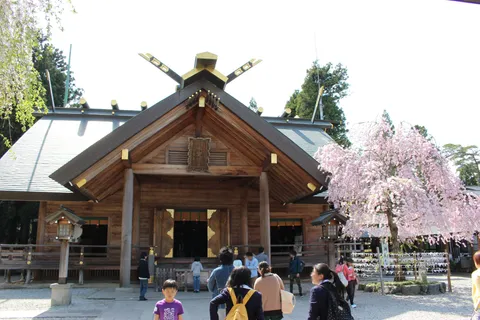
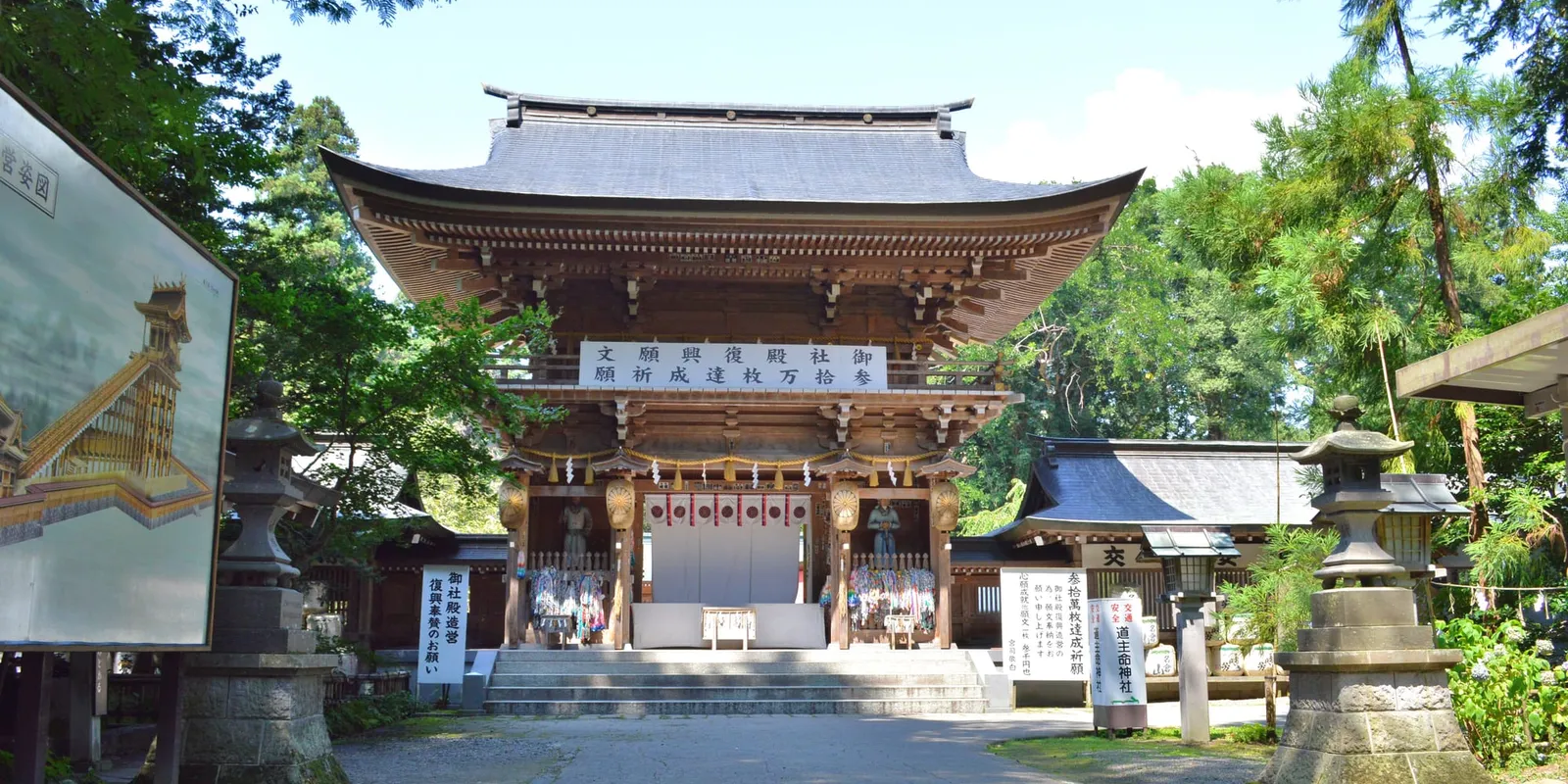
The main shrine buildings, including the main hall and worship hall, were destroyed by fire in October 2008, so rites are now held in a temporary shrine building. The two-story gate (romon), built in 1989, escaped the fires and still stands, forming the face of the grounds at the end of the approach. Beside it stands the Usuzumi-zakura, counted among the five famous cherry trees of Aizu, whose blossoms shift from white to pink. At the spring Flower Celebration Festival, rice cakes made with the blossoms are used in a celebratory feast.
The grounds also hold a Fukushima Prefecture Natural Monument wisteria (known as the “Flying Dragon Wisteria,” a giant vine) and a cypress said to have been planted by the high priest Tenkai. The treasure hall houses the Muromachi-period vermilion-lacquered, gilt-bronze mikoshi (a national Important Cultural Property) and a pair of wooden komainu guardian dogs thought to date from the Nanbokucho period (a Fukushima Prefecture Important Cultural Property). In the shrine’s outer grounds lies the Ayame-en iris garden, with over 200 varieties of Japanese iris and related flowers.
Visiting Tips
Because the main shrine buildings are being rebuilt, the official site explains that the temporary shrine forces many festivals and events to be scaled back, simplified, or suspended. A reconstruction support association was founded in December 2024, with completion of the main hall, offering hall, and worship hall targeted for 2030. It is best to visit knowing that you are seeing the shrine in the middle of its rebuilding.
Goshuin are available from 9:00 AM to 4:00 PM: ¥1,000 for the standard version, and ¥500 each for the block-script version, the Aizu Seven Lucky Gods version, and each subsidiary shrine. When the head priest is absent, a pre-written paper goshuin is given. The treasure hall is open 9:00 AM–4:00 PM, with admission of ¥300 for adults and ¥150 for ages 18 and under. Drone photography in the grounds is prohibited.
For access, it is about a 25-minute walk from Aizu-Takada Station on the JR Tadami Line, or take the Aizu Bus bound for Nagaino from JR Aizu-Wakamatsu Station to Yokomachi stop and walk about 3 minutes. By car, it is about 15 minutes from Shinzuru Smart IC on the Ban-etsu Expressway, and parking is available for 120 regular cars and 5 large buses.
Annual Festivals
- Saitansai (January 1): A New Year ceremony praying for national prosperity and the well-being of worshippers.
- Spring Grand Festival and Flower Celebration Festival (April 29): The Daidai Kagura sacred dance is offered, and rice cakes made with petals of the Usuzumi cherry are shared.
- Sunayama Festival (May 5): A rite praying that Aizu will never lack salt, performed as a secret ritual passed down within the shrine (not open to the public).
- Ayame Festival (mid-June to early July): The irises of Ayame-en reach their peak in the outer grounds. The festival period varies by year; in 2026 it was announced for June 13–30.
- Rice Planting Festival (July 11–13, main day July 12): One of Japan’s “three great rice-planting festivals,” alongside the Ise Jingu morning planting and the Atsuta Jingu evening planting, designated a national Important Intangible Folk Cultural Property in 2019 as the “Otaue-sai of Aizu.” Highlights include the Shishi-oi (lion chase), in which children carry lion-head masks through the town, a mikoshi procession, and rice planting by young women (saotome) at Ota Shrine, performed to the singing of saibara. Traffic restrictions apply around the shrine on July 12.
- Grand Annual Festival (September 14–16): The shrine’s most important festival, tied to its founding, praying for a good harvest and peace in the country.
- Niinamesai (November 23): The first grain of the new harvest is offered to the deities in thanks.
Monthly festivals are also held at 10:00 AM on the 1st and 15th, and a daily offering ceremony takes place at 7:00 AM.
Nearby Food & Sightseeing
- Ayame-en: An iris garden in the shrine’s outer grounds with over 200 varieties of Japanese iris and related flowers. It peaks from mid-June to early July, and is a circular garden with pavilions and ponds. Admission is reported to be free.
- Isasumi Shrine Treasure Hall: Houses the nationally designated Important Cultural Property vermilion-lacquered, gilt-bronze mikoshi and other treasures (9:00 AM–4:00 PM; adults ¥300, 18 and under ¥150).
- Tsurugajo Castle (Aizuwakamatsu): The castle site that symbolizes Aizuwakamatsu, a good addition to a trip tracing Aizu’s history alongside a visit to its chief guardian shrine.
Frequently Asked Questions
- Q. Can I get a goshuin at Isasumi Shrine?
- A. Yes, between 9:00 AM and 4:00 PM. The standard goshuin is ¥1,000; the block-script version, the Aizu Seven Lucky Gods goshuin, and each subsidiary shrine goshuin are ¥500. When the head priest is absent, a pre-written paper goshuin is given instead. Subsidiary shrine goshuin are always given on paper.
- Q. Can I still see the main hall and worship hall?
- A. The main shrine buildings, including the main hall and worship hall, were destroyed in fires in October 2008, and rites are now held in a temporary shrine building. The two-story gate (romon), built in 1989, escaped the fires and still stands. A reconstruction support association was founded in December 2024, with completion of the main hall, offering hall, and worship hall targeted for 2030.
- Q. Is there parking?
- A. Yes, there is parking for 120 regular cars and 5 large buses (the official site gives no fee information). On July 12, the day of the Rice Planting Festival, traffic restrictions apply around the shrine.
- Q. How do I get there by train or bus?
- A. It is about a 25-minute walk from Aizu-Takada Station on the JR Tadami Line. From JR Aizu-Wakamatsu Station, take the Aizu Bus bound for Nagaino and get off at Yokomachi (about 40 minutes), then walk about 3 minutes.
- Q. When is the Rice Planting Festival (Otaue-sai)?
- A. It runs from July 11 to 13 each year, with July 12 as the main day. It is counted as one of Japan's three great rice-planting festivals alongside those of Ise Jingu and Atsuta Jingu, and was designated a national Important Intangible Folk Cultural Property on March 28, 2019, as the "Otaue-sai of Aizu."
Plan Your Visit
Before you go, you can book a stay and get your shrine-visit items ready.
Amazon links open Amazon.co.jp (Japan) in English; whether an item ships overseas depends on the product.
※ Contains ads (PR). Links open external sites such as Amazon, Rakuten, Trip.com and Booking.com.