History
Motomachi Itsukushima Shrine (Motomachi Itsukushima-jinja) stands at the foot of a low hill between Motomachi 4-chome and 5-chome in Naka-ku, Yokohama. The official site writes the name with the old character form “嚴島神社,” and its central deities are the three Munakata goddesses (Ichikishimahime no Mikoto, Takirihime no Mikoto and Takitsuhime no Mikoto). It is a different shrine from the Itsukushima Shrine on Miyajima in Hiroshima Prefecture, which this site covers on a separate page.
According to the official history, the shrine’s origins are said to go back to the early Kamakura period. In 1180 (Jisho 4), Minamoto no Yoritomo, on raising his army, is said to have prayed for victory to Benzaiten, enshrined at Sugiyama in Doi, western Izu. After his wish was granted, he is said to have built a hall at Kenga-fuchi on Myoga-jima (Yokohama village, around present-day Kannai) and invited Benzaiten there from Izu. The place was called “Shimizu Benten” for its clear spring water, and also “Sunoshima Benten,” and the name is said to survive today in Benten Bridge, which crosses from Sakuragicho to Kannai.
In the Genroku era a temporary hall was built within the grounds of Zotokuin temple (on the Motomachi side of today’s Foreign General Cemetery) and called “Kaminomiya Sugiyama Benten.” In the late Edo and port-opening period it drew wide devotion as the guardian shrine of Yokohama harbor, and the official site explains that when villagers were ordered by the shogunate to move in 1860 (Man’en 1) and named their new home “Yokohama Motomura,” this laid the foundation of Motomachi. In 1868 Shimizu Benten was moved to Hagoromo-cho, and in 1869 Sugiyama Benten was separated from Zotokuin under the Shinto-Buddhist separation order and enshrined as Itsukushima Shrine.
The Great Kanto Earthquake of 1923 toppled and burned the buildings, so the shrine moved to its present site and was formally re-enshrined in 1933 (Showa 8). The Yokohama air raid of May 1945 destroyed it again, and the main hall was rebuilt in 1951 and the worship hall in 1961. The Motomachi Shopping Street’s official site also says that the shrine, at 5-208 Motomachi, was originally on Sunoshima in Yokohama village and has been called Motomachi Itsukushima Shrine since 1869 (Meiji 2).
Highlights
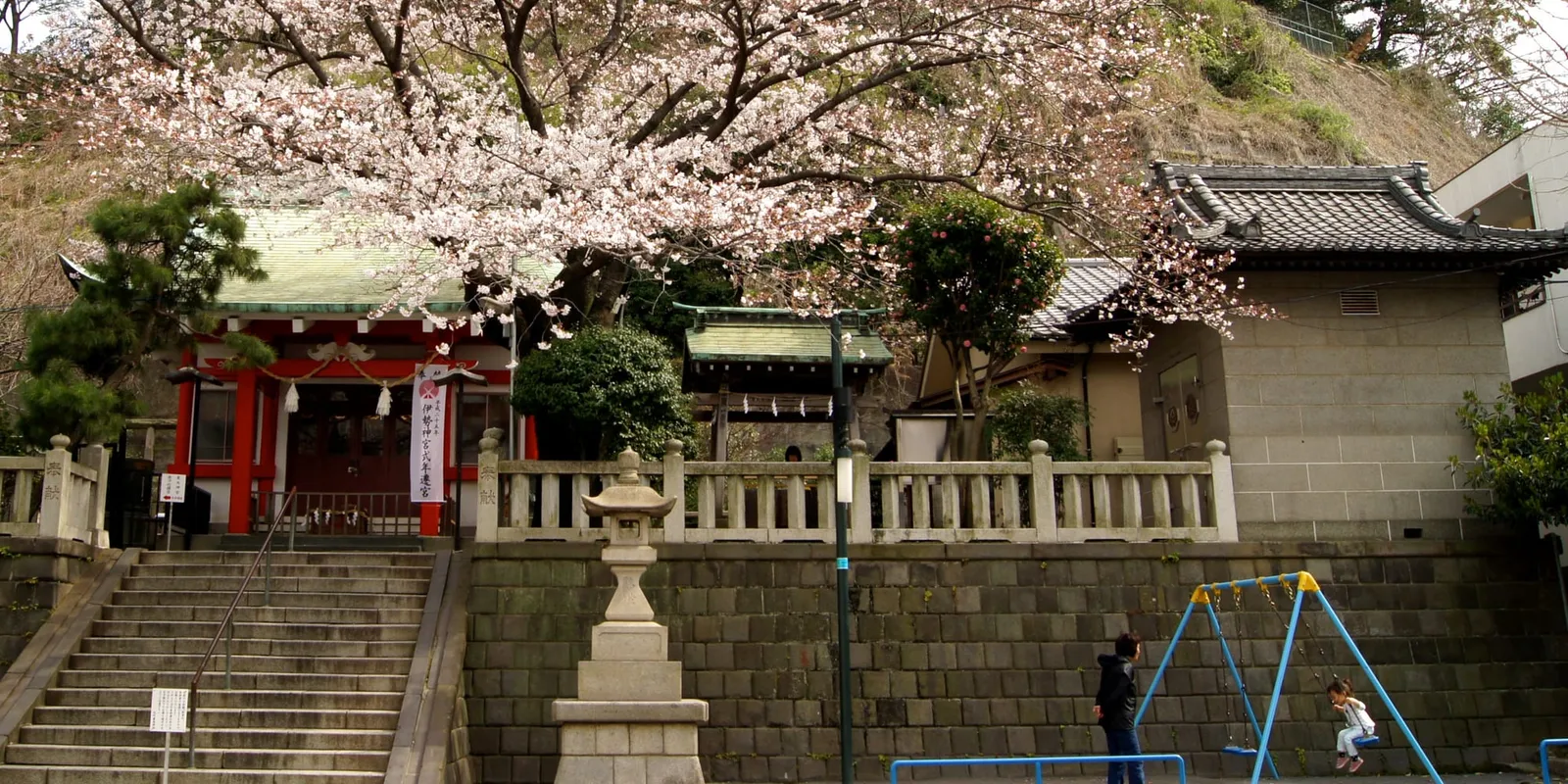
According to the Motomachi Shopping Street’s official site, you pass through a red torii and climb the stairs in front to reach the main shrine, with Kotai Jingu on its left and Kotohira-gu beside that again. The official page on the enshrined deities lists Ichikishimahime no Mikoto, Takirihime no Mikoto, Takitsuhime no Mikoto and Konohanasakuya-hime no Mikoto, along with Amaterasu Omikami at Kotai Jingu and Omononushi no Kami and Emperor Sutoku at Kotohira-gu. The grounds, with their torii and stone steps, sit at the foot of the hill between Motomachi 4-chome and 5-chome.
The range of amulets is wide. The official amulet page lists charms for safe childbirth, traffic safety, travel safety, academic success, marital harmony, business prosperity, health and longevity, victory, and children, among others. Most are ¥1,000, while the “kaiun yakuyoke” (good fortune and protection from misfortune) charm and the children’s charm are ¥500. Among ofuda, the Jingu Taima, Kotohira-gu Taima and Itsukushima Shrine Taima are each listed at ¥1,000.
For goshuin, there is the regular goshuin (¥500) plus limited-edition special goshuin. Per the official site, in 2026 these included one for the biennial “Noryo no Yube” summer evening event and mikoshi procession (from August 1, until supplies run out; the design takes the shrine’s mikoshi as its motif, with a summer sky and cool waves, and a “Natsumode” (summer visit) stamp is added in August only), and one for the Motomachi Shopping Street’s “Charming Sale 2026 Autumn” (from September 19; the design draws on the sale’s official poster). Both are ¥500, and the shrine’s own seal is stamped in the center of the finished goshuin.
Visiting Tips
The official site does not state visiting hours; it announces the amulet office (goshuin and charms) hours month by month. In the October 2026 calendar many days were 10:00 AM–4:00 PM, but some days were shortened to hours such as 10:00 AM–2:00 PM or closed. Hours may change in coordination with the neighborhood association, so if you are after a goshuin or charm, check the official site’s news or the official Instagram for the current month before you go.
The official site lists a 6-minute walk from JR Ishikawacho (Motomachi-Chukagai) Station and an 8-minute walk from Motomachi-Chukagai Station on the Minatomirai Line, or a 2-minute walk from the “Motomachi” bus stop. Parking is not mentioned on the official site, so going by train is the convenient choice.
The Munakata goddesses are known as deities of sea travel, and the official site describes them as watching over traffic safety as well as safe childbirth, academic success and good relationships. Amulets for travel safety, traffic safety, safe childbirth and academic success are available.
Annual Festivals
The regular festivals listed on the official “Main Festivals and Rites” page are:
- Saitan-sai (New Year’s Day festival) (January 3)
- Setsubun Festival (February 3)
- Annual festival (June 2): The official site says the festival day was anciently in November, later became August 15, and was fixed as June 2 after a grand festival marking the first anniversary of the port’s opening was held on that date in 1860 (Man’en 1) by order of the Kanagawa magistrate.
- Great Purification (Oharae) (June 30)
- Monthly festival (the 2nd of each month, except January and June)
- Summer festival (every other year, first Saturday and Sunday of August): Described as a rite in which the deity, parishioners and community together re-enact the relocations recounted in the shrine’s history. In 2026 a special goshuin tied to the “Noryo no Yube” event and mikoshi procession was announced.
Dates can change, so check the official site for the latest.
Nearby Food & Sightseeing
- Motomachi Shopping Street: A shopping street that runs close to the shrine. According to the street association’s official site, its history goes back to the opening of the port in 1859, when shops serving residents of the foreign settlement grew up naturally. The shrine also issues special goshuin tied to the street’s Charming Sale (the autumn 2026 edition is announced on the shrine’s official site).
- Yokohama Foreign General Cemetery: Per the shrine’s history, Zotokuin temple once stood on what is now the Motomachi side of the cemetery. The Motomachi Shopping Street’s official site says the cemetery began with the burial of a sailor from Perry’s fleet. Access to the grounds is limited, so check the open days before you go.
- Motomachi Park: According to the Motomachi Shopping Street’s official site, a park of about 2 hectares laid out in the early Showa period together with the construction of the Motomachi swimming pool. It is in the Yamate area and makes an easy stop on a stroll.
Frequently Asked Questions
- Q. Which deities are enshrined at Motomachi Itsukushima Shrine, and what are its blessings?
- A. According to the official site, the main deities are the three Munakata goddesses: Ichikishimahime no Mikoto, Takirihime no Mikoto and Takitsuhime no Mikoto. Konohanasakuya-hime no Mikoto is also enshrined. The Munakata goddesses have long been revered as deities of sea travel, and the official site says they watch over traffic safety as well as safe childbirth, academic success and good relationships on life's long voyage. The grounds also hold Kotai Jingu (Amaterasu Omikami) and Kotohira-gu (Omononushi no Kami and Emperor Sutoku).
- Q. Can I get a goshuin here?
- A. Yes. The official site's amulet page lists the goshuin at ¥500. Amulet office hours are announced month by month on the official site and may change in coordination with the neighborhood association. In the October 2026 calendar, many days were 10:00 AM–4:00 PM, but some days were shortened to hours such as 10:00 AM–2:00 PM or closed. According to the official site, limited-edition special goshuin (¥500 each) were also issued in 2026 to coincide with the "Noryo no Yube" summer evening event and the Motomachi Charming Sale 2026 Autumn. Check the official site or official Instagram for the latest.
- Q. How do I get there, and is there parking?
- A. The official site lists a 6-minute walk from JR Ishikawacho (Motomachi-Chukagai) Station, an 8-minute walk from Motomachi-Chukagai Station on the Minatomirai Line, and a 2-minute walk from the "Motomachi" bus stop. The address is 5-208 Motomachi, Naka-ku, Yokohama. The official site does not mention parking, so going by train is the convenient choice.
- Q. What is the shrine's history, and why is it in Motomachi?
- A. The official history says its origins go back to the early Kamakura period, when Minamoto no Yoritomo is said to have prayed to Benzaiten for victory and built a hall in the Yokohama area. During the Genroku era (1688–1704) a temporary hall was set up within the grounds of Zotokuin temple and called "Sugiyama Benten." In 1869 (Meiji 2), under the order separating Shinto and Buddhism, it became independent of the temple and was enshrined as "Itsukushima Shrine." After the Great Kanto Earthquake (1923) destroyed its buildings, it was relocated to its present site and formally re-enshrined in 1933 (Showa 8). The Yokohama air raid of May 1945 destroyed it again; the main hall was rebuilt in 1951 and the worship hall in 1961, and it stands today.
- Q. When are the annual festival and the summer festival?
- A. The official "Main Festivals and Rites" page lists the New Year's Day festival (Saitan-sai) on January 3, Setsubun on February 3, the annual festival on June 2, the Great Purification (Oharae) on June 30, and the monthly festival on the 2nd of each month (except January and June). The summer festival is held every other year on the first Saturday and Sunday of August and is described as a rite in which the deity, parishioners and community together re-enact the shrine's relocations described in its history. Dates may change, so check the official site before you visit.
Plan Your Visit
Before you go, you can book a stay and get your shrine-visit items ready.
Amazon links open Amazon.co.jp (Japan) in English; whether an item ships overseas depends on the product.
※ Contains ads (PR). Links open external sites such as Amazon, Rakuten, Trip.com and Booking.com.