History
Kogane Shrine (Kogane Jinja) stands in Kanemachi, Gifu City, Gifu Prefecture. The official site introduces it as a shrine long revered for industrial prosperity, wealth and financial luck, and business prosperity. The site also uses the affectionate name “Kogane-san.”
According to the official history, the date of its founding is in the distant past: in the reign of Emperor Seimu (135 CE, per the site), Mononobe no Omi Kabukinomikoto is said to have set up the provincial capital here and revered the deity Kogane no Okami. The principal deity, Nunoshihime no Mikoto, was the sixth daughter of Emperor Keiko and the consort of Inishikiirihiko no Mikoto, the principal deity of Inaba Shrine.
The official site relays the legend handed down at Inaba Shrine as follows. Inishikiirihiko no Mikoto pacified the Ōshū region on an imperial order, but because of a report by Mutsu no Kami Toyomasu, who envied his success, he was branded an enemy of the court and was killed in this land. Hearing of her husband’s death, Nunoshihime no Mikoto set out from the capital in deep grief, followed his trail to this land, and spent the rest of her life comforting his spirit. During that time she cared for the local people like a mother, used her own wealth to develop the town and contributed to the growth of industry and agriculture, which later became the foundation of the city of Gifu. Moved by her compassion, people came to revere her as a deity who brings wealth, and she was enshrined here as “Kogane no Okami.”
Japanese Wikipedia, for its part, lists Kogane no Okami, Nunoshihime no Mikoto, Ichihayao no Mikoto, Inishikiirihiko no Mikoto and Hibasuhime no Mikoto as enshrined deities, and notes views that Nunoshihime is Kogane no Okami or that the four deities together are called Kogane no Okami. The official site names only Nunoshihime no Mikoto as principal deity, so explanations differ by source.
Highlights
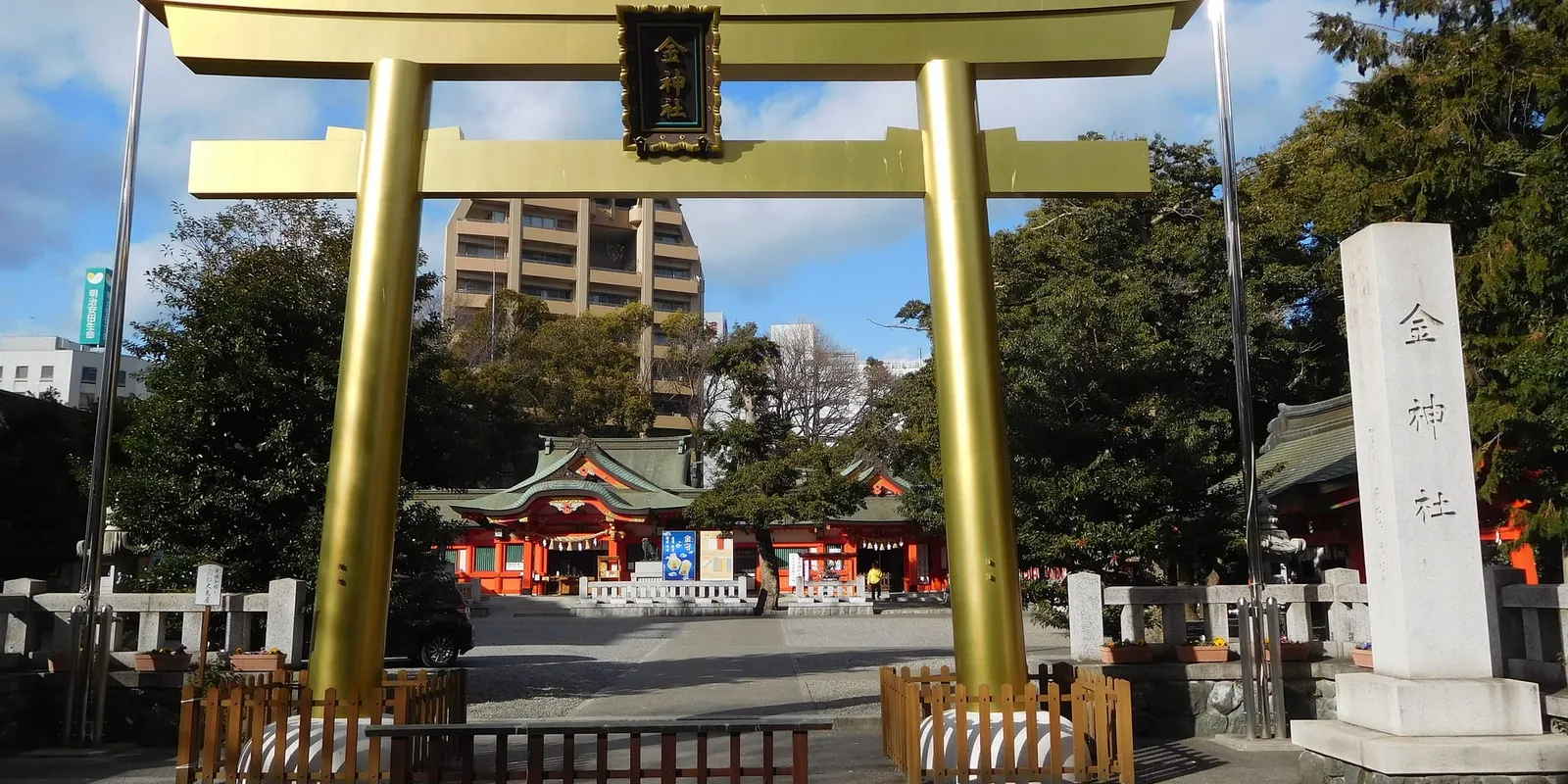
The golden torii (“Kin no Torii”) in the grounds is the shrine’s signature sight, and the official site’s grounds guide includes it. According to Japanese Wikipedia, a special-steel torii built in 1987 was repainted gold in 2015 after rust appeared (the official site does not mention this history).
Besides the main hall, the grounds hold the auxiliary shrines Konsho Inari Shrine and Kogane-Takahashi Shrine, a hand-washing pavilion, a sazare-ishi stone and the amulet and shrine offices. The official festival list also names auxiliary shrines such as Akiba, Tamahime, Kuroiwa, Shinmei, Mononobe/Kabukinogi and Sarutahiko. The official site introduces the “nanjamonja” (fringe tree) in the grounds as being in season in May. The main hall is air-conditioned and heated, and prayers and weddings are held there, the site says.
The Kogane Shrine Hall in the grounds is described as a facility for meetings and other events, and the official site notes a self-roasted coffee shop, “Cafe Tabibito no Ki,” in the basement.
Visiting Tips
Prayer services are held as people arrive from 9:00 AM to 4:30 PM, take about 20 minutes, and start from ¥5,000 (official site). Services include yakuyoke (warding off misfortune), safe childbirth, first shrine visit, Shichi-Go-San and car purification; for car purification, you drive in from the Kinkabashi-dori (Heiwa-dori) side and speak to the shrine office. Group prayers require a reservation.
The goshuin costs ¥500 and the goshuin book ¥1,500 (large ¥3,000). On the last Friday of each month, “Premium Kin Day,” a “gold goshuin” with only the shrine name written in gold is offered. The remaining 2026 dates are November 27 and December 25. If there is a line at 5:00 PM on the day, the shrine says it will close the queue, so going earlier is safer. The limited “flower-foil goshuin” (¥700) was, per a November 2025 notice, offered only in December and February. Hours for regular-day goshuin are not separately stated on the official site, and offerings change over time.
Charms include “Kogane-mamori,” “Kaiun-mamori,” “Shigoto-mamori” and “Kozuchi-mamori” (¥800–¥1,000 each), and a golden “Shiawase Ema” (¥800) decorated with a four-leaf clover. These are prices as listed on the official site; none of this is a guarantee of financial luck or good fortune.
On access, the official site’s map says to enter by the shrine’s west entrance. Japanese Wikipedia gives about 10 minutes on foot from JR Gifu Station and about 15 from Meitetsu Gifu Station, with the bus stop “Bunka Center Kogane Jinja-mae.” Parking is available in the grounds, but on April 4, 2026, the first day of the annual festival, parking was announced as unavailable.
Annual Festivals
Main events from the official annual festival list (times as listed on the official site; they may vary by year):
- Monthly ceremonies (1st and 15th): 8:30 AM on the 1st and 9:00 AM on the 15th.
- New Year’s Day ceremony (January 1): 7:00 AM (the first-meal ceremony is at midnight).
- Sagicho fire rite (January 14): 9:00 AM.
- Setsubun ceremony (February 3): 9:00 AM.
- Toshigoi-sai (February 17): 10:00 AM.
- Annual grand festival (April 5): 10:00 AM, with an eve-of-festival ceremony at 3:00 PM on the 4th. In 2026 the child procession on the 4th was announced as cancelled.
- Akiba Shrine spring festival (May 15): 11:00 AM. The nanjamonja in the grounds is said to be in season.
- Photo burning ceremony (June 1) and purification rite (June 30): 1:30 PM and 4:00 PM respectively.
- Nagoshi-no-Harae with chinowa rite (the 9th) and lantern-offering ceremony (the 15th): listed under the “August” tab on the official site (there is no July tab, so the month label should be checked).
- Niiname-sai (November 23): 10:00 AM. The site also lists an autumn festival (“Kogane-san no Aki Matsuri”) in the grounds on the same day.
- Shichi-Go-San visits (November 15): per the official prayer guide.
- Tencho-sai (December 23), purification rite and New Year’s Eve ceremony (December 31): the New Year’s Eve ceremony is at 4:30 PM.
Nearby Food & Sightseeing
- Inaba Shrine: The shrine that Kogane Shrine’s official site names as the one whose principal deity, Inishikiirihiko no Mikoto, was the husband of Nunoshihime no Mikoto.
- Cafe Tabibito no Ki: A self-roasted coffee shop in the grounds (in the basement of the shrine hall), according to the official site. Please check the shop’s own information for opening hours.
Frequently Asked Questions
- Q. What are the visiting hours and prayer service hours?
- A. The official site does not list visiting hours for the grounds. Prayer services are held as people arrive from 9:00 AM to 4:30 PM (about 20 minutes, from ¥5,000), and the phone line is staffed 9:00 AM–5:00 PM. The site notes that prayers may be temporarily unavailable during shrine ceremonies.
- Q. What is the gold goshuin, and when can I get it?
- A. According to the official site, on the last Friday of each month ("Premium Kin Day"), the shrine name, normally written in black, is written in gold on the goshuin. The goshuin is ¥500 and the goshuin book ¥1,500, and a limited "Kogane-mamori" charm (¥1,000) is available only that day. The 2026 dates are Jan 30, Feb 27, Mar 27, Apr 24, May 29, Jun 26, Jul 31, Aug 28, Sep 25, Oct 30, Nov 27 and Dec 25; if there is a line at 5:00 PM on the day, the shrine says it will close the queue.
- Q. Are there other goshuin designs?
- A. In a notice from November 2025, the official site announced a "flower-foil goshuin" (¥700) that depicts the golden "Shiawase Kin Otorii" in foil, offered only in December and February (ending when the planned quantity runs out). The news page also lists a New Year zodiac foil goshuin and spring-limited designs. Availability changes over time, so check the official site or its Instagram.
- Q. How do I get there, and is there parking?
- A. The official site gives no travel times from stations and only says to enter by the shrine's west entrance. Japanese Wikipedia says about 10 minutes on foot from JR Gifu Station and about 15 minutes from Meitetsu Gifu Station, with the Gifu Bus stop "Bunka Center Kogane Jinja-mae" (tourist sites give varying walking times). There is parking in the grounds; the number of spaces and fees are not stated.
- Q. Which deity is enshrined here?
- A. The official site names Nunoshihime no Mikoto as the principal deity. It describes her as the sixth daughter of Emperor Keiko and the consort of Inishikiirihiko no Mikoto, the principal deity of Inaba Shrine, and says she came to be enshrined here as "Kogane no Okami." She is revered as a deity of industrial prosperity, wealth and financial luck, and business prosperity. Japanese Wikipedia, however, lists Kogane no Okami and several other deities, so explanations differ by source.
Plan Your Visit
Before you go, you can book a stay and get your shrine-visit items ready.
Amazon links open Amazon.co.jp (Japan) in English; whether an item ships overseas depends on the product.
※ Contains ads (PR). Links open external sites such as Amazon, Rakuten, Trip.com and Booking.com.