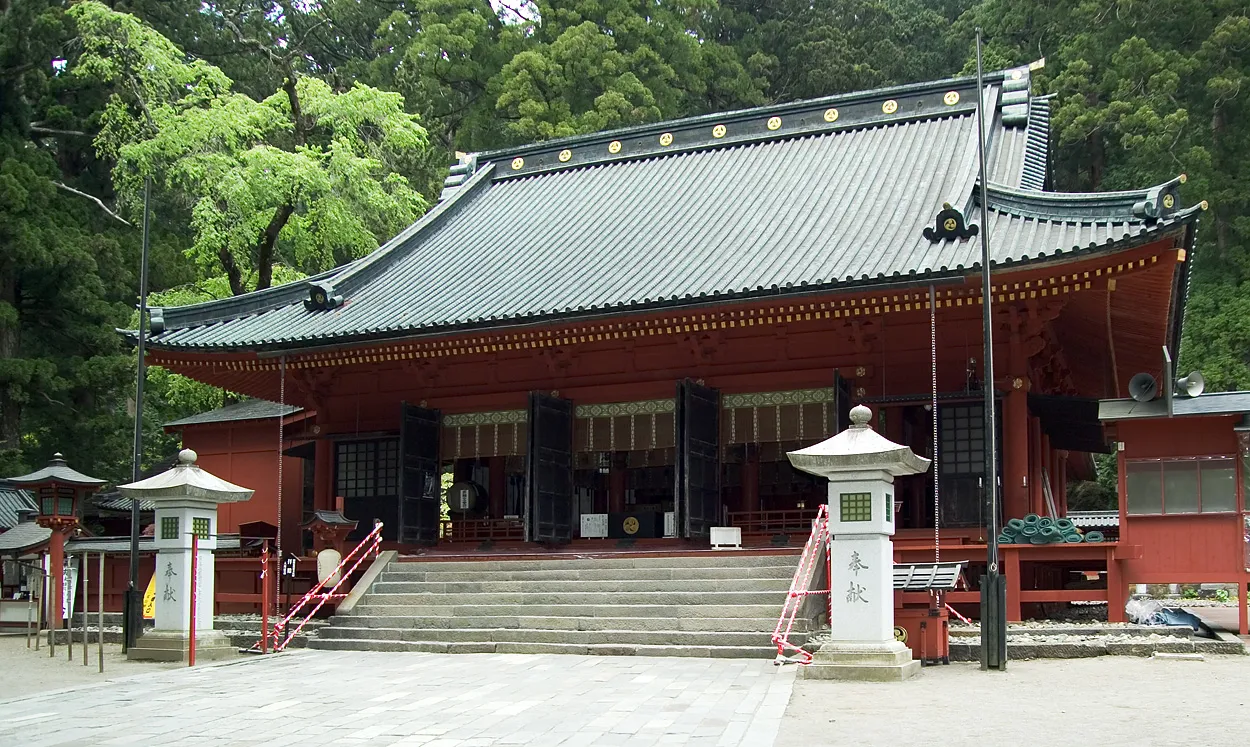
History
Nikko Futarasan Jinja traces its origins to 767, when the monk Shodo Shonin built a small shrine to the deity of Mt. Nantai — the sacred peak also known by its old name, Futarasan — marking the beginning of Nikko’s mountain-worship tradition. Shodo Shonin, a monk from the old province of Shimotsuke, went on to reach the summit of Mt. Nantai in 782, laying the foundation for the mountain-worship faith that treats Futarasan itself as the shrine’s sacred body (goshintai) to this day. As the ichinomiya, or highest-ranked shrine, of former Shimotsuke Province, it has been venerated since ancient times.
The shrine enshrines three deities together known as the “Futarasan Okami”: the father, Onamuchi no Mikoto; the mother, Tagorihime no Mikoto; and their son, Ajisukitakahikone no Mikoto. The shrine grounds sit immediately west of Nikko Toshogu, and as the guardian shrine of this land predating Toshogu’s founding in 1617, it forms the “two shrines, one temple” grouping together with Toshogu and Rinno-ji temple — inscribed in 1999 as part of the UNESCO World Heritage Site “Shrines and Temples of Nikko.” Where Toshogu is the newer shrine built to deify Tokugawa Ieyasu, Futarasan Jinja represents the original wellspring of faith in Nikko itself.
Highlights
At the rear of the grounds, the Shinen sacred garden (admission ¥300) is packed with highlights distinctive to a shrine famed for good relationships: the “Futara Reisen,” a spring said to hold miraculous power; the “Enmusubi no Sasa,” bamboo grass where visitors tie wishes for good relationships; the “Bake-doro,” a bronze lantern whose flickering flame at night is said to have once fooled samurai guards into thinking it was a ghost; the ornate Mikoshi-sha shrine-palanquin hall; and the Homotsuden treasure hall displaying shrine treasures.
In front of the sacred gate stands the “Meoto-sugi” (married-couple cedars), and facing it, three ancient cedar trunks joined at a single root known as the “Oyako-sugi” (parent-and-child cedars) — sacred trees beloved as fitting symbols for a shrine that enshrines a family of deities: father, mother, and son.
Visiting Tips
Visiting the shrine grounds alone takes about 30 minutes, but allow about an hour if you also tour the Shinen garden. Goshuin stamps are available at the shrine office on the grounds. Many visitors combine this shrine with the adjacent Nikko Toshogu and Rinno-ji temple as the “two shrines, one temple” circuit, and a combined admission ticket covering all three is available — well worth considering if you’re spending the day in Nikko.
Annual Festivals
- Yayoi Festival (April 13–17): A grand festival said to date back 1,200 years to the Jingo-Keiun era, when the shrine itself was founded. Eleven elaborately decorated “hana-yatai” floats, adorned with paper flowers of Yashio azalea, parade through the town to announce the arrival of spring.
- Mid-Autumn Festival (September): A rite of thanks for the autumn harvest.
- Year-End Purification Festival (December 31): A rite marking the close of the year.
- New Year’s Visits (January 1–3): The shrine draws large crowds alongside the neighboring Toshogu and Rinno-ji.
Nearby Food & Sightseeing
- Nikko Toshogu: Sitting right next door to Futarasan Jinja, this shrine enshrines Tokugawa Ieyasu and is famed for its lavishly decorated buildings — most visitors combine it with Futarasan Jinja as part of the “two shrines, one temple” circuit.
- Nikko-zan Rinno-ji: A venerable Tendai-sect temple that, together with Futarasan Jinja and Toshogu, forms the “two shrines, one temple” ensemble. Its Sanbutsudo hall houses three imposing gilded Buddha statues.
- Saryo Nirin: A restaurant near Toshogu, Rinno-ji, and Futarasan Jinja serving noodle dishes made with Nikko’s local yuba (tofu skin).
Frequently Asked Questions
- Q. What are the visiting hours?
- A. 8:00–17:00 from April to October, and 8:30–16:00 from November to March.
- Q. When is the goshuin office open?
- A. Around 9:00–16:00, for ¥500.
- Q. Is there parking?
- A. Yes, on-site parking is available (about 50 spaces, ¥500 per day for cars).
- Q. How is this shrine different from Nikko Toshogu?
- A. Futarasan Jinja traces its origins to 767, when the monk Shodo Shonin enshrined the deity of Mt. Nantai, making it older than Toshogu, which was founded in 1617. The two sit right next to each other and, together with Rinno-ji temple, form the "two shrines, one temple" ensemble at the heart of the UNESCO World Heritage Site "Shrines and Temples of Nikko."
- Q. How do I get there?
- A. About a 14-minute bus ride from Tobu or JR Nikko Station to the Taiyuin-Futarasan-jinja-mae stop, then a 1-minute walk.