History
Nitta Jinja stands on Mount Shinki (Shinkisan) in Miyauchi-cho, Satsumasendai, Kagoshima, and calls itself the “Ichinomiya of Satsuma Province.” It is read “Nitta Jinja” (the official site gives its English spelling as “NITTA JINJA” but does not print a kana reading; Japanese Wikipedia gives “Nitta-jinja” or “Niita-jinja”). Because shrines of the same name exist elsewhere, “Satsumasendai” is added to this page’s title.
According to the official site, Mount Shinki is a small turtle-shaped hill. The principal deity is Amatsuhidaka Hikoho no Ninigi no Mikoto (Ninigi), with Amaterasu Sumeomikami and Masaya Agatsu Katsuhayahi Ame no Oshihomimi no Mikoto as the two accompanying deities. The official history relates old traditions: the sun goddess Amaterasu ordered her grandson Ninigi to rule the earth and gave him rice ears (the “Yuniwa no Inaho no Shinchoku”), he descended to Takachiho-no-mine in Kirishima (the “Tenson Korin”), and after passing through Kasasa no Miya he came to the Sendai area and built a high hall called “Utena” there. The name Sendai is said to derive from this “Utena,” and the official site adds that “Nitta” (new rice field) carries the meaning that Ninigi drew water from the Sendai River and made new rice fields.
The tomb made when Ninigi died is today’s “Eno no Misasagi” (可愛山陵), and the worship of Ninigi there is said to be the beginning of Nitta Jinja. It is also handed down that there was originally no building and the mountain itself was the shrine. Per the official site, the name “Nitta-no-miya” first appears in old documents in the Heian period; after a fire in Joan 3 destroyed the buildings, the shrine was rebuilt on the present hilltop after consulting the court and the shogunate, the Shimazu lord Yoshihisa built the basis of the present buildings in the Keicho era, and in Meiji 18 it became a National Shrine of the Middle Rank (kokuhei chusha). Japanese Wikipedia gives the founding as Jinki 2 (725) while noting there is no firm documentation, and also records a medieval dispute with Hirakiki Shrine over the title of Ichinomiya.
Highlights
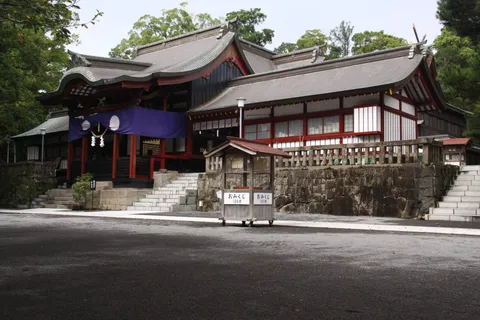
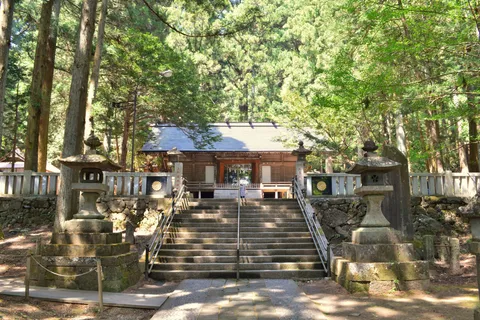
A large vermilion torii stands at the entrance to the approach, which leads up to the shrine buildings on the hill. The official site lists the grounds as including the main hall, the ceremonial hall, the imperial-envoy hall, the east and west inner gardens, Ukemochi Shrine, the sacred rice field and the treasure hall.
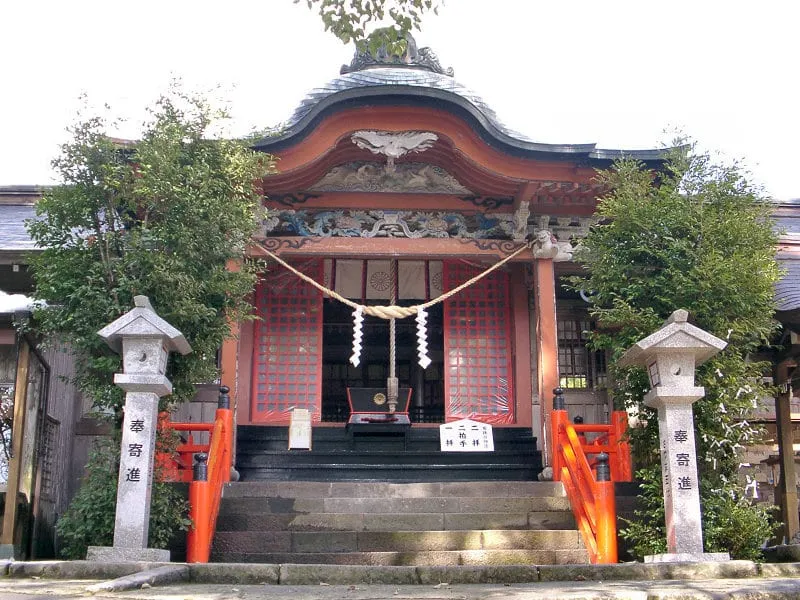
The official site’s list of cultural properties gives, as national Important Cultural Properties, the bronze mirrors (花鳥文様鏡, 秋草蝶鳥鏡 and 柏樹鷹狩鏡) and the Nitta Jinja documents; as prefectural tangible cultural properties, the main hall, worship hall, dance hall, imperial-envoy hall and the side shrines on both flanks; as prefectural intangible folk cultural properties, the yakko-furi dance and other performances tied to the rice-planting festival; and, at the city level, the great camphor tree (a natural monument) that is the sacred tree, among others. The official site says the treasure hall is open to the general public only on August 7 each year, at the Treasure Airing Festival (御宝物虫干祭).
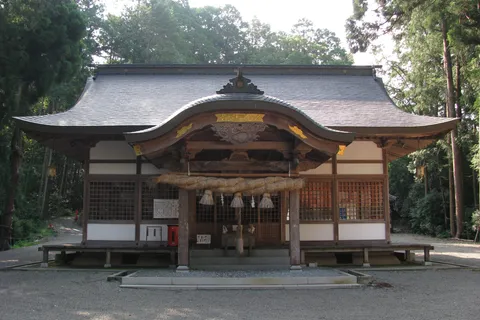
According to Japanese Wikipedia, the Eno no Misasagi is a burial mound behind the shrine buildings and is managed by the Imperial Household Agency. The table of contents of the Imperial Household Agency Archives and Mausolea Department’s bulletin also lists a survey report on fence repair work at this mausoleum. The third photo in this page’s gallery was uploaded by the photographer as this mausoleum (per the Wikimedia Commons description).
Visiting Tips
Reception for prayer services, goshuin and amulets is 9:00 AM–12:00 PM and 1:00–4:00 PM (last prayer reception at 3:45 PM). Prayers for household safety, traffic safety, purification from bad luck, safe childbirth, first shrine visits and Shichi-Go-San are taken on the day, and the official site says to allow about 20–30 minutes. For a car purification, park at the car purification area and go to the prayer reception to the right of the main hall. As the shrine’s blessings, the official site lists good fortune and prosperity, bountiful harvests, safe childbirth and traffic safety.
The goshuin fee is not stated on the official site. In 2026 the notices announced limited-edition goshuin such as a Year of the Horse design (from January 1), a seasonal cherry-blossom design (from March 14), a rice-planting festival design (May 30 to June 30) and a gold-foil special goshuin (from July 15, written on a separate sheet). From October 17, a spread-format goshuin book showing shrine maidens dancing kagura and the flowers of the four seasons is also announced. Distribution periods can change, so check the latest notices on the official site. (The official notices contain typos such as “Reiwa 8, 10th day 17th day,” with “day” written where the month should be; this page reads them as October 17 and so on, going by the day of the week.)
It is about 25 minutes on foot from Kami-Sendai Station on the Hisatsu Orange Railway, or about 10 minutes by taxi from Sendai Station on the Kyushu Shinkansen (official site). There are about 200 parking spaces in the grounds.
Annual Festivals
The main events below are taken from the official site’s annual event list and its 2026 notices. Dates change from year to year.
- Musha-sai and Nanakusa Mairi (January 7): A traditional archery rite praying for peace under heaven and bountiful harvests, performed with children aged seven from Mikuni Kindergarten and others. A target-breaking rite follows the shooting.
- Setsubun Yakuyoke Kaiun Kigan-sai (February): In 2026 the bean-throwing event was held only in the mornings (9:00 AM–12:00 PM) of February 1–3.
- Hayauma-sai (the spring equinox day): A festival praying for bountiful harvests, safety of cattle and horses and prosperity of commerce and industry, with an offering of bell-decked horses (shan-shan uma). In 2026 it was Friday, March 20.
- Nitta Hachiman Sakura Matsuri (early April): The front approach (Hachiman Baba) is known as a cherry-blossom spot, and night-cherry lanterns are lit.
- Otaue-sai (Sunday before the day of nyubai): A festival with yakko-furi and bo-odori offerings. In 2026 it was Sunday, June 7.
- Mikagami Sumashi-sai (July 28): Over 70 bronze mirrors from the treasure hall are offered before the deity, and children polish them one by one in a special rite.
- Treasure Airing Festival, 御宝物虫干祭 (August 7): The one day the treasure hall is open to the general public, per the official site.
- Annual festival (September 15): In 2026 it began at 10:30 AM.
- Shichi-Go-San (around November 15): Prayers are accepted from September.
- Niiname-sai (November 23): Scheduled for 10:30 AM in 2026.
Nearby Food & Sightseeing
The official site’s “Access” page introduces the following places as nearby sights.
- Satsuma Kokubunji Historic Park: According to the official site, a temple built following the edict issued by Emperor Shomu in Tenpyo 13 (741), with its founding estimated to be between the late Nara and early Heian periods.
- Sendai Magokoro Bungakukan: According to the official site, it exhibits literary and artistic materials centered on the writer Ton Satomi, as well as literary materials of Kaizosha.
- Sendai Great Tug-of-War (Sendai Otsunahiki): According to the official site, a traditional event held on the night of September 22 each year, in which 3,000 young people pull a great rope 365 m long and weighing 5 tons.
Frequently Asked Questions
- Q. What are the hours for prayers and goshuin?
- A. The official site lists reception for prayer services, goshuin and amulets as 9:00 AM–12:00 PM and 1:00–4:00 PM, with the last prayer reception at 3:45 PM (hours stated as effective from August 1, 2024). Because of the midday break, it is safest to avoid 12:00–1:00 PM. During festivals such as the annual festival and Niiname-sai, prayer requests are still taken at any time, but you will be asked to wait until the ceremony ends. Opening and closing times for the grounds are not stated on the official site.
- Q. Are there limited-edition goshuin, and how much do they cost?
- A. According to the official site's notices, in 2026 the goshuin reception issued limited-edition written goshuin on separate sheets: a Year of the Horse design (from January 1), a seasonal cherry-blossom design (from March 14), a rice-planting festival design (May 30 to June 30) and a gold-foil special goshuin (from July 15). Some of these have notices saying distribution has ended, so check the official site for what is currently available. From October 17, a spread-format goshuin book (with the 花鳥文様鏡 bronze mirror on the back) is also announced. Goshuin in your own regular book, with calligraphy, are also accepted. The fee is not stated on the official site.
- Q. How do I get there, and is there parking?
- A. The official site gives about 25 minutes on foot from Kami-Sendai Station on the Hisatsu Orange Railway, or about 10 minutes by taxi from Sendai Station on the Kyushu Shinkansen. The shrine grounds have about 200 parking spaces (no fee is mentioned). Temporary parking is set up for the rice-planting festival and the New Year period, and visitors who only want to look around are asked to use the "visitor parking."
- Q. What is the Eno no Misasagi (可愛山陵) said to be behind the shrine?
- A. The official site's history page says a tomb was built when Ninigi no Mikoto died, that it is today's "Eno no Misasagi" (可愛山陵) and that the worship of Ninigi at this place is said to be the origin of Nitta Jinja. According to Japanese Wikipedia, the Eno no Misasagi is a burial mound behind the shrine buildings and is managed by the Imperial Household Agency. The table of contents of the Imperial Household Agency's Archives and Mausolea Department bulletin also lists a fiscal 2023 report on an attended survey during fence repair work at the Amatsuhidaka Hikoho no Ninigi no Mikoto Eno no Misasagi (可愛山陵). As the mausoleum is on Imperial Household Agency land, please take care about entering restricted areas when you visit.
- Q. When is the rice-planting festival (Otaue-sai)?
- A. According to the official site, the Otaue-sai is held every year on the Sunday before the day of nyubai (the start of the rainy season). In 2026 it was Sunday, June 7, with the main ceremony at 9:00, yakko-furi offering at 9:30, bo-odori (staff dance) offering at 10:00, a ceremony at Ukemochi Shrine at 11:00, a procession to the sacred rice field at 11:25, and the rice-planting rite at 11:40. The yakko-furi and related performances are listed on the official site as prefectural intangible folk cultural properties. Dates change from year to year, so check the official site before you go.
Plan Your Visit
Before you go, you can book a stay and get your shrine-visit items ready.
Amazon links open Amazon.co.jp (Japan) in English; whether an item ships overseas depends on the product.
※ Contains ads (PR). Links open external sites such as Amazon, Rakuten, Trip.com and Booking.com.