History
Osaki Hachimangu’s origins trace back to the Heian period, when, according to shrine tradition, the shogunate general Sakanoue no Tamuramaro enshrined a divided spirit of Usa Jingu (in present-day Oita Prefecture) at Isawa Castle — present-day Mizusawa, Oshu, in Iwate Prefecture — as “Chinjufu Hachimangu.” Generations later, during the Muromachi period, the Osaki clan, who held the powerful position of shogunal deputy over the Oshu region, relocated this Hachiman shrine to their own domain, in present-day Tajiri, Osaki City, Miyagi Prefecture, giving rise to the name “Osaki Hachimangu.”
After the Osaki clan was dissolved by Toyotomi Hideyoshi in 1590, the region came under the control of Date Masamune. In 1604 Masamune began building a new shrine hall at the present site, northwest of Sendai Castle, inviting master craftsmen from Kyoto and the wider Kinai region — some of whom had previously worked in the service of the Toyotomi family. Construction was completed on August 12, 1607, and the shrine was thereafter venerated for more than four centuries as the guardian shrine of all Sendai, revered by Date Masamune himself, the successive lords of the Sendai domain, and the townspeople alike. The shrine formally adopted its present name, “Osaki Hachimangu,” in 1997.
Highlights
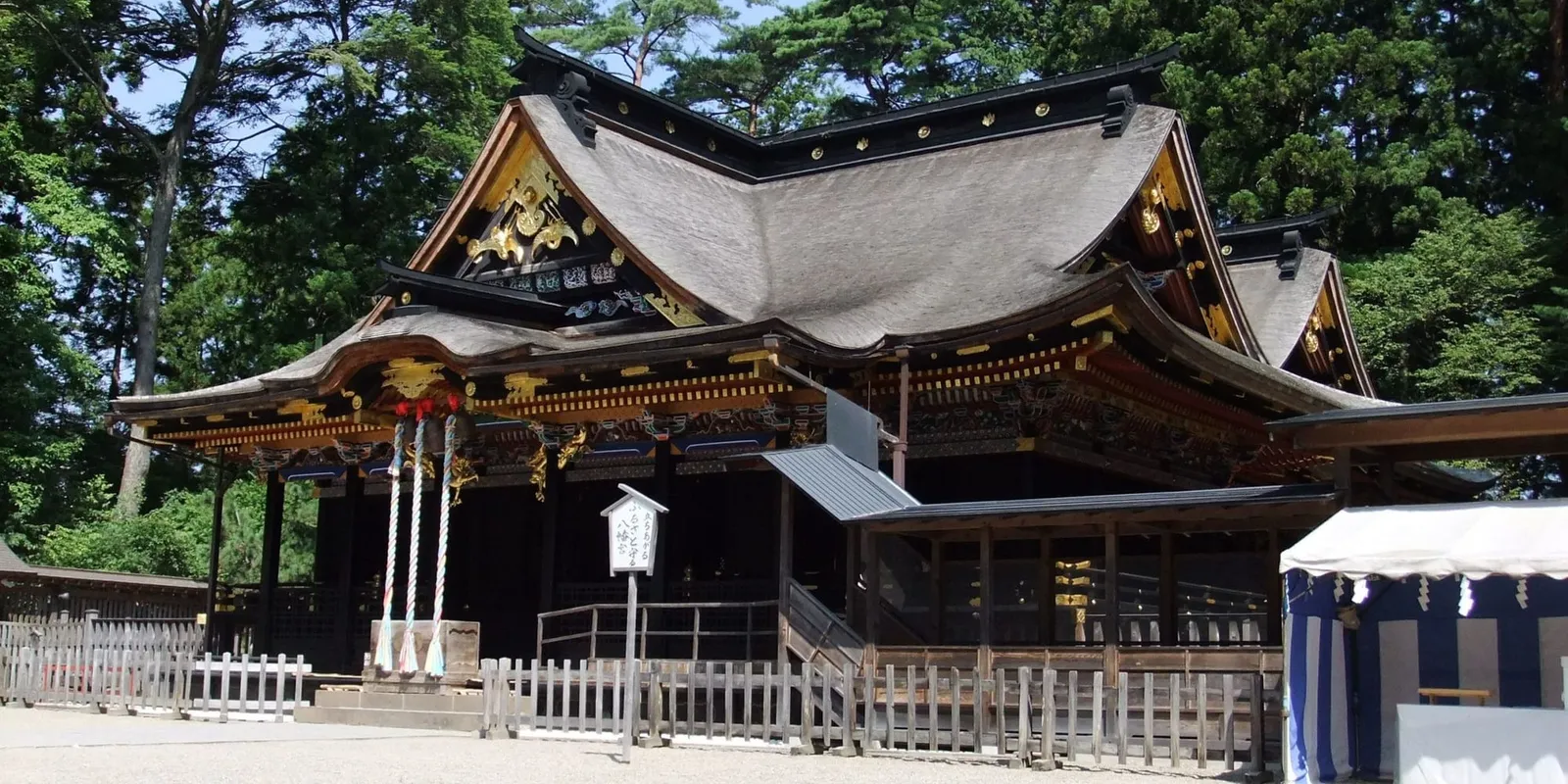
The centerpiece of Osaki Hachimangu is its National Treasure shrine hall — the honden (main sanctuary), ishi-no-ma (connecting hall), and haiden (worship hall) — built as a single continuous structure. This architectural form, in which the haiden and honden are joined by a lower connecting bay called the ishi-no-ma under one unbroken roofline, is known as “Gongen-zukuri” (also called “ishi-no-ma-zukuri”), and Osaki Hachimangu’s shrine hall is considered the oldest surviving example of the style in Japan. Said to have been modeled on the ornate mausoleum of Toyotomi Hideyoshi in Kyoto, its black-lacquered pillars, richly carved and gold-leafed ornamentation, and intricate metal fittings represent, in the words of architectural historians, “the finest of Momoyama-era craftsmanship” carried over from the Kyoto region to Sendai by the very artisans who worked on that era’s grandest buildings. First protected as a National Treasure under the old system in 1903 (later reclassified as an Important Cultural Property), the shrine hall was designated a National Treasure again, under the current system, on November 22, 1952. This same opulent Gongen-zukuri style is said to have gone on to shape later shrine architecture nationwide, most famously the lavishly decorated Nikko Toshogu shrine built to enshrine Tokugawa Ieyasu — making Osaki Hachimangu a pivotal early landmark in the history of Japanese shrine architecture.
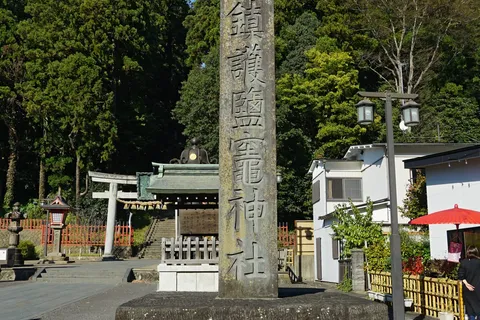
The large stone torii gate at the entrance and the quiet cedar-lined main and north approaches are also worth a visit, drawing worshippers and architecture enthusiasts alike throughout the year to see the National Treasure hall up close.
Visiting Tips
The shrine grounds are open 6:00–18:00, but the office for goshuin, amulets, and prayer reception closes earlier, at 16:00, so it’s best to allow enough time. Sendai Station is only about a 20-minute bus ride away, making the shrine an easy addition to a day of sightseeing in the city.
One of the shrine’s biggest draws is the chance to view the National Treasure hall up close, taking in the fine detail of its carvings and coloring. Free parking is available in front of the north approach for those arriving by car, though the shrine becomes extremely crowded on January 14 for the Dontosai fire festival, when public transport is strongly recommended instead.
Annual Festivals
- Dontosai / Matsutaki Festival (January 14): Miyagi Prefecture’s largest fire festival, in which New Year decorations and old amulets are burned to pray for good health and safety in the year ahead. With roughly 300 years of history, it’s famous nationwide for its “Hadaka Mairi” (naked pilgrimage), in which groups wrapped only in white sarashi cloth circle the sacred bonfire holding a lantern in the left hand and ringing a bell in the right — a scene that has come to symbolize a Sendai winter, drawing around 80,000 visitors each year.
- Grand Yakuyoke Prayer Festival (mid-January to around February): A festival dedicated to prayers for protection from misfortune in the year ahead.
- Annual Festival / Reitaisai (September): The shrine’s most important yearly rite, including a mikoshi procession.
- Shichigosan (November): Families visit to pray for the healthy growth of their children.
Nearby Food & Sightseeing
- The old castle-town streets near the north approach: The streets leading away from the north approach torii gate are lined with small restaurants and sweet shops, convenient for a stop before or after visiting the shrine.
- Jozenji-dori Avenue: Sendai’s signature tree-lined boulevard, famous for its rows of zelkova trees, easily reached from Osaki Hachimangu and lined with cafes and galleries popular for a stroll.
- Sendai Castle Ruins (Aoba Castle Ruins): The former site of the castle built by Date Masamune, featuring an equestrian statue of Masamune and an observation deck overlooking the city of Sendai. As another site closely tied to Masamune, it’s often visited together with Osaki Hachimangu.
Frequently Asked Questions
- Q. What are the visiting hours?
- A. The shrine grounds are open 6:00–18:00. The office where you can receive goshuin, amulets, and prayer services is open 9:00–16:00.
- Q. Can I get a goshuin here, and how much does it cost?
- A. Yes, you can receive up to five different goshuin: one for the main shrine (Osaki Hachimangu) and one each for the four subsidiary shrines on the grounds — Taigensha, Suwasha, Kashimasha, and Hokushinsha. The fee is by donation for all five, with no fixed amount specified.
- Q. How do I get to Osaki Hachimangu?
- A. Take a Sendai City Bus from bus stops 10, 15, or 16 at the west exit terminal of Sendai Station, about a 20-minute ride, and get off at the "Osaki Hachimangu-mae" stop, right by the shrine. The Loople Sendai sightseeing loop bus also stops there. By train, it's about a 12-minute walk from Tohoku-Fukushi-Daimae Station to the north approach, or about 15 minutes from Kunimi Station to the main approach, both on the JR Senzan Line.
- Q. Is parking available?
- A. Yes, free parking for worshippers is available in front of the north approach, with space for about 70 cars, 4 taxis, and 2 tour buses. It gets extremely crowded on January 14 for the Dontosai fire festival, when temporary park-and-ride lots and shuttle buses are arranged instead.
- Q. What is the Dontosai festival held here?
- A. Dontosai is a New Year's fire festival held every January 14 to burn the past year's New Year decorations and old amulets, praying for good health and safety in the year ahead. At Osaki Hachimangu it's known as the "Matsutaki Festival" and has roughly 300 years of history as one of Miyagi Prefecture's largest such events. Its best-known feature is the "Hadaka Mairi" (naked pilgrimage): groups of participants wrapped only in white sarashi cloth circle the sacred bonfire carrying a lantern in the left hand and ringing a bell in the right — a scene famous nationwide as a symbol of Sendai's midwinter, drawing around 80,000 visitors each year.