History
Owari Okunitama Shrine stands in Inazawa, Aichi. The official site gives its reading as “Owari Okunitama-jinja,” and it is commonly called “Konomiya” or “Konomiya Shrine” (per the site’s own page description). The official site writes the name with the older character 國 for “kuni.” The enshrined deity is Owari Okunitama no Kami; the official site explains that the ancestors of the people of Owari settled and cleared this land and revered, as a deity, the great spiritual power of the land from which their livelihood comes.
According to the official history, the shrine has been widely worshipped as the guardian of the Owari region, protector of agriculture and commerce, and a deity who wards off misfortune. In the Nara period it stood next to the provincial government office (kokuga), so it was designated the sosha (provincial head shrine) of Owari Province, and the provincial governor himself conducted its rites; this is explained as the origin of the common name “Konomiya.” The founding year is not stated on the official site. The official site also describes the “Iwakura,” five large natural stones standing in a circle against the main hall, as the oldest, primitive ritual site from before shrine buildings were built, which it says shows that the shrine has existed on this land since long ago.
Highlights
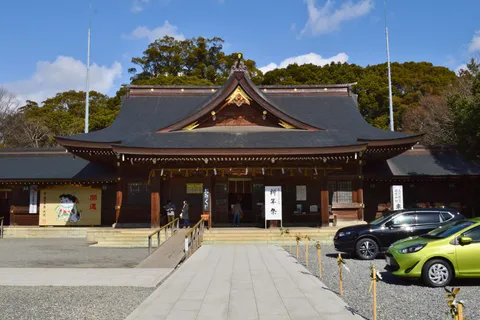
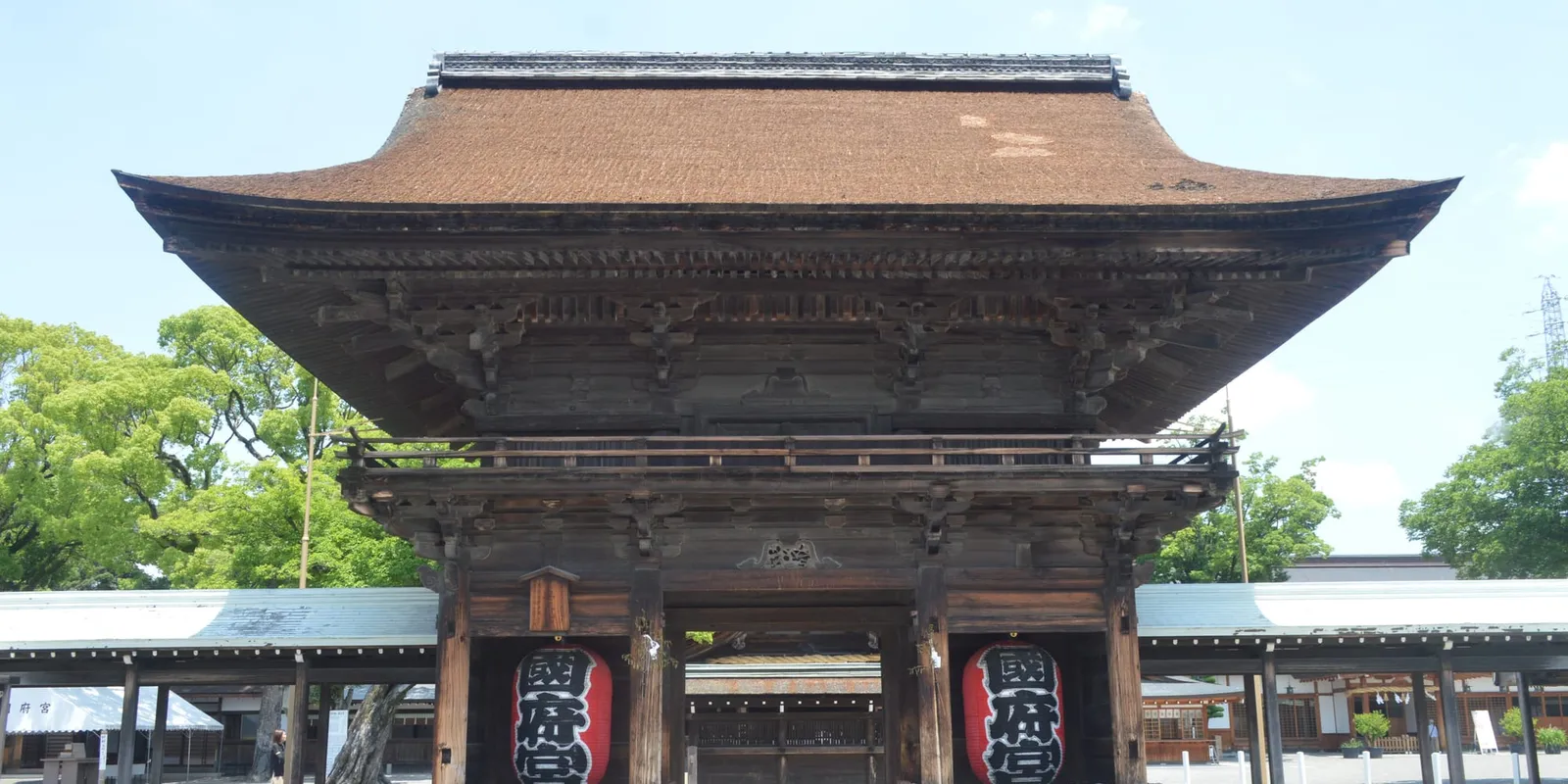
The main hall is in nagare-zukuri style and the worship hall is gabled (kirizuma-zukuri), with the main hall, passage, ritual-text hall, east and west cloisters, worship hall and two-story gate lined up in the layout known as the “Owari style” (official site). The gate is said to date from the early Ashikaga period and the worship hall from the early Tokugawa period, and both are national Important Cultural Properties. The precinct guide gives the designation as 1955 (Showa 30), and says the gate’s upper story was altered in a major dismantling repair in 1646 (Shoho 3), so it combines the building styles of two eras.
Among the sacred treasures, the Onaru-suzu (an iron bell used in the Naoi Shinji, dated roughly to the Nanbokucho to Muromachi periods), the ceramic lion-dogs (Muromachi period) and the lion mask (roughly Nanbokucho to Muromachi periods) are designated cultural properties of Inazawa City. The grounds also hold the Naoiden, where the shin-otoko stays in seclusion for three days and nights before the Hadaka Matsuri, six auxiliary shrines, and sukiya-style tea houses (三笑亭 and 半床庵) with a garden.
Visiting Tips
Prayer services are accepted every day, 9:00 AM–4:00 PM (open all year, no reservation), and prayers for protection from misfortune, car purification, household safety, academic success and others start from ¥7,000 (official site). The official site explains that Konomiya holds no Setsubun event, with the Naoi Shinji (Hadaka Matsuri) taking its place, and says that a very large number of people come for protection-from-misfortune prayers between New Year and the Hadaka Matsuri. Car purification is held on the east side of the worship hall, and on crowded days such as January 1–7 and the Naoi Shinji period, visitors are asked not to drive in front of the worship hall.
Amulets include the Yakuyoke-mamori for protection from misfortune (¥500), a bagged version (¥1,000), traffic-safety, health and exam charms and more. The “Naoigire,” a charm tied to the Hadaka Matsuri (five strips for ¥500), is available year-round (official site). Limited-edition special goshuin are sometimes announced, but the fee and hours for the regular goshuin are not stated on the official site. A goshuin book is ¥2,000.
It is a 3-minute walk from the north exit of Konomiya Station on the Meitetsu Main Line, or 15 minutes on foot from Inazawa Station on the JR Tokaido Line. For three days before and after the Hadaka Matsuri the area around the shrine is under traffic control and, per the official site, the shrine’s parking lot cannot be used at all.
Annual Festivals
- Naoi Shinji (Hadaka Matsuri) (Friday, February 19, 2027): According to the official site, it is held on the 13th day of the old lunar New Year. It is said to have begun in 767 (Jingo-keiun 1), when Empress Shotoku ordered prayers against epidemics at provincial temples and the Owari provincial governor prayed at this shrine, the sosha. Based on the belief that touching the naoi-nin (shin-otoko), chosen by prayer and by lot, wards off misfortune, crowds of naked men press around him. The ceremony begins at 3:00 PM, the scrum starts around 4:00 PM (it varies by year), and the highlight is the hour or so until the shin-otoko is taken into the Naoiden.
- Related events to the Naoi Shinji (2027): Marker-post setting and the selection of the naoi-nin on Feb 8, the offering of the great mirror rice cake (50 bales) on Feb 18, the Yo-Naoi Shinji at 3:00 AM on Feb 20 (the shin-otoko is driven out of the grounds carrying the “earth rice cake,” which is then buried), the Matoi Shinji on Feb 23, and the Naoi tea gathering on Feb 28 (dates per the official site).
- Naoi-zasa and sasa cloth: People who cannot go naked can obtain a cloth (“sasa-yo nuno,” ¥500 each) inscribed with their prayers, name and age, available for about one month, which naked men tie to the “naoi-zasa” bamboo and dedicate at the shrine.
- Naoi Yakuiwai-ko: A Yakuiwai-ko service has been held on the 13th of each month since 1947 (Showa 22); the prayer fee is ¥300 per person (official site).
- Annual festival (May 6) and the plum-wine rite 梅酒盛神事 (Uma Matsuri, “horse festival”): Per the official 2026 annual schedule.
- Rice-planting festival (June 28) and the 除疫祭並輪くぐり (July 31): Per the 2026 annual schedule.
- Osuzu-sai (November 1–3): Prayers for the growth of children born between October 1 last year and September 30 this year (official site).
- Niiname-sai (November 23) and the Great Purification with New Year’s Eve ceremony (December 31): Per the 2026 annual schedule.
Dates change from year to year, so check the “annual festivals” page and news section on the official site for the latest.
Nearby Food & Sightseeing
- Inazawa City Ogisu Memorial Art Museum (稲沢市荻須記念美術館): A museum of works by Takanori Ogisu, a painter from Inazawa who worked mainly in Paris (per the Aichi prefectural tourism site). Access by Meitetsu bus from Konomiya Station is suggested. It is closed on the day of the Hadaka Matsuri.
- Owari Kokubunji Ruins (尾張国分寺跡): An ancient temple site in Yawase-cho, Inazawa, designated a national Historic Site in 2012 according to the Agency for Cultural Affairs’ database. It is away from the shrine, so check the route on a map app.
Frequently Asked Questions
- Q. When is the next Konomiya Hadaka Matsuri?
- A. The Hadaka Matsuri page on the official site lists Friday, February 19, 2027 (Reiwa 9). The Naoi Shinji begins at 3:00 PM. Because it is held every year on the 13th day of the old lunar New Year, the date on the modern calendar changes (in 2026 the official annual schedule gives March 1). Traffic controls and the day's flow are announced each year, so check the news section of the official site.
- Q. What are the prayer hours, and do I need a reservation?
- A. According to the official site, prayer services are accepted every day of the year from 9:00 AM to 4:00 PM, and reservations are not accepted. Prayers for protection from misfortune, car purification, household safety, academic success and more start from ¥7,000. Visiting hours for the grounds themselves are not stated on the official site.
- Q. Can I get a goshuin?
- A. The official site carries announcements of limited-edition special goshuin. The 2026 New Year goshuin was ¥500, and the 2026 Hadaka Matsuri embroidered goshuin and see-through special goshuin were ¥1,000 each (per the official announcement images). The fee and hours for the regular goshuin are not given on the official site. The goods list shows a goshuin book at ¥2,000.
- Q. How do I get there, and is there parking?
- A. It is a 3-minute walk from the north exit of Konomiya Station on the Meitetsu Main Line, or a 15-minute walk from Inazawa Station on the JR Tokaido Line (official site). The shrine has a parking lot, but its capacity and fees are not stated on the official site, and it gets crowded around New Year and the Hadaka Matsuri. For three days before and after the festival the area is under traffic control and the shrine lot cannot be used at all, so visitors are asked to take public transport.
- Q. Does the shrine have any Important Cultural Properties?
- A. Yes. According to the official site, the two-story gate (romon) and the worship hall (haiden) are national Important Cultural Properties, and the precinct guide says they were designated in 1955 (Showa 30). The sacred treasures Onaru-suzu (an iron bell used in the Naoi Shinji), a ceramic pair of lion-dogs and a lion mask are designated cultural properties of Inazawa City.
Plan Your Visit
Before you go, you can book a stay and get your shrine-visit items ready.
Amazon links open Amazon.co.jp (Japan) in English; whether an item ships overseas depends on the product.
※ Contains ads (PR). Links open external sites such as Amazon, Rakuten, Trip.com and Booking.com.