History
Toga Shrine (Toga-jinja) stands in Ichinomiya-cho, Toyokawa, Aichi, and calls itself the Ichinomiya (first-ranked shrine) of Mikawa Province. The official site names Onamuchi no Mikoto as the enshrined deity, also known as Okuninushi no Mikoto. It describes benefits including matchmaking, traffic safety, prosperity of the household and the removal of misfortune.
According to the official site, the Satomiya was enshrined in Taiho 1 to 4 (701–704), and the history of faith here spans 1,300 years. The “Mikawa-no-kuni Ichinomiya Toga Daibosatsu Goengi” (dated Tensho 2), which the site cites, says that in the Taiho era an imperial envoy was sent to Mt. Engan to pray for Emperor Monmu’s recovery from illness; guided by an old man, he saw the emperor recover, and the old man then asked to settle at the foot of the mountain, from which the shrine was founded. Another source, the “Tajima Zoku Fudoki,” says that Onamuchi no Mikoto came to Mikawa from the Akabuchi shrine in Asago District, Tajima Province, and settled on Mt. Motomo (Mt. Hongu) as the place where he would “stay” (the “toga” of the shrine’s name). Both are the shrine’s own accounts of its origins and are not presented as established history.
On rank, the official site says the shrine was granted Junior Fifth Rank, Lower Grade in Kasho 3 under Emperor Montoku and Junior Fourth Rank, Upper Grade in Jogan 18. In the Heian period it was listed in the Engishiki and became the “Ichinomiya,” the shrine Mikawa’s provincial governors visited first. It enjoyed the patronage of nearby feudal lords in the Edo period, was granted Senior First Rank in Bunsei 10, and in Meiji 4 (1871) was ranked as a lesser national shrine (kokuhei shosha).
Highlights
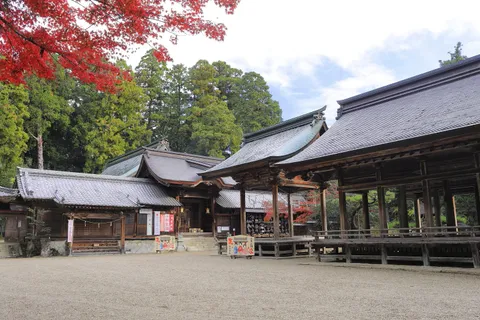
The shrine’s defining feature is the “nisho ittai” faith of honoring one deity in two places. The Satomiya, where the buildings stand, is a traditional cypress-wood structure in a sacred grove of large zelkova and camphor trees, with cherry blossoms and autumn leaves marking the seasons. The Okumiya is at the summit of Mt. Hongu (789 m). The official site describes the mountain as a sacred peak where Onamuchi no Mikoto has been said to rest since ancient times, with ancient ritual sites scattered over it and huge boulders and giant trees, including a great cedar sacred tree, worshipped as iwakura and iwasaka (sacred rock seats and boundaries).
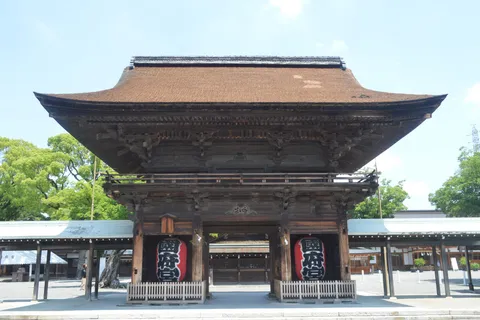
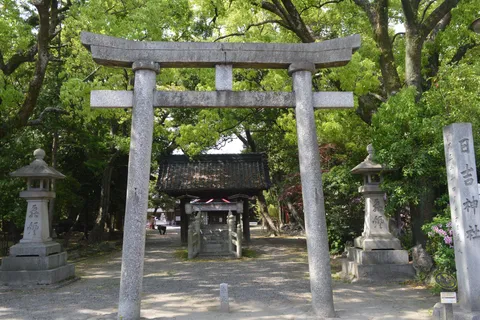
The Satomiya grounds include the front sacred gate, the front torii, the guest hall and the drum tower, along with the auxiliary shrine Mikawa Ebisu-sha and sub-shrines such as Hachimangu, Yatsukaho Shrine, Akiba Shrine and Gokoku Shrine. There are also five “sacred stones” (sazare-ishi, shinki-seki, hinode-ishi, shincho-seki and setake-ishi), according to the Satomiya stroll page on the official site. Cultural-property designations could not be confirmed from the official pages consulted, so none are listed here.
Visiting Tips
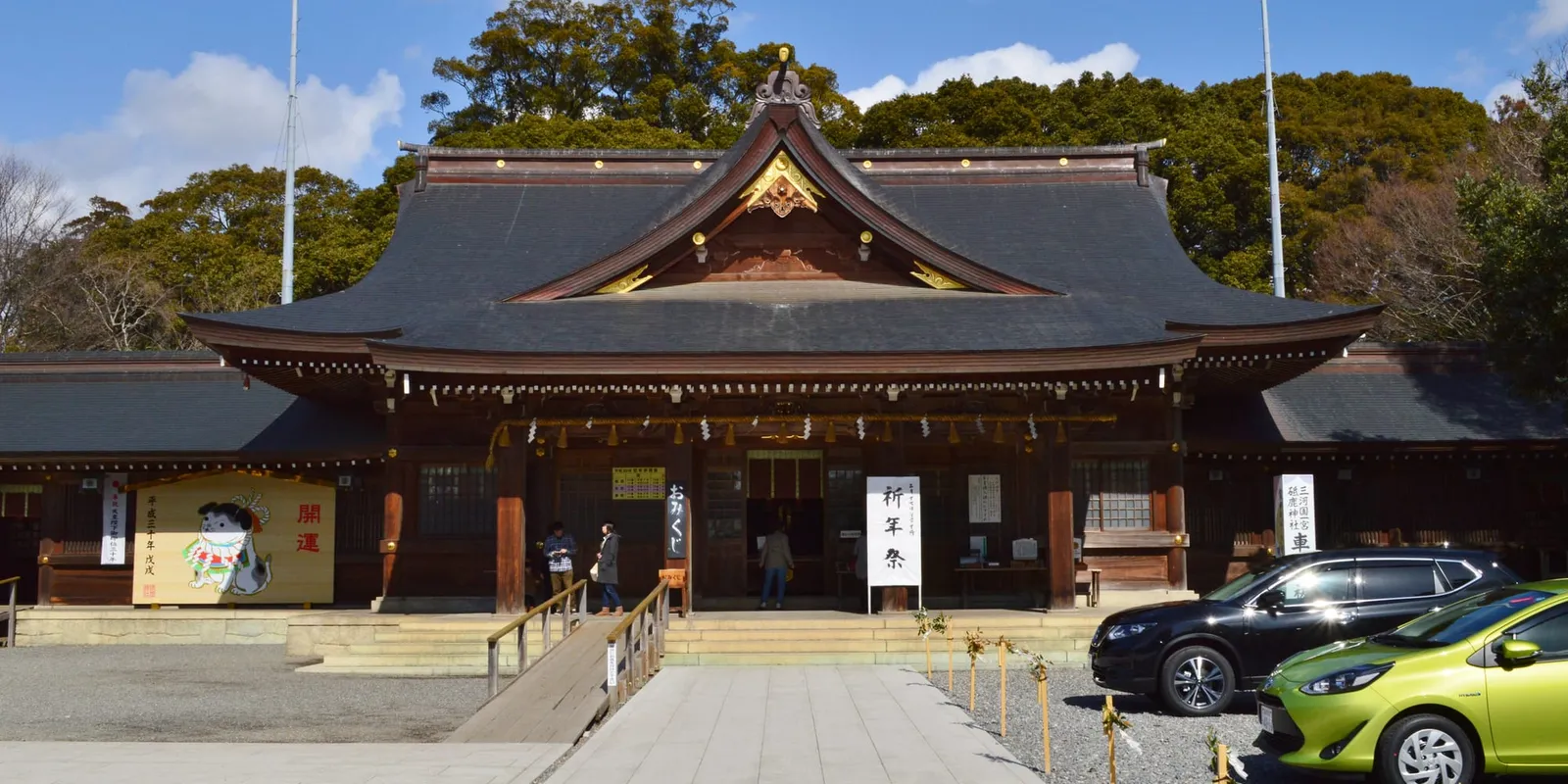
The Satomiya is open every day of the year with free admission. Amulets and goshuin are handled 8:30 AM–4:30 PM. The official site lists the etiquette as purifying your hands and mouth at the temizu, then bowing twice, clapping twice and bowing once. Prayer services are accepted at the guest hall to the left of the worship hall, 9:00 AM–3:30 PM, with the prayer fee starting from ¥6,000 (the amounts for each type of prayer are to be confirmed at the guest hall). The types listed include household safety, traffic safety, protection from misfortune, good matches and exam success, as well as safe childbirth and Shichi-Go-San. For a car-safety blessing, enter by the vehicle entrance at the front gate and park at the vehicle purification area.
For goshuin, bring your goshuin book to the shrine office or the guest hall. The fee is not stated on the official site. The Okumiya is at the summit and has its own address (4 Motomiya-shita, Kaminagayama-cho, Toyokawa). Because the official site gives no visiting hours or hiking-trail guidance for it, it is safest to phone the shrine (0533-93-2001) beforehand if you plan to climb. Individuals may take photos on the grounds, but commercial photography is prohibited except by the designated photo studio (per the official site).
Annual Festivals
Selected events from the official annual schedule (times as given on the site):
- New Year’s Day festival, 歳旦祭 (January 1): 6:00 AM, Satomiya. Includes an offering of rice from parishioners.
- Rice-field ritual, 田遊祭 (January 3): 2:30 PM, Satomiya. A rite praying for a good harvest, presented as a performance of rice farming.
- Kayuura Festival, 粥占祭 (January 15): 8:00 AM, Okumiya. A divination with rice porridge to foretell the year’s weather and crops.
- Setsubun-sai (the day before Risshun): Satomiya. The official site gives February 3 (Tuesday) for 2026.
- Grand Annual Festival (May 3–5): On the 4th, the annual rite at 10:00 AM, a lion dance and mikoshi procession at 2:00 PM, and yabusame mounted archery at 4:00 PM. At 8:00 AM on the 4th there is also a rite in which the horses are purified in the Toyokawa River (流鏑馬祓).
- Nagoshi no Oharae (June 30): 2:00 PM at the Okumiya and 4:00 PM at the Satomiya. People pass through a ring of straw to be purified.
- Autumn festival of the Hongu-ko, 本宮講 (last Sunday of October): 11:00 AM, Okumiya.
- Ebisu-ko Taisai (November 20): Satomiya. Prayers for business prosperity and household safety.
- Shichi-Go-San visits (November 1–30): Satomiya.
- Niiname-sai (November 23): 10:00 AM, Satomiya.
- Toshikoshi no Oharae and Joya-sai (December 31): 4:00 PM, Satomiya.
Dates can change from year to year, so check “Festivals and Events” on the official site for the latest.
Nearby Food & Sightseeing
- Toga Shrine Okumiya (summit of Mt. Hongu): The Aichi prefectural tourism site “Aichi Now” describes Mt. Hongu as the highest mountain in Toyokawa at 789 m, with the Okumiya of Toga Shrine, the Ichinomiya of Mikawa, at its summit. According to the official site, the Okumiya is about 50 minutes by car from Toyokawa IC.
- Honnoyu (Natural Hot Spring): Per “Aichi Now,” a day-use hot spring at the foot of Mt. Hongu, with an outdoor carbonated bath, medicinal baths and a bubble bath. A place to rest after a climb or a stroll.
- Toyokawa Inari (Toyokawa-kaku Myogon-ji): According to “Aichi Now,” a Soto Zen temple whose approach town is known for walk-and-eat “Toyokawa inari sushi.” The same site says the grounds hold the Reiko-zuka, with more than 1,000 stone fox statues.
Frequently Asked Questions
- Q. What are the visiting hours of Toga Shrine?
- A. The official site says the Satomiya is open every day of the year and free to visit. Amulets and goshuin are handled 8:30 AM–4:30 PM. Prayer services are accepted at the guest hall to the left of the worship hall, 9:00 AM–3:30 PM. Visiting hours for the Okumiya are not stated on the official site.
- Q. Can I get a goshuin at Toga Shrine?
- A. Yes. According to the official site, you bring your goshuin book to the shrine office or the guest hall; they are handled 8:30 AM–4:30 PM. The fee is not stated on the official site. The site says the Satomiya goshuin is silver and the Okumiya goshuin is gold, but it does not make clear whether this applies only to the limited New Year goshuin (loose sheets, limited quantities) or to the regular ones as well.
- Q. How do I get there, and is there parking?
- A. The Satomiya is about a 5-minute walk east of the exit of Mikawa-Ichinomiya Station on the JR Iida Line, or about 5 minutes by car from Toyokawa IC on the Tomei Expressway (official site). Parking is free, with about 30 spaces at the front gate and about 170 at the west gate, plus temporary parking at New Year. The Okumiya is about 50 minutes by car from Toyokawa IC and has a free lot (number of spaces not stated).
- Q. What is the Okumiya, and how does it differ from the Satomiya?
- A. According to the official site, Toga Shrine honors Onamuchi no Mikoto in two places, the Satomiya, where the shrine buildings stand, and the Okumiya at the summit of Mt. Hongu (789 m), in a form called "nisho ittai" (two places, one entity). During the Taiho era (701–704), the shrine on the summit became the Okumiya and the one built at the foot became the Satomiya, together forming one shrine. The Okumiya is in Kaminagayama-cho, Toyokawa, so its address differs from the Satomiya's.
- Q. When is the Grand Annual Festival?
- A. In the official annual schedule the Grand Annual Festival (Reitaisai) runs May 3–5. On the 4th, the annual rite is at 10:00 AM, a procession with a lion dance and mikoshi at 2:00 PM, and the yabusame mounted archery at 4:00 PM. Times and content can change from year to year, so check "Festivals and Events" on the official site before you go.
Plan Your Visit
Before you go, you can book a stay and get your shrine-visit items ready.
Amazon links open Amazon.co.jp (Japan) in English; whether an item ships overseas depends on the product.
※ Contains ads (PR). Links open external sites such as Amazon, Rakuten, Trip.com and Booking.com.