History
Ogamiyama Jinja is an ancient shrine, recorded in the Engishiki shrine register, that venerates Mount Daisen (1,729 meters) — the highest peak in the Chugoku region and the symbolic mountain of old Hoki Province (western Tottori) — as its sacred object of worship. The exact founding date is unknown, but tradition holds that monks from the Tendai temple Daisenji began climbing Mount Daisen for Shugendo mountain-ascetic training in the late Heian period, establishing a simple worship site at the summit. From there, mountain worship centered on Daisen itself grew together with Shugendo practice centered on Daisenji, and the shrine came to be honored as the second-ranked shrine (Ni-no-Miya) of Hoki Province.
One notable historical episode: in 1333, Emperor Go-Daigo, having just escaped exile on the Oki Islands, is said to have prayed here for the downfall of the Kamakura shogunate. During the Edo period, because the mountaintop shrine (used only in summer) became impossible to maintain through the heavy winter snows, a “winter shrine” was established at the mountain’s base. After several relocations, this lower shrine settled at its present site in Yonago’s Odaka district in 1653.
The 1875 Meiji-era edict separating Shinto and Buddhism formally cut ties with Daisenji, reorganizing the valley shrine into “Ogamiyama Jinja Honsha” and the mountaintop shrine — with its Buddhist elements removed — into “Ogamiyama Jinja Okunomiya,” the two-site structure that stands today.
The Enshrined Deity
The enshrined deity is Onamuchi no Kami, a youthful name for Okuninushi no Kami, the great nation-building deity of the Kojiki and Nihon Shoki. The Honsha writes the name with a slightly different kanji variant (Onamuji no Kami), though it refers to the same deity. Onamuchi no Kami is venerated for a wide range of blessings, including recovery from illness, abundant harvests, livestock health, traffic safety, good fortune, victory in competition, and good relationships.
Honsha and Okunomiya — Two Sites at the Heart of Mount Daisen Worship
The key to understanding Ogamiyama Jinja is that it isn’t a single building, but two linked sites of worship: the Honsha at the mountain’s base and the Okunomiya partway up its slope.
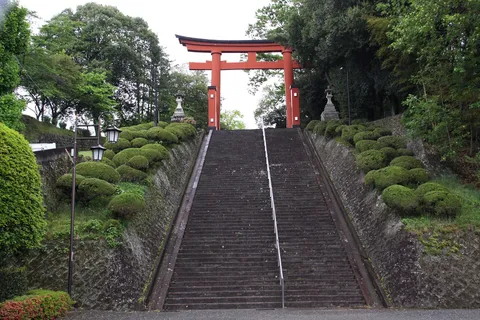
- Honsha (main shrine): Located in Odaka, at the foot of Mount Daisen in Yonago City — the site formerly known as the “winter shrine.” Well served by JR Hoki-Daisen Station and the Yonago Interchange, it can be visited comfortably year-round, and most visitors come here. Free parking for about 50 vehicles is available on the grounds.
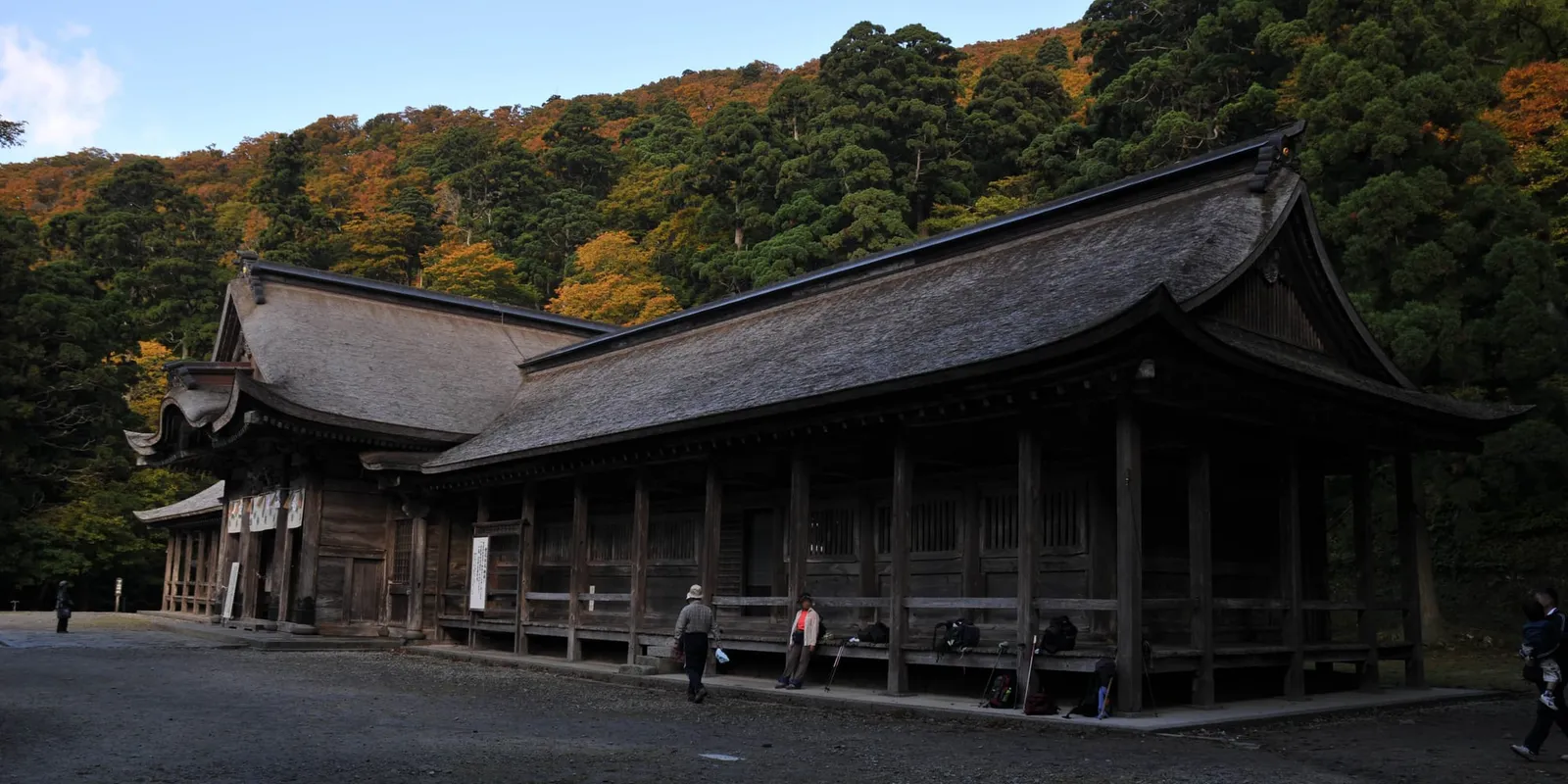
- Okunomiya (inner shrine): Located on Mount Daisen’s northern slope at roughly 900 meters elevation, this was the shrine’s original summer-season center of worship. Its main hall, offering hall, and worship hall are built in the gongen-zukuri style typical of the Shinto-Buddhist syncretic era, and are said to form one of the largest such structures in Japan — all nationally designated Important Cultural Properties. The shrine gate, whose doors open inward because its securing bar sits on the outside (earning it the nickname “reverse gate” or “backward gate”), is a Tottori Prefecture-designated protected cultural property in its own right. For a deeper sense of Mount Daisen’s mountain-worship tradition, the Okunomiya is well worth the extra walk.
Both sites venerate the same deity, but understanding that the Okunomiya developed historically as the “true” center of worship, with the Honsha serving as its winter substitute, adds real depth to a visit to either one.
Japan’s Longest Stone-Paved Approach Path
No visit to the Okunomiya is complete without its roughly 700-meter stone-paved approach path, running from the Daisenji temple town entrance up to the shrine itself. Paved with natural stones, it’s said to be the longest approach of its kind in Japan, with its present form dating to the Kansei era (1789-1800). Also known as the Goko Sando (“Imperial Procession Path”), this stately, cedar-lined walkway passes the ruins of old monks’ lodgings, a mid-Edo-period cliff-carved Jizo statue, and a bronze torii relocated from elsewhere, with a spring of sacred water (goshinsui) bubbling up along the way.
Walking over the natural, often moss-covered stones makes for a striking scene in fresh spring greenery or autumn foliage season, but the path becomes genuinely slippery in rain or during winter snow and ice — sturdy, comfortable walking shoes are strongly recommended.
Mount Daisen and Its Shugendo Heritage
Mount Daisen has been revered as a sacred, kami-inhabited mountain since at least the 8th century, and the Okunomiya itself grew directly out of its history as a training ground for Daisenji’s mountain ascetics. During the era of Shinto-Buddhist syncretism, Daisenji and Ogamiyama Jinja formed a single sphere of worship, with many Shugendo practitioners and warrior-monks traversing the mountain’s steep paths in pursuit of ascetic training. Though formally separated by the Meiji-era split of Shinto and Buddhism, that older syncretic and Shugendo heritage still survives visibly today — in the gongen-zukuri architecture of the shrine buildings, and in the old monks’-lodging ruins and cliff-carved Buddhist images that remain along the stone-paved approach path.
Annual Festivals
- Daisen Natsuyama-biraki (Mountain-Opening Festival, first Saturday and Sunday of June): Ogamiyama Jinja’s largest annual event, praying for climbers’ safety as Mount Daisen’s summer climbing season opens. On the eve of the festival, a torch-lit procession of roughly 2,000 torches winds from the Okunomiya down to a special venue at Daisenji’s Bakuroza, and the next day a ceremony is held at the summit of Mount Daisen.
- Koshiki-sai (an ancient rite including the Shinsui-kumitori and Mohitori rituals): A long-observed ceremony centered on drawing Mount Daisen’s sacred water.
- Honsha Reitaisai (Annual Festival): October 9
- Okunomiya Reitaisai (Annual Festival): September 24
Goshuin
A goshuin can be received at both the Honsha and the Okunomiya, each for a fee of ¥300. Reception hours at both run roughly 9:00 AM to 4:00 PM, though the Okunomiya — located partway up the mountain — can see its hours shift with the weather or snow conditions. Because the Honsha and Okunomiya each maintain their own shrine office, collecting a goshuin from both means visiting each location in turn.
Access & Visiting Information
The Honsha (1025 Odaka, Yonago, Tottori) is about a 5-minute drive from JR Hoki-Daisen Station, about a 10-minute drive from JR Yonago Station, and about 5 minutes by car from the Yonago Interchange on the Yonago Expressway. By public transport, take a Nippon Kotsu bus bound for Daisenji from Yonago Station and get off at the “Odaka” stop, then walk about 5-10 minutes. Free parking for about 50 vehicles, bus-accessible, is available on the grounds.
The Okunomiya (Daisen, Daisen Town, Saihaku District, Tottori) is reached by a roughly 15-20 minute walk up the stone-paved approach path from the Daisenji temple town / approach entrance. By car, park at the Bakuroza or Nankokawara lots near the Daisenji bus terminal and continue on foot from there. Note that these lots charge a parking fee during the ski season, roughly late December through the end of March. It’s about 40 minutes by car or bus from JR Yonago Station.
The grounds at both sites are free to visit and open all day, though goshuin and amulets are only available roughly 9:00 AM to 4:00 PM.
Nearby Food & Sightseeing
- Daisenji Temple: The historic Tendai temple that was once one with the Okunomiya before the Meiji-era separation of Shinto and Buddhism. The stone-paved approach path to the Okunomiya doubles as Daisenji’s own approach, and many visitors combine the two as the heart of Mount Daisen’s worship tradition.
- Kaike Onsen: A seaside hot spring resort in Yonago, close to the Honsha. A relaxing way to unwind after a visit to the shrine or Mount Daisen, with views out over the Sea of Japan.
- Daisen Makiba Milk no Sato: A dairy-farm tourist facility at the foot of Mount Daisen, known for rich soft-serve ice cream and dairy products from Daisen Dairy. An easy, popular stop in Daisen Town after a visit to the Okunomiya.
Frequently Asked Questions
- Q. I hear Ogamiyama Jinja has both a Honsha and an Okunomiya. Which one should I visit?
- A. Ogamiyama Jinja is made up of two linked sites: the Honsha (main shrine) in Odaka, at the foot of Mount Daisen in Yonago City, and the Okunomiya (inner shrine) partway up the mountain at roughly 900 meters elevation, in Daisen Town. The Honsha is easy to reach year-round, and a standard visit is perfectly complete there. The Okunomiya, however, is where you'll find the shrine's standout features: one of Japan's largest gongen-zukuri shrine halls (a nationally designated Important Cultural Property) and the roughly 700-meter natural stone-paved approach path said to be the longest of its kind in Japan. If you have the time and stamina, visiting both gives the fullest picture of Mount Daisen's mountain-worship tradition.
- Q. Can I get a goshuin here, and how much does it cost?
- A. Yes — a goshuin is available at both the Honsha and the Okunomiya, each for a fee of ¥300. Reception hours at both run roughly 9:00 AM to 4:00 PM, though at the Okunomiya — located partway up the mountain — those hours can shift with weather and snow conditions. Since the Honsha and Okunomiya each have their own shrine office, collecting goshuin from both means visiting each location separately.
- Q. What is the famous stone-paved approach path, and is it hard to walk?
- A. The roughly 700-meter approach path leading to the Okunomiya is said to be the longest natural stone-paved pilgrimage path in Japan. Its present form dates back to the Kansei era (1789-1800), and it's also known as the Goko Sando (Imperial Procession Path). Lined with cedar trees, it passes the ruins of old monks' lodgings, a mid-Edo-period cliff-carved Jizo statue, a relocated bronze torii, and a spring of sacred water (goshinsui) along the way. Because it's paved with natural, often moss-covered stones, it gets genuinely slippery in rain or winter, so sturdy, comfortable walking shoes are strongly recommended.
- Q. Can I visit the Okunomiya in winter?
- A. The Okunomiya sits at roughly 900 meters elevation on a notably snowy stretch of Mount Daisen's slope, so the approach path is covered in snow and ice through the winter. The shrine office's hours shift with the weather, but the grounds themselves can technically be visited year-round. That said, the stone path becomes very slippery when snow-covered or frozen, so winter footwear and warm clothing are essential if you go. Also note that the Bakuroza and Nankokawara parking areas used by Okunomiya visitors charge a fee during the ski season, roughly late December through the end of March.
- Q. What is the Daisen Natsuyama-biraki (mountain-opening) festival?
- A. Held on the first Saturday and Sunday of June each year, this is Ogamiyama Jinja's largest annual festival, praying for the safety of climbers ahead of Mount Daisen's summer climbing season. On Saturday night, a torch-lit procession of roughly 2,000 torches winds its way down the approach path from the Okunomiya to a special venue at Daisenji's Bakuroza, filling the early-summer night with a river of light. The following day, a summit ceremony is held at the top of Mount Daisen, drawing large numbers of climbers and visitors.
Related Shrines
Aichi Prefecture, Nagoya
Atsuta Jingu
Atsuta-jingū
- Good Fortune
- Household Safety
- Victory in Competition
Shizuoka, Mishima
Mishima Taisha
Mishima Taisha
- Business Prosperity
- Good Fortune
- Victory in Competition
Gunma, Tomioka
Ichinomiya Nukisaki Jinja
Ichinomiya Nukisaki-jinja
- Victory in Competition
- Industrial Prosperity
- Traffic Safety