History
Suitengu is a shrine in Nihonbashi-Kakigaracho, Chuo Ward, Tokyo. It is read “Suitengu” (the official site does not give a reading, but its domain is also “suitengu”). The official site names four enshrined deities: Ame-no-Minakanushi-no-Okami, Emperor Antoku, Kenreimon-in and Nii no Ama. It draws faith as a shrine for safe childbirth and conception, and is well known as a place where expectant mothers visit on Inu no Hi, the “dog day.”
According to the official history, Suitengu began in the Kurume domain (present-day Kurume, Fukuoka). In 1818 (Bunsei 1), Arima Yorinori, the 9th lord, enshrined a branch of it at his upper residence in Edo (the official site gives different place names for the residence in different sections, so it is described here only as “the Edo upper residence”). The shrine says that in the Edo period the lord opened the residence gates on the 5th of each month so that ordinary people could pray, giving rise to the saying “Nasake Arima no Suitengu” (roughly, “Arima’s compassionate Suitengu”). The 5th is still treasured as the shrine’s monthly festival day. It later moved to its present site in Nihonbashi-Kakigaracho in 1872 (Meiji 5).
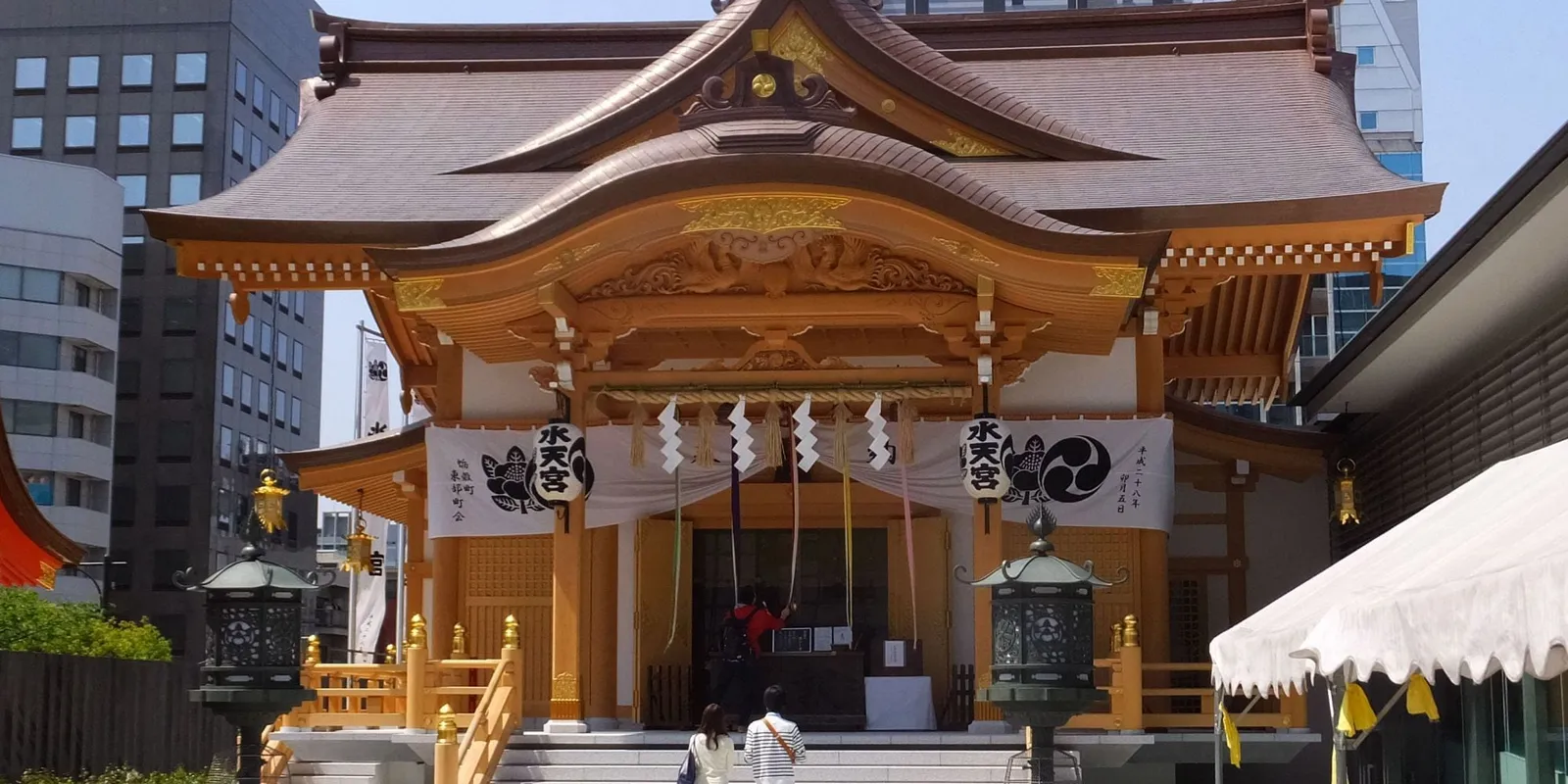
The present buildings were completed in 2016 (Heisei 28) after about three years of construction, and the shrine reopened in April that year, according to the official site. They use a base-isolation structure, and the site explains that in a major earthquake the building can shift about 60 cm horizontally. On May 3, 2018, a ceremony marked 200 years since the shrine was first enshrined in Edo.
Highlights
The grounds are known for statues symbolizing safe childbirth and child-rearing. The official site introduces the “Kodakara Inu,” a mother dog with her puppy, which visitors stroke while making a wish; stroking the zodiac animal that matches your birth year among those around it is said to bring blessings for childbirth and a child’s growth. The guardian lion-dogs are a pair, one with its mouth open guarding a ball and one with its mouth closed guarding a pup, and the site says they were donated by Ishibashi Shojiro, founder of Bridgestone. There is also a statue of a parent kappa with baby kappa clinging to it, for safe childbirth and child-rearing.
The grounds also enshrine Hosho Benzaiten. According to the official site, this is the Benzaiten to whom the 9th lord prayed before a Noh contest with the lord of the Kaga domain, and it is associated with learning, the arts, and wealth. Its statue can be viewed only on the 5th of each month and on Snake (Mi) days. Small shrines such as Hikaze Shrine, Takao Shrine and Akiba Shrine also stand in the grounds.
The shrine is set up to be easy to visit for expectant mothers and families with small children, with a gentle slope up to the main hall, a waiting room with a nursing room, and an elevator.
Visiting Tips
Per the official site, the gates are open 7:00 AM–6:00 PM, the amulet office 8:00 AM–6:00 PM, and prayer reception 8:00 AM–3:00 PM. Prayers cannot be reserved and are taken in order of arrival on the day, lasting about 15 minutes. They begin at 9:15 AM (8:30 AM on Inu no Hi). Many people choose an Inu no Hi for the safe-childbirth prayer, but the shrine says praying on a day when the mother feels well is also fine. Inu no Hi days, weekends, holidays and Taian days are especially busy, and waits can be long.
A well-known amulet for safe childbirth is the cloth belly band (御子守帯), which the official site traces to a story from long ago of pregnant women using cloth from the shrine’s bell cord as a belly band. The shrine says it prays over the bands at dawn on every Inu no Hi and distributes them for the fifth-month belly-band ceremony. The safe-childbirth prayer starts from ¥10,000, or from ¥12,000 with the belly band or small-cloth charm. For conception, there is a ¥2,000 conception amulet.
Goshuin and goshuin books are available at the amulet office, but the fee is not stated on the official site, so please check on site. The shrine is only about 1 minute on foot from Exit 5 of Suitengumae Station on the Hanzomon Line. There is parking for up to 40 cars on the first floor, but it may be unavailable on Inu no Hi days, and the official site recommends public transport.
Annual Festivals
According to the shrine’s festival guide (no year is given), the following events are held. Dates can change from year to year, so check the latest announcements before you go.
- Hatsu-Suitengu (January 5): A New Year festival day recalling the monthly 5th-day visits of the Edo period.
- Setsubun Festival (February 3): Beans are scattered to pray for the removal of misfortune and the arrival of good luck.
- All-Japan Disaster Recovery Prayer Ceremony (March 11): A recovery prayer ceremony is held every year from 2:46 PM.
- Grand Festival (May 5): Described as the most important festival of the year.
- Hosho Benzaiten Festival (May, second Snake day): A festival honoring the deity of learning, the arts and wealth.
- Summer purification (June 30) and year-end purification (December 31): Rites to cleanse the sins and impurities of the past half-year.
- Niiname-sai (November 23): A harvest festival offering new grain to the kami and giving thanks for the year’s crop.
- Osame no Suitengu (December 5): A year-end festival day recalling that in the Edo period this was the last day of the year when people could pray at the shrine.
- Monthly festival (1st, 5th and 15th of each month): Offers daily thanks and reports to the kami.
Nearby Food & Sightseeing
- Amazake Yokocho: A shopping street near Ningyocho Station. You can walk there from Suitengu toward Ningyocho.
- Meijiza Theater: A theater in Nihonbashi-Hamacho, in the district next to Kakigaracho where Suitengu stands.
- Koami Shrine: Another shrine in Nihonbashi, Chuo Ward, which can be combined with a tour of the area’s shrines.
Frequently Asked Questions
- Q. What are the visiting hours and prayer reception hours?
- A. The official site lists the gates as open 7:00 AM–6:00 PM, the amulet office 8:00 AM–6:00 PM, and prayer reception 8:00 AM–3:00 PM. Prayers begin at 9:15 AM, or 8:30 AM on Inu no Hi days. There is no lunch break, and prayers cannot be received after reception closes. Prayers may pause during shrine ceremonies, so check the announcements page too.
- Q. Can I get a goshuin at Suitengu?
- A. Yes. The official FAQ says goshuin and goshuin books are both available at the amulet office. However, the fee and separate goshuin hours are not given on the official site, so please check the amount on site. The amulet office hours (8:00 AM–6:00 PM) are a rough guide.
- Q. How do I get there, and is there parking?
- A. It is about a 1-minute walk from Exit 5 of Suitengumae Station on the Tokyo Metro Hanzomon Line (official site). Ningyocho Station (Hibiya and Asakusa lines) is about 6–8 minutes on foot, and Hamacho Station (Toei Shinjuku Line) about 12. Parking is on the first floor of the grounds, up to 40 spaces, open 8:00 AM–5:00 PM (exit until 6:00 PM), with no discounts, and it may be unavailable on Inu no Hi days. The official site asks visitors to use public transport.
- Q. What should I know about praying for safe childbirth on Inu no Hi?
- A. According to the official site, prayers cannot be reserved and are handled on the day at the amulet office (company or group visits need advance booking). A prayer takes about 15 minutes, in order of arrival. On Inu no Hi days they begin at 8:30 AM, and the number allowed into the hall is the expectant mother plus one adult on weekdays and the mother alone on weekends and holidays (subject to change with crowding). On other days up to six adults may enter, with no limit on children. Waits are given as roughly 15–45 minutes on weekday Inu no Hi days and 30 minutes to 1.5 hours on weekends and holidays.
- Q. How much do the safe-childbirth and conception prayers cost?
- A. The official site lists the safe-childbirth prayer from ¥10,000 (or any amount as an offering), and the version that includes the belly band or small-cloth charm from ¥12,000. The conception prayer is ¥10,000 or more, or any amount, and the conception amulet is ¥2,000. No envelope is needed; you pay directly at the amulet office. Amounts can change, so check the official site for the latest.
Plan Your Visit
Before you go, you can book a stay and get your shrine-visit items ready.
Amazon links open Amazon.co.jp (Japan) in English; whether an item ships overseas depends on the product.
※ Contains ads (PR). Links open external sites such as Amazon, Rakuten, Trip.com and Booking.com.