History
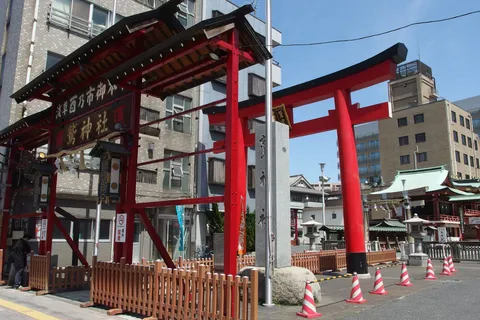
Teppozu Inari Shrine stands in Minato, Chuo Ward, Tokyo. According to the shrine’s official website, the enshrined deities are Wakumusubi no Kami, Toyouke-hime no Kami, and Ukanomitama no Kami, worshipped together as the “Inari no Okami” (the deity of growth and creation). Tradition holds that it began in 841, in the early Heian period, when local residents, taught a lesson by successive crop failures, enshrined the land’s guardian deity and prayed for daily protection.
As land reclamation advanced, the shrine moved step by step toward the sea. According to the official website, it passed through the area of present-day Kyobashi, moved in the late 1520s to the then-new coastline at present-day Shin-Kyobashi where it was called “Hatchobori Inari Shrine,” and in 1624 (Kan’ei 1) was relocated to Teppozu. The Hachiman shrine that had stood there before was kept as a subsidiary shrine (sessha), laying the foundation for today’s Teppozu Inari Shrine. In the Edo period, rice, salt, sake, firewood, charcoal, and many other goods came in through the Teppozu harbor, and the shrine is said to have become known across the country as a protector of sailors at sea.
On the origin of the name “Teppozu” (literally “Gun Sandbar”), the official website explains that it is said either to have resembled the firearms introduced to Tanegashima, or to have been the test-firing ground for large guns when the Tokugawa clan entered Edo. It also quotes the Zoku Edo Sunago, which records that in the Kan’ei era the place was used to test large guns, and notes that the theory in the Edo Kanoko Meisho Taizen that the sandbar’s shape resembled a gun is regarded as mistaken. The place name is usually written with the simplified character form 鉄砲洲, but the shrine’s official name uses the older form 鐵砲洲.
Highlights
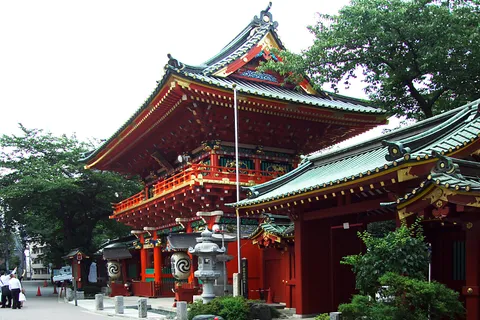
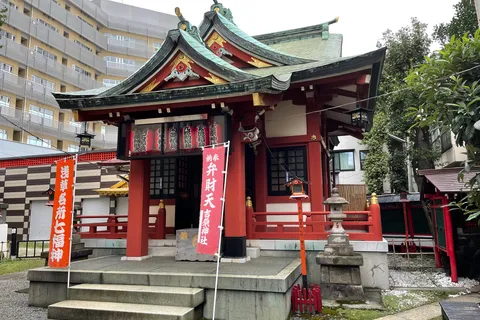
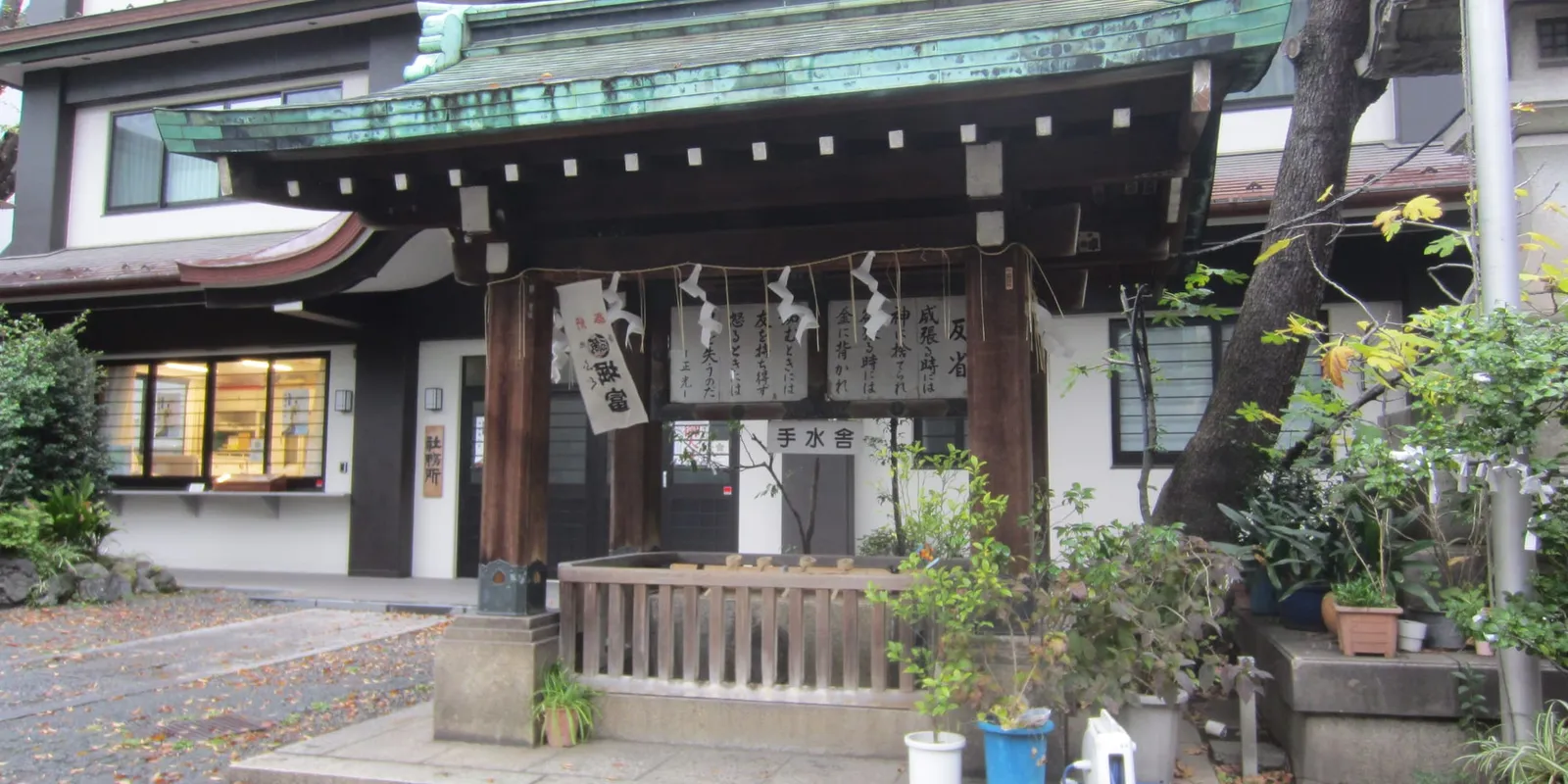
The shrine’s buildings are registered as Chuo Ward Tangible Cultural Properties (structures). According to the ward, they were registered on April 1, 1992; the main shrine building dates from 1935 and the kagura-den, subsidiary shrine, and purification fountain from 1937. Built after the Great Kanto Earthquake, they are valued as a record of how reinforced concrete came to be used in shrine architecture.
Another highlight is the Fuji-zuka, a miniature Mt. Fuji (also called Teppozu Fuji). It is a Chuo Ward Tangible Folk Cultural Property (registered April 1, 1992). According to the ward, it is a mound about 5 m high covering about 95 square meters, modeled on Mt. Fuji above its fifth station. Its slopes are covered with black volcanic stone, and it has a zigzag climbing path, a pond, a cave recreating the Hitoana cave where the Fuji ascetic Hasegawa Kakugyo trained, an Inari stone shrine, and a stone shrine of Fuji Sengen at the summit. About 32 stone monuments related to Fuji worship confraternities stand on its slopes. The ward’s materials say a mound built near the old shrine site in 1790 was rebuilt in 1874 and later moved to its present location. It is often described as the only surviving Fuji-zuka in Chuo Ward.
The grounds also keep chikara-ishi, “strength stones” once lifted in contests of strength. Chuo Ward’s materials list two stones carved with the date of 1734 (estimated Edo period) and one stone embedded in the Fuji-zuka (estimated Meiji period), each registered as a Tangible Folk Cultural Property. They are folk relics of the Teppozu riverbank where goods were unloaded.
Visiting Tips
The official website does not list visiting hours or shrine-office hours, so if timing matters, it is safest to call the shrine office (+81-3-3551-2647) in advance. Some visitor-guide sites say the office is open roughly 9:00 AM–5:00 PM, and some mention a break around noon. These may change.
Goshuin are issued at the shrine office in the grounds, and several visitor-guide sites give the offering as ¥300 (not stated on the official website). The style of issuance (written on the spot or pre-written) seems to change from time to time.
For access, the official website says it is a 5-minute walk from Hatchobori Station (JR Keiyo Line, Tokyo Metro Hibiya Line) and a 10-minute walk from Shintomicho Station (Tokyo Metro Yurakucho Line). The Teppozu stop of Toei Bus Route Higashi 15 and the Edo Bus (South Loop) is right by the shrine. We could not confirm any visitor parking, so public transport is recommended. Some guides say the Fuji-zuka can be climbed only on its mountain-opening day, so please check the shrine’s notices before you go.
Annual Festivals
The official website’s annual events page lists the following.
- Reitaisai (grand annual festival, May 2–5): The shrine’s biggest festival; the full-scale main festival, held once every three years, includes a mikoshi procession. According to the official website, 2026 was the “1,186th anniversary festival,” scheduled to include a display of the main shrine’s mikoshi at the Mihara-bashi street-corner plaza in Ginza 4-chome on April 29, a spirit-transfer ceremony on the evening of May 2, a mikoshi procession from the shrine to the Kyobashi Park resting place on May 3, a return procession on May 4, and a Shintomiza Children’s Kabuki offering and return ceremony on May 5 (for details, see the “Yayoikai” site the shrine links to). Please check the shrine’s announcements for the date of the next main festival. The TV program page described below said that in 2022 the festival had been cancelled repeatedly because of COVID-19.
- Sentansai (January 1): The first ceremony of the new year.
- Kanchu Suiyoku Taikai (midwinter cold-water purification, second Sunday of January): A purification rite for good health in which participants in loincloths (white robes for women) enter a tank containing blocks of ice. According to the official website, the 71st was held on January 11 in 2026.
- Setsubun-sai (February 3): Includes the tsuina ritual and bean-throwing.
- Natsugoshi no Oharae (June 30) and Shiwasu no Oharae (December 31): Rites of purification.
- Teppozu Fuji Sengen Shrine festival (July 1): The festival of the Fuji Sengen shrine enshrined on the Fuji-zuka.
- Hachiman Shrine festival (August 14): The festival of the subsidiary Hachiman shrine.
- Shichi-Go-San celebration (November 15) and Harvest Thanksgiving (November 23)
- Toji Kaiun Kigansai (winter solstice, December): According to the official website, the “Kingin Fuki” talismans given out on this day are received by people across Japan.
- Joyasai (New Year’s Eve, December 31)
Featured on TV
On TV Tokyo’s “Shutsubotsu! Ad-machic Tengoku” (Adomachi), in its Shintomicho episode broadcast on Saturday, April 9, 2022, Teppozu Inari Shrine was introduced at No. 1 (according to the program’s official page). The page describes it as the neighborhood’s guardian shrine, founded in the Heian period, and says that its parishioners include not only the Shintomicho area but also the whole Higashi-Ginza area, which is why the “Kabuki Inari Shrine” in a corner of the Kabukiza theater enshrines a deity divided from Teppozu Inari Shrine. It also says the May festival, the highlight for local people, had been cancelled repeatedly because of COVID-19 and that residents were eagerly awaiting its return (all as of the 2022 broadcast).
Nearby Food & Sightseeing
- Kabukiza: The kabuki theater in Higashi-Ginza. According to the Adomachi page above, the “Kabuki Inari Shrine” in a corner of the Kabukiza enshrines a deity divided from Teppozu Inari Shrine.
- Shintomicho area: A neighborhood that once had the Shintomiza kabuki theater. In the same Adomachi episode, the program’s official page introduced companies of craftspeople who work behind the scenes of kabuki, a tabi sock shop founded in the Edo period’s An’ei era, and a public bathhouse that has been running for more than 100 years. A good place for a stroll after your visit.
- Namiyoke Shrine: Another Inari shrine in Chuo Ward, in Tsukiji. A good pairing if you are touring Chuo Ward’s shrines with their ties to the sea and the harbor.
Frequently Asked Questions
- Q. Can I get a goshuin here?
- A. Yes. Goshuin are issued at the shrine office in the grounds, and several visitor-guide sites give the offering as ¥300 (the official website does not list hours or the fee). Many sources say about 9:00 AM–5:00 PM, but this may change, so if you want to be sure, call the shrine office (+81-3-3551-2647) beforehand.
- Q. How do I get there from the nearest station?
- A. According to the official website, it is a 5-minute walk from Hatchobori Station (JR Keiyo Line, Tokyo Metro Hibiya Line) and a 10-minute walk from Shintomicho Station (Tokyo Metro Yurakucho Line). The Teppozu stop of Toei Bus Route Higashi 15 and the Edo Bus (South Loop) is right by the shrine. We could not confirm any visitor parking, so public transport is recommended.
- Q. What is the Fuji-zuka (miniature Mt. Fuji) in the grounds?
- A. The shrine's Fuji-zuka is registered as a Chuo Ward Tangible Folk Cultural Property (April 1, 1992). According to Chuo Ward, it is a mound about 5 m high covering about 95 square meters, modeled on Mt. Fuji above its fifth station, with a pond, a cave, and a stone shrine at the summit, and 32 stone monuments related to Fuji worship confraternities on its slopes. It is often described as the only surviving Fuji-zuka in Chuo Ward.
- Q. When is the shrine's grand festival?
- A. The official website lists the Reitaisai (grand annual festival) for May 2–5 each year. According to visitor-guide sites, the festival held once every three years is the full-scale main one, with a mikoshi procession. The official website posted a schedule for 2026 as the 1,186th anniversary festival, including a procession from the shrine to the Kyobashi Park resting place on May 3. Please check the shrine's announcements for the date of the next main festival.
- Q. Has the shrine been featured on TV?
- A. Yes. TV Tokyo's "Shutsubotsu! Ad-machic Tengoku" (Adomachi) featured Teppozu Inari Shrine at No. 1 in its Shintomicho episode broadcast on Saturday, April 9, 2022 (according to the program's official page). The page calls it the neighborhood's guardian shrine, founded in the Heian period, and says its parishioners include not only the Shintomicho area but the whole Higashi-Ginza area.
Plan Your Visit
Before you go, you can book a stay and get your shrine-visit items ready.
Amazon links open Amazon.co.jp (Japan) in English; whether an item ships overseas depends on the product.
※ Contains ads (PR). Links open external sites such as Amazon, Rakuten, Trip.com and Booking.com.