History
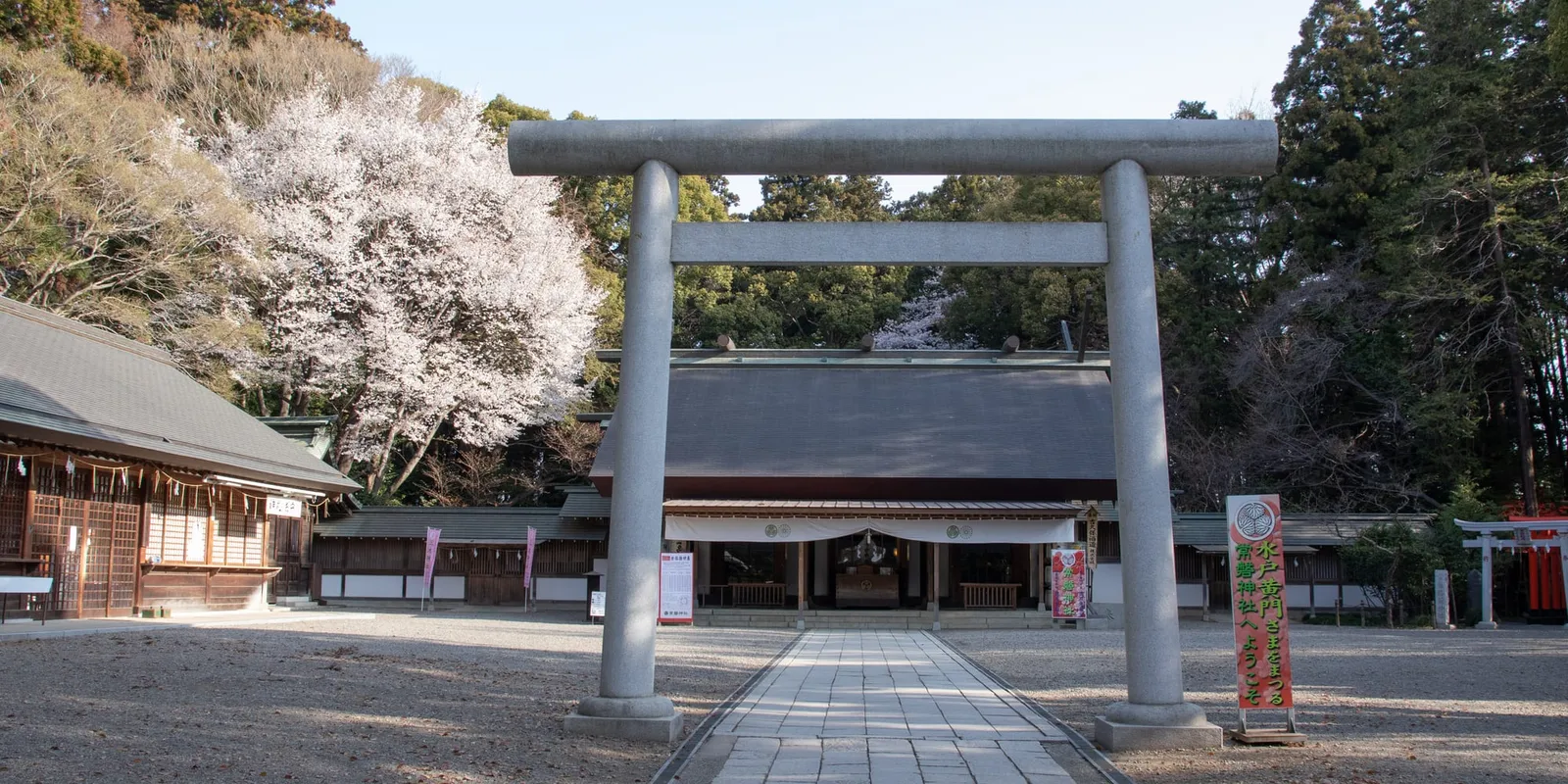
Tokiwa Jinja stands next to Kairakuen in Mito, Ibaraki Prefecture. Its name is read “Tokiwa Jinja,” and the official site describes it as the shrine that enshrines “Mito Komon, Tokugawa Mitsukuni.” The two enshrined deities are Tokugawa Mitsukuni (Giko), the second lord of the Mito domain, and Tokugawa Nariaki (Rekko), the ninth lord. According to the official site, Mitsukuni is known by the nickname “Mito Komon,” which comes from his having been appointed Gon-Chunagon (provisional middle counselor).
According to the official history, in the early Meiji era many people who admired the virtue of the two lords founded a small hall (shido) in Kairakuen. In 1873 (Meiji 6) the shrine name “Tokiwa Jinja” was granted by imperial decree of Emperor Meiji, and the shrine was raised to prefectural-shrine rank that same year. In 1874 (Meiji 7) the shrine buildings were constructed at the present site, the transfer ceremony was held on May 12, and that day was set as the annual festival. Posthumous divine titles were conferred, “Takayuzuru-umashi-michine-no-mikoto” on Giko and “Oshitakeo-kuni-no-mitate-no-mikoto” on Rekko, it is said. In 1882 (Meiji 15) the shrine was ranked Bekkaku Kanpeisha.
According to the official site, Mitsukuni (1628–1700) began compiling the “Dai Nihonshi” in 1657 (Meireki 3), and it was completed 250 years later, in 1906, with the completion reported before the deities and the work presented to the court. The official site says Nariaki (1800–1860) founded the domain school Kodokan and served as the shogunate’s adviser on coastal defense when the Black Ships arrived. The last shogun, Tokugawa Yoshinobu, was Nariaki’s seventh son.
Almost all the buildings were destroyed in the wartime air raids of 1945, and the present shrine buildings were restored in 1958 with donations from believers across the country (the grounds guide says the present building dates from 1959 and is in the Shinmei-zukuri style). The official chronology also notes that the shrine was damaged in the 2011 Great East Japan Earthquake, and that a grand festival marking the 140th anniversary of enshrinement and recovery from the earthquake was held in 2014.
Highlights
The shrine hall is in the Shinmei-zukuri style, and the official site says daily rites are performed in the traditional manner. The grounds hold the auxiliary shrine Toko Jinja (founded 1943), dedicated to Fujita Toko, who served Nariaki; the subordinate shrine Miki Jinja, dedicated to the Mito retainer 三木之次 and his wife, who raised Mitsukuni (said to bring safe childbirth, fertility, child-raising and family harmony); and the subordinate shrines Tokiwa Mizu Jinja and Tokiwa Inari Jinja. The Noh Hall (Nogakuden) is the former kagura hall, the only building to survive the war, and was converted into a Noh stage in 1991 (Heisei 3). Various dedicatory events are still held there.
The Giretsukan displays relics and calligraphy of Mitsukuni and Nariaki and materials on Mito-gaku. According to the official site, its collection includes a wooden statue of Giko by the woodcarver 森山朝光, the “Jindaiko” war drum that Nariaki used for signals at a military exercise (a Mito City designated cultural property), and a cannon inscribed “Taikyoku” in Nariaki’s hand. However, the same page says the museum has been closed for the time being since June 1, 2022 (Reiwa 4), and that groups of 10 or more can request an opening by prior application. If you plan to visit, confirm with the shrine first.
In the Giretsukan’s front garden, the grounds guide mentions the “Naniwa no Ume” plum, said to have been planted by Mitsukuni himself. The official explanation says Mitsukuni wrote the 梅花記 and Nariaki the 種梅記, showing the long link between Mito and plum trees. A monument to the site where the Dai Nihonshi was completed also stands in the grounds.
Visiting Tips
The official site does not state visiting hours for the grounds (one guide site gives 6:00 AM–5:00 PM). An official notice says the shrine office counter (prayer reception, goshuin, talismans and amulets) is normally open until 4:30 PM, though hours may be shortened at the end of the year and similar times. Individual prayer services are accepted daily at the reception window from 9:00 AM to 4:00 PM (3:30 PM from November 1 to January 31), with an offering of ¥5,000 or more for individuals. The shrine handles many kinds of prayers, including safe childbirth, first shrine visits, Shichi-Go-San, exam success, academic success, household safety and business prosperity. From late October to November 30 a Shichi-Go-San special prayer is held (reception 9:00 AM–3:30 PM, no booking needed).
Goshuin are handled at the shrine office counter. The fee for the regular goshuin is not stated on the official site, and a May 2024 official notice listed a limited-time “150th Anniversary of Enshrinement Goshuin” at ¥500 (paper only, available at the shrine only). Please check the current offering with the shrine beforehand.
It is about 15 minutes by bus from the north exit of JR Mito Station, or about 15 minutes by car from the Mito IC on the Joban Expressway (official site). The official site does not give the number of parking spaces, and one guide site lists 70. For New Year’s visits, the official notice says a large offering box is set up during the first three days, so you can also pray in front of the doors to the left and right of the front.
Annual Festivals
Dates are those given in the official site’s list of regular festivals (check the official site for details each year).
- Ume Matsuri Hokokusai (January 6): A rite praying for a lively and safe plum-festival season.
- Setsubun-sai (February 3): A bean-scattering rite.
- Baika-sai (February 20): Plum blossoms favored by the enshrined deities are offered, announcing the arrival of the plum-viewing season.
- Rekko Tanshin-sai (April 4): A festival celebrating the birth of Tokugawa Nariaki.
- Annual festival (May 12): The shrine’s most important festival of the year, marking the enshrinement at the present site on May 12, Meiji 7. The shrine’s own kagura “Kairaku-mai” is performed, with flower offerings by the Ikenobo Mito branch and a tea offering by the Mito Sekishu-ryu group 何陋会.
- Jinkosai (Sunday nearest the annual festival): The portable shrine is carried through Mito, including the main street called “Komon-san Dori.”
- Otaue-sai (late May to early June) and Nuibo-sai (mid to late October): Rice seedlings are planted by hand in the shrine’s rice field, and the harvest is celebrated in autumn.
- Nagoshi no Oharae (June 30): The rite includes passing through a ring of reeds (chinowa).
- Giko Tanshin-sai (July 11): A festival celebrating the birth of Tokugawa Mitsukuni.
- Kangetsu-sai (August 15 of the old lunar calendar): Kagura dance and gagaku music are offered at the Noh Hall.
- Niiname-sai (November 23): A harvest thanksgiving festival.
Nearby Food & Sightseeing
- Kairakuen: The garden next to the shrine. According to the shrine’s official English page, it was built by Tokugawa Nariaki, with construction beginning in 1841, and has more than 3,000 plum trees. The official access page says a temporary station is used during the plum-festival season.
- Kodokan: The domain school founded by Nariaki. It is also linked from the “Guide to Mito” page of the official site.
- Mito Komon Shrine (Birthplace of Giko): According to the official site, the site of the house of the Mito retainer Miki family, where Mitsukuni was born in 1628, and a Mito City designated cultural property (“Birthplace of Giko”). Its address is given as 2-2-29 Sannomaru, Mito. The Jinkosai rite is held here.
- Lake Senba: The lake seen from Kairakuen. An official New Year’s notice says you can see the first sunrise rise over Lake Senba from Kairakuen.
Frequently Asked Questions
- Q. What are the visiting hours?
- A. The official site does not state visiting hours for the grounds (one guide site gives 6:00 AM–5:00 PM). An official notice says the shrine office counter is normally open until 4:30 PM, and individual prayer services are accepted at the reception window between 9:00 AM and 4:00 PM (3:30 PM from November 1 to January 31). On days with regular festivals or weddings the wait can be long, and the shrine advises asking in advance (phone 029-221-0748).
- Q. Can I get a goshuin at Tokiwa Jinja?
- A. An official notice says goshuin are handled at the shrine office counter, which is normally open until 4:30 PM. The fee for the regular goshuin is not stated on the official site. In May 2024 the shrine announced a limited-time "150th Anniversary of Enshrinement Goshuin" at ¥500 (paper only, available at the shrine only). Please check the current offering, and any changes to reception hours such as on May 10 and 12 during the annual festival, with the shrine beforehand.
- Q. How do I get there, and is there parking?
- A. The official site says it is about 15 minutes by bus bound for Kairakuen from the north exit of JR Mito Station on the Joban Line. During the Mito Plum Festival, on weekends and holidays you can get off right at the temporary Kairakuen Station. By car it is about 15 minutes from the Mito IC on the Joban Expressway. The official site does not mention parking; one guide site lists 70 spaces. It may be crowded during the plum festival, so it is safest to check beforehand.
- Q. Can I visit the Giretsukan museum?
- A. The Giretsukan displays relics and calligraphy of Tokugawa Mitsukuni and Tokugawa Nariaki and materials related to Mito-gaku (Mito learning). The museum's page on the official site says it has been closed for the time being since June 1, 2022 (Reiwa 4), and that groups of 10 or more can request an opening by prior application (contact: 029-221-0748). If you hope to visit, please confirm with the shrine by phone beforehand.
- Q. When are the annual festival and the plum-related events?
- A. According to the official list of regular festivals, the annual festival (Reisai) is on May 12, marking the shrine's enshrinement at the present site on May 12, Meiji 7, and the Jinkosai, in which the portable shrine travels through Mito's streets, is held on the Sunday nearest to it. As for plum events, the Ume Matsuri Hokokusai, which opens the plum-festival season, is on January 6, and the Baika-sai, which offers plum blossoms favored by the enshrined deities and announces the start of the plum-viewing season, is on February 20. Other events may vary by year, so check the official site.
Plan Your Visit
Before you go, you can book a stay and get your shrine-visit items ready.
Amazon links open Amazon.co.jp (Japan) in English; whether an item ships overseas depends on the product.
※ Contains ads (PR). Links open external sites such as Amazon, Rakuten, Trip.com and Booking.com.