History
Toyokuni Jinja enshrines Toyotomi Hideyoshi, a man born the son of a poor peasant farmer who rose through the ranks under Oda Nobunaga to eventually unify all of Japan under his own rule. Hideyoshi’s climb from a low-ranking foot soldier to Chancellor (Kampaku) and Grand Minister of State stands as one of the most remarkable stories of self-made success in Japanese history — and, by most accounts, in world history as well.
Hideyoshi died at Fushimi Castle on September 18, 1598, at the age of 63. In accordance with his will, a mausoleum was built the following year, in 1599, on the slopes of Mt. Amidagamine in Kyoto’s Higashiyama district, and the imperial court granted him the divine title “Toyokuni Daimyojin” (“Great Illuminating Deity of the Bountiful Realm”), deifying him as a kami. The shrine’s original buildings were said to have been built on an unprecedented scale, with lavish special festivals held there in its earliest years.
After Hideyoshi’s death, however, as power shifted from the Toyotomi clan to Tokugawa Ieyasu, the shrine’s fortunes reversed. When the Toyotomi clan was finally destroyed in the Siege of Osaka in 1615, Ieyasu moved to dismantle Toyokuni Jinja, a potent symbol of Toyotomi authority. While the shrine buildings themselves were not entirely torn down, Hideyoshi’s divine title was revoked, the shrine was formally abolished, and all repairs were forbidden — leaving it to decay, neglected, for more than two centuries.
It was not until the Meiji era that Toyokuni Jinja was restored to its former glory. In 1868, Emperor Meiji, visiting Osaka, proclaimed the shrine’s restoration; in 1873 it was ranked among the “extra-rank” state-sponsored shrines (Bekkaku Kanpeisha); and in 1880 its present buildings were completed and the shrine relocated to its current site — the former grounds of Hoko-ji Temple’s Great Buddha Hall. A shrine that once honored a man who built an era, only to vanish from the historical stage after his death, was at last brought back into the light in Japan’s new Meiji age.
Highlights
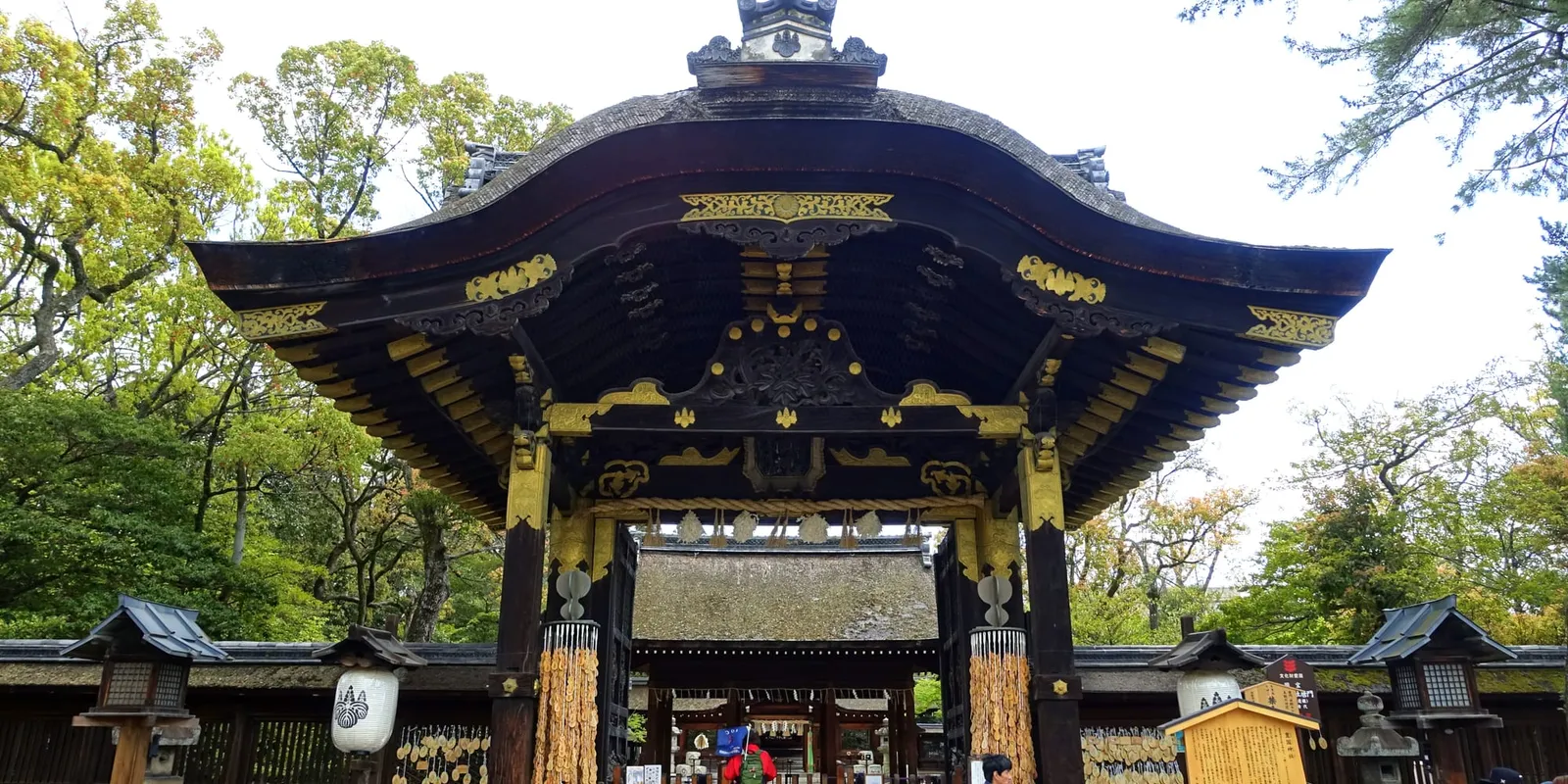
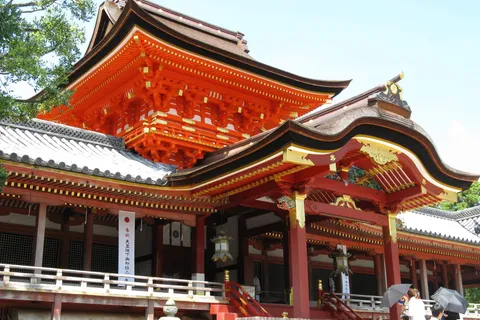
The single greatest highlight of Toyokuni Jinja is its Karamon Gate, designated a National Treasure. Said to be a surviving structure from Fushimi Castle, the gate passed through Nijo Castle and then Konchi-in, a sub-temple of Nanzen-ji, before being relocated here during the shrine’s Meiji-era restoration. A four-legged gate with karahafu (undulating gable) roofs on the front and rear and an irimoya-style gable on its sides, it is decorated with bold, dynamic bracket carvings characteristic of the Momoyama period, and is counted alongside the karamon gates of Nishi Hongan-ji and Daitoku-ji as one of Japan’s “Three Great National Treasure Karamon Gates.”
Much of the shrine’s present grounds once belonged to Hoko-ji Temple, which Hideyoshi himself had built to house Kyoto’s own Great Buddha statue. The land was seized by the Meiji government and folded into Toyokuni Jinja’s precincts, and the paving stones of its approach are said to be repurposed floor stones from Hoko-ji’s Great Buddha Hall. Hoko-ji itself still stands immediately next to the shrine today, and still preserves the temple bell inscribed with the phrase “Kokka Anko” (“the nation, peaceful and secure”) — the very inscription Tokugawa Ieyasu used as a pretext to move against the Toyotomi clan. The shrine honoring Hideyoshi and the temple whose bell helped trigger his clan’s destruction stand, to this day, side by side.
Visiting Tips
The shrine grounds are open to visitors at all times, but the Treasure Hall (admission ¥500) keeps hours of 9:00–16:30. Goshuin are available during the same hours at the shrine office, for ¥500. Paid parking is available on the grounds (¥150 per 30 minutes, about 15 spaces), and the Kyoto National Museum’s parking lot, about a 3-minute walk away, offers an alternative when it’s full. The Kyoto National Museum and Sanjusangendo Temple are both just a short walk away, and many visitors combine all three into a single outing.
Annual Festivals
- Annual Festival and Tea Offering Festival (September 18–19): Held once a year on the anniversary of Hideyoshi’s death. Only invited guests may attend the main ceremony, but visitors can watch the dedication of bugaku court dance from in front of the Karamon Gate. At the tea offering festival, the head of the Yabunouchi school of tea ceremony offers thick and thin matcha tea, after which the shrine’s Hoshusha tea house and reception hall open their own tea gatherings, free for anyone to attend. A flea market is also held on the grounds on the 18th.
Nearby Food & Sightseeing
- Hoko-ji Temple: Adjacent to Toyokuni Jinja, this temple preserves the bell bearing the “Kokka Anko” inscription that Tokugawa Ieyasu used as a pretext to move against the Toyotomi clan.
- Sanjusangendo Temple: A famous temple within walking distance, known for its hall of 1,000 statues of the thousand-armed Kannon; many visitors combine it with Toyokuni Jinja and the Kyoto National Museum.
- Kyoto National Museum: Located right next to Toyokuni Jinja, this museum holds an extensive collection of art and crafts connected to Kyoto’s history.
Frequently Asked Questions
- Q. What are the visiting hours and admission fee at Toyokuni Jinja?
- A. The grounds are open to visitors at all times. The Treasure Hall is open 9:00–16:30, with an admission fee of ¥500.
- Q. Can I get a goshuin here?
- A. Yes, at the shrine office from 9:00 to 16:30, for ¥500.
- Q. Is there parking?
- A. Yes, paid parking is available on the grounds (¥150 per 30 minutes, about 15 spaces). If it's full, the Kyoto National Museum parking lot is available about a 3-minute walk away.
- Q. How do I get to Toyokuni Jinja?
- A. About a 5-minute walk from the "Hakubutsukan-Sanjusangendo-mae" city bus stop, or about a 10-minute walk from Keihan Railway's Shichijo Station.
- Q. Is this the same shrine as the "Toyokuni Jinja" at Osaka Castle?
- A. No, they are separate shrines. The Toyokuni Shrine at Osaka Castle (written with the older kanji form 豊國神社, read "Hokoku Jinja") was founded in 1879 as a branch shrine of this Kyoto shrine, and became independent in 1921. While this Kyoto shrine enshrines Toyotomi Hideyoshi alone, the Osaka shrine also enshrines his son Toyotomi Hideyori and his brother Toyotomi Hidenaga alongside him, and its name is even read differently — "Toyokuni" in Kyoto versus "Hokoku" in Osaka. Shrines of the same name also exist in Nagoya, Nagahama, and elsewhere across Japan, but this Kyoto shrine is the original, head shrine.
Related Shrines
Kyoto Prefecture, Kita Ward, Kyoto
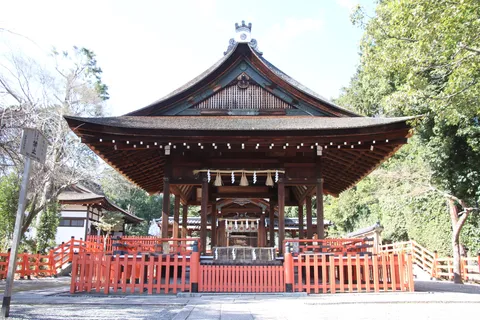
Kenkun Jinja
Kenkun-jinja (formally Takeisao-jinja)
- Good Fortune
- Victory in Competition
- Career Success
Kyoto Prefecture, Sakyo-ku, Kyoto
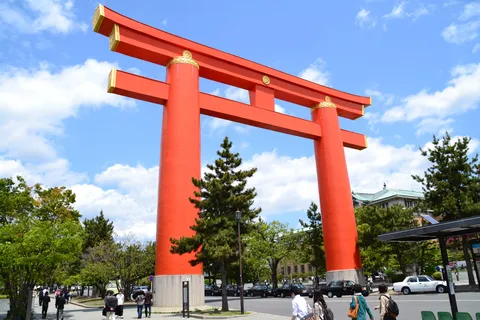
Heian Jingu
Heian-jingū
- Good Fortune
- Protection from Misfortune
- Household Safety
Kyoto Prefecture, Yawata
Iwashimizu Hachimangu
Iwashimizu Hachimangū
- Protection from Misfortune
- Victory in Competition
- Household Safety