History
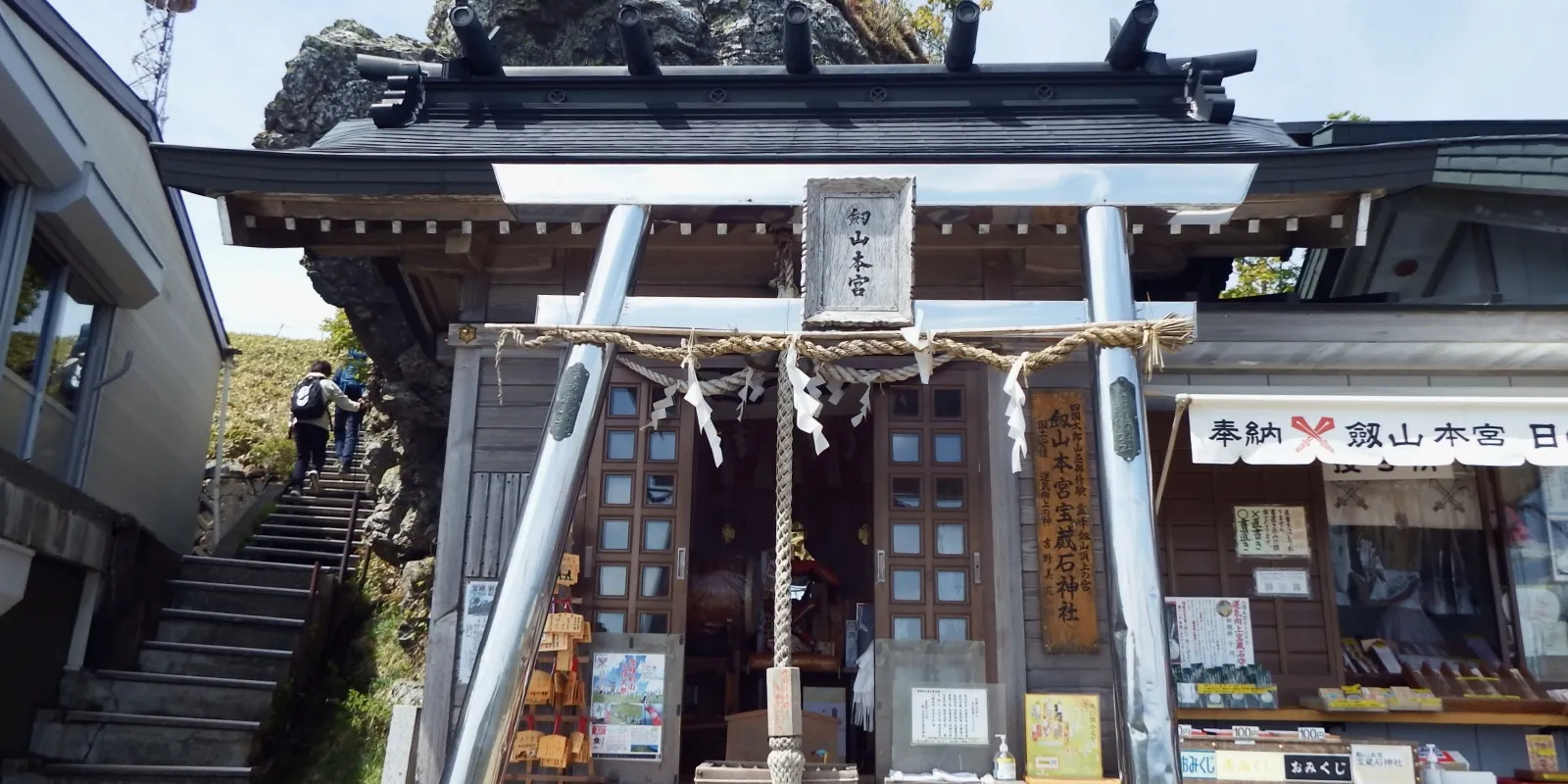
Tsurugisan Hongu Hozoishi Jinja stands just below the summit of Mt. Tsurugi, at roughly 1,930m elevation on Shikoku’s highest and most storied peak (1,955m). It functions as the summit sanctuary of Tsurugisan Hongu Tsurugi Jinja, whose main shrine building sits lower down the mountain at Koyadaira in Mima City; the summit structure has long been known simply as “Hozoishi Jinja” and today serves as the focal point of worship for most visitors to the mountain.
According to shrine tradition, the sanctuary’s origin dates to 1185, when Taira clan retainers — fleeing after their defeat at the Battle of Dan-no-ura at the end of the Genpei War — brought the young Emperor Antoku to this remote mountain for safety. They are said to have enshrined the emperor’s sacred sword within a massive sacred rock (iwakura) at the summit, venerating it as “Tsurugisan Daigongen.” This boulder, known as Hozo-ishi (“treasure-storing rock”), still towers behind the shrine building today, and tradition holds that the mountain’s name, Tsurugisan (“Sword Mountain”), derives from this very legend. It’s worth noting that this account is shrine tradition and local lore rather than a documented historical record — no primary source fixes an exact founding date or verifies the episode as historical fact. The shrine today enshrines three deities: Susanoo no Mikoto, Emperor Antoku, and Oyamatsumi no Mikoto.
Mt. Tsurugi is also widely associated with a very different and much more recent claim: that the Ark of the Covenant, the sacred artifact of ancient Israel, lies hidden somewhere on the mountain. This theory has no basis in the shrine’s own traditional history — it originates from the “Japanese-Jewish common ancestry theory” (Nichiyu Doso-ron) popularized in Japan by Sakai Katsutoki and others in the 1930s, and was fueled by the striking, altar-like appearance of the boulder formations near the summit. It remains an unverified legend rather than an established historical or archaeological fact, and is entirely separate from the shrine’s own Heike-sword tradition described above.
Highlights
The great boulder called Hozo-ishi, rising behind the shrine building, is the sacred rock at the heart of Tsurugisan worship. Bound with a sacred rope and crowned with a small subsidiary shrine at its summit, its sheer scale is startling to find at the top of a mountain.
The summit area of Mt. Tsurugi is itself unusual: rather than a sharp peak, it forms a broad, gently rolling plateau nicknamed “Heike-no-Baba” (“the Heike’s riding ground”), after a legend that Taira refugees once trained horses there. Covered in miyama-kumazasa dwarf bamboo grass and crossed by protective wooden boardwalks, the treeless summit offers sweeping views across the mountains of Shikoku on a clear day — a rare, almost alpine-meadow landscape for a Japanese peak of this height.
Partway up the trail from Nishijima Station stands Otsurugi Jinja, whose sacred object is another massive rock, Mitama-ishi. A spring called Tsurugisan Goshinmizu flows continuously from beneath it — one of Japan’s official “100 Famous Waters” (Meisui Hyakusen) — prized by hikers for its cold, clear taste; it can be drunk on the spot or carried away in a bottle.
At the summit, the Tsurugisan-Chojo Hutte mountain lodge (with an annex, Unkaiso) serves simple meals like udon and soba and offers overnight lodging (open roughly late April through late November). An award-winning eco-friendly toilet facility is also maintained at the summit for hikers’ convenience.
Visiting Tips
The shrine grounds are technically open year-round, but in practice a visit is only realistic during the lift’s operating season (mid-April to November 30); climbing to the summit in snow or bad weather is genuinely hazardous and should be avoided. The shrine office — for goshuin and other items — is staffed only on selected days from late April to early November, mainly weekends and holidays, so it will be unattended outside those times. If the office is closed, staff at the summit hut may occasionally help with goshuin, but this isn’t guaranteed. Even with the lift, reaching the shrine still requires about a 40-minute hike from Nishijima Station, so wear proper footwear and bring layers and rain gear.
Annual Festivals
- Grand Festival (July 17): The most important annual festival of Tsurugisan Hongu, held at the main shrine.
- Tsurugisan Hongu Summit Grand Festival (the Sunday following July 17, or the same day if the 17th falls on a Sunday): About 20 white-robed bearers carry a mikoshi (portable shrine) roughly 300m from the main shrine up to Hozoishi Jinja at the summit in a dramatic procession. An eve festival is held the preceding Saturday, and the main day features mochi-throwing and draws large crowds of hikers and local residents.
- Weekend and holiday goshuin season (late April–early November): Throughout the lift’s operating season, hikers combine their climb with a stop for goshuin or the wooden summit-pilgrimage certificate whenever the office is staffed.
Nearby Food & Sightseeing
- Tsurugisan-Chojo Hutte: A mountain lodge right beside the shrine, serving light meals like udon and soba plus coffee, with overnight lodging available — a convenient stop before or after visiting.
- Minokoshi: The access hub where the Tsurugisan Sightseeing Lift departs, with free parking, restaurants, and shops. It also serves as a trailhead for Mt. Maruzasa and Mt. Tsurugi’s neighbor peak, Mt. Miune.
- Iya Kazurabashi Vine Bridge: A famous attraction in Miyoshi City’s Iya Valley, often combined with a Mt. Tsurugi visit. Woven from mountain vine, this suspension bridge is designated an Important Tangible Folk Cultural Property of Japan.
Frequently Asked Questions
- Q. Where exactly is Tsurugisan Hongu Hozoishi Jinja located?
- A. It stands just below the summit of Mt. Tsurugi (elevation 1,955m, the highest peak in Tokushima and on Shikoku's Iya side), at roughly 1,930m elevation. Its registered address is in Mima City, but the trailhead most hikers use — Minokoshi, where the sightseeing lift departs — sits on the Miyoshi City side. Mt. Tsurugi itself straddles the boundary of Mima City, Miyoshi City, and Naka Town.
- Q. When can I get a goshuin here, and how much does it cost?
- A. The shrine office is staffed mainly on weekends and holidays from late April to early November, and a standard goshuin costs ¥500. Only pre-written (kakioki) goshuin are available — the office does not write directly in visitors' books. Limited seasonal designs featuring alpine flowers are offered, along with a wooden 'proof of summit pilgrimage' certificate, and goshuin can be requested by mail. Outside office hours, the staff at the nearby summit hut may sometimes help, but this isn't guaranteed.
- Q. Which deities are enshrined at Tsurugisan Hongu Hozoishi Jinja?
- A. Three deities are enshrined: Susanoo no Mikoto, Emperor Antoku, and Oyamatsumi no Mikoto. Shrine tradition holds that Taira clan retainers, defeated in the Genpei War, hid the young Emperor Antoku's sacred sword in the great rock at the summit — the episode said to have given the mountain its name, Tsurugisan ('Sword Mountain').
- Q. How do I get to Tsurugisan Hongu Hozoishi Jinja?
- A. From Minokoshi, ride the Tsurugisan Sightseeing Lift to Nishijima Station (about 15 minutes), then hike roughly 40 minutes along the ridge trail to the shrine. The lift runs mid-April through November 30 and costs ¥1,900 round trip. By car, Minokoshi is about 42km from Mima Interchange on the Tokushima Expressway; a taxi from JR Sadamitsu Station is the most convenient option without a car. Free parking is available at Minokoshi (about 200 spaces across two lots).
- Q. Is it true that the Ark of the Covenant is hidden on Mt. Tsurugi?
- A. A long-circulated legend claims the Ark of the Covenant from ancient Israel is hidden somewhere on Mt. Tsurugi, but this has never been verified by any historical or archaeological evidence — it remains an unproven theory, not an established fact. The idea traces back to the 'Japanese-Jewish common ancestry theory' promoted by Sakai Katsutoki and others in the early Showa era (1930s), and gained popularity partly because clusters of large boulders near the summit resemble ancient altars. The shrine's own traditional history is a separate story: it centers on the legend that Emperor Antoku's sacred sword was enshrined in the summit's sacred rock, distinct from the Ark theory.