History
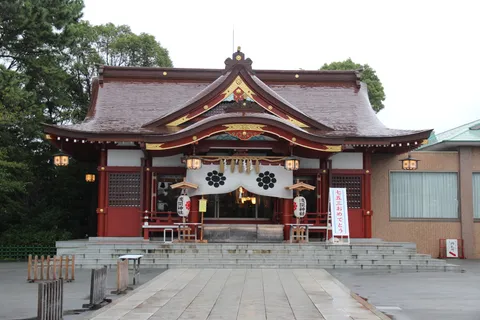
Asuwa Shrine stands on the mid-slope of Mt. Asuwa in Fukui City. It is read “Asuwa-jinja,” and the official site’s domain is also “asuwajinja” (the official site has no written statement of the reading, so the reading also follows the Japanese Wikipedia). The official site introduces it as a shrine listed in the Engishiki, said to have been founded by Emperor Keitai, with more than 1,500 years of history, and called 越前祖神 (roughly, the ancestral deity of Echizen). The principal deity is Emperor Keitai, and the Omiyadokoro no Mitama (生井神, 福井神, 綱長井神, 阿須波神 and 波比岐神) are also enshrined.
According to the official history, in the latter half of the 5th century, when Prince Ootono (男大迹王, read Ootono-no-miko on the official site; later Emperor Keitai) took on large-scale flood-control works in Echizen, he first invoked the Omiyadokoro no Mitama (坐摩神) enshrined at the imperial court to Mt. Asuwa and prayed for safety, which is taken as the shrine’s origin. When he left Echizen to take the throne as the 26th emperor, he is said to have enshrined his own living spirit (ikimitama) in the shrine, saying “I shall remain the guardian of this land forever,” and Emperor Keitai has been enshrined at the center of the main hall ever since. The shrine also explains that place names such as Fukui and Asuwa derive from the deity’s name. All of this is the shrine’s own account.
The official site says the shrine received reverence from the imperial court and successive shoguns and provincial lords, and that the Matsudaira lords of the province later revered it deeply too. Plaques with the imperial calligraphy of Emperor Komyo and Emperor Ninko had been designated National Treasures, but they were lost when the treasure hall burned in the last war. The shrine buildings were destroyed by fire or collapse in the 1900 (Meiji 33) fire in the area south of the river (橋南の大火), the Fukui air raid of 1945 and the Fukui earthquake of 1948, but each time they were rebuilt, with the work completed in 1959. In 2007 a commemorative festival marked the 1,500th anniversary of Emperor Keitai’s accession, according to the official site.
Highlights
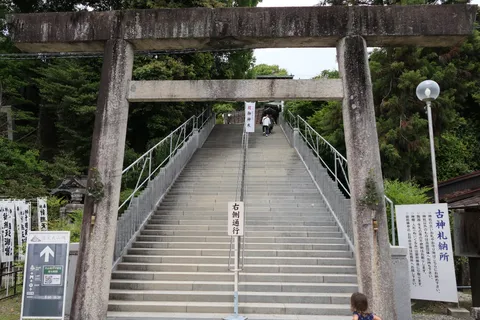
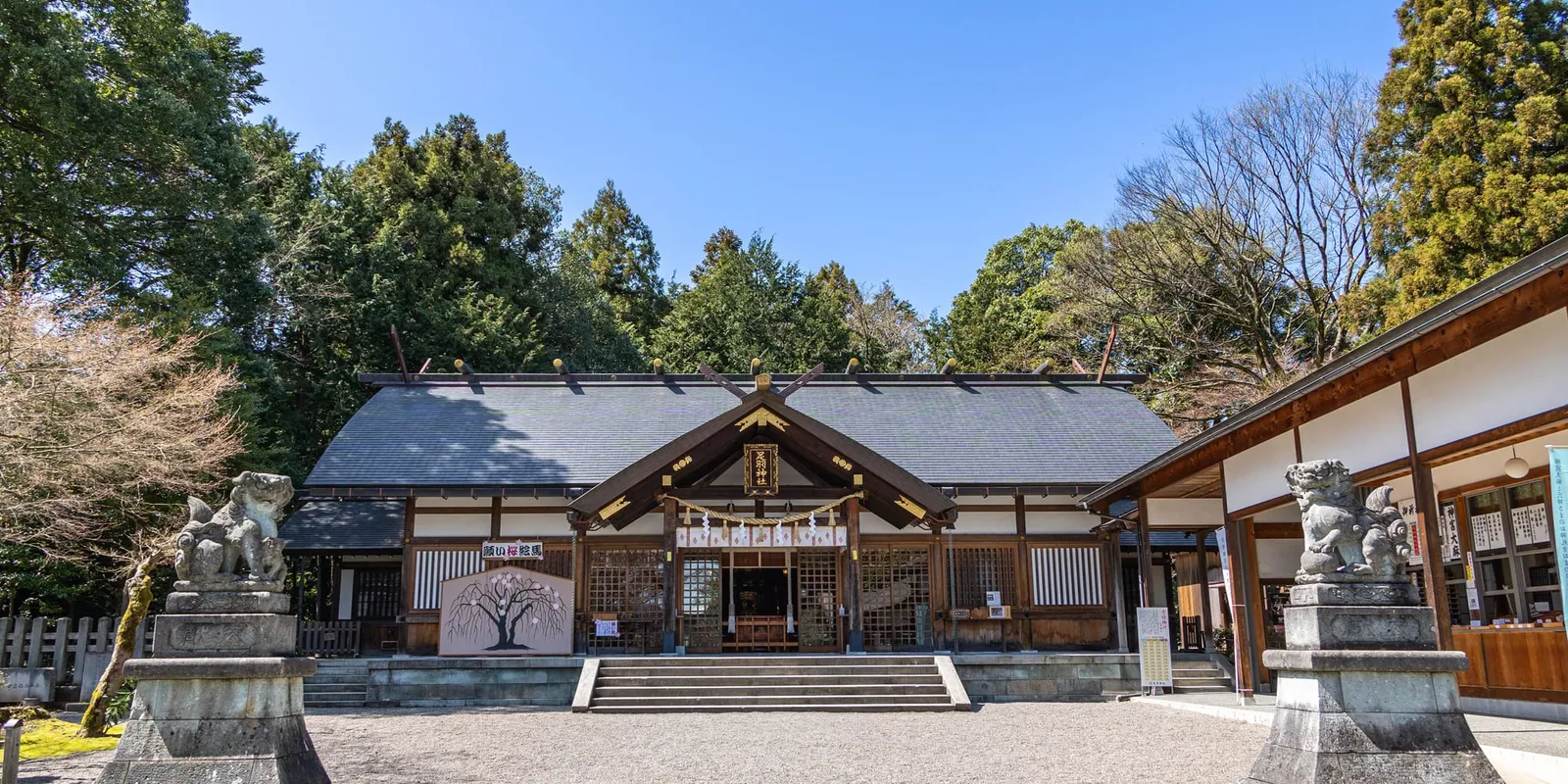
The highlights are the two natural monuments in the grounds. The “Asuwa-san no Shidare-zakura” weeping cherry in the precincts is Fukui City Natural Monument No. 2 (designated November 3, 1970; about 380 years old as of 2023), and the official site calls its dome shape unmatched in beauty. It is at its best for about two weeks from the end of March into April, and from 6:00 PM to 11:00 PM from the end of March to early April it is lit up (extended depending on the blossoms). The Takao maple in the middle of the approach steps is Fukui City Natural Monument No. 1 (designated the same day; about 430 years old as of 2023), and the grounds are said to turn bright red in mid-November. The Fukui City tourism site also introduces both as Fukui City natural monuments.
The shrine crest is the “Sanko no Mon,” a sun, moon and star enclosed in a circle. The official site calls it “a very rare crest” and explains that the star represents the North Star, a symbol of the emperor and a guide to direction at night.
The reed ring for the Summer Purification (June 30) is unusual in having a second ring at your feet, which the official site says represents the form of purification by entering a pond and standing under a waterfall. Locally rooted amulets are also on offer, according to the official amulet guide: the “Ashi-mamori” (足守り, ¥1,000), a foot charm drawing on the shrine’s name; the Hama-yumiya bow-and-arrow charm (破魔弓矢, ¥2,000), based on the tradition that Emperor Keitai drove off an evil dragon with a bow and arrow and controlled the floods of the Fukui plain; and a bracelet charm (from ¥6,000) using shakudani stone (Fukui Blue) from the foot of Mt. Asuwa.
Visiting Tips
Prayer services are accepted 9:00 AM–4:30 PM (walk-in, no reservation), and the prayer fee starts at ¥7,000 for individuals (official site). Services include protection from misfortune and from all directions, Shichi-Go-San, first shrine visits for babies, exam success, traffic safety, and fertility and safe childbirth, and requests for matchmaking, business prosperity and construction safety are also accepted. The Fukui City tourism site lists the shrine office as 9:00 AM–5:00 PM. The official site gives no visiting hours for the grounds.
The goshuin is ¥500 for both the regular and enshrined-deity versions. Limited-time goshuin are offered in spring, summer and autumn, and the Summer Visit (夏詣, June 15–August 16) limited goshuin is a pre-written sheet only. The official site gives no separate hours for goshuin, so avoid arriving late in the day. Goshuin books are the “Sakura” (¥1,500) and the “Echizen lacquerware” (¥3,000).
According to the Fukui City tourism site “Fukuiro,” it is about 6 minutes by taxi from JR Fukui Station, about 15 minutes by Red Cross Hospital-bound bus to “左内公園口” plus about 8 minutes on foot, or about 10 minutes on foot from Asuwayama-koen-guchi Station on the Fukui Railway Fukubu Line. Parking is available but large buses cannot park there, and no number of spaces or fee is given. It can get crowded during the cherry blossom and autumn foliage seasons.
Annual Festivals
These are the dates in the official site’s annual-events list (they may change from year to year).
- Saitan-sai (January 1): 6:00 AM. Prayer services are accepted from midnight to 6:00 PM on New Year’s Day.
- Sagicho-sai (January 15): 9:00 AM.
- Kanchu Misogi (January, the Sunday after Daikan): 9:00 AM.
- Setsubun-sai (February 3): Prayer services are accepted 9:00 AM–5:00 PM on the 1st and 2nd, and 9:00 AM–8:00 PM on the 3rd.
- Sakura Matsuri (early April): The weeping cherry is lit up from 6:00 PM to 11:00 PM from the end of March to early April.
- Spring Grand Festival (May 15): 10:30 AM. A Shinko-sai procession is held beforehand (the official site writes “5月15日 前日曜”).
- Summer purification and Wakuguri-sai (June 30): Reed-ring walk-through 9:00 AM–8:00 PM, purification ceremony at 6:00 PM, and riverbank purification (floating paper effigies) at 9:00 PM on the Asuwa River bank below Tsukumo Bridge.
- Summer Visit, Natsumode (夏詣, from July 1): Prayer wind chimes (offering ¥500) and a flower-filled hand-washing basin while the hydrangeas bloom.
- Autumn Grand Festival (September 19–21): House-by-house prayers for parishioners begin at 8:30 AM on the 20th.
- Ningyo Kanshasai (November 15): 3:00 PM.
- Niiname-sai (November 23): 9:00 AM.
- Year-end purification (December 31): 5:00 PM.
A monthly ceremony (Tsukinami-sai) is also held at 8:30 AM on the 1st of each month.
Nearby Food & Sightseeing
- Asuwayama Park: A park on Mt. Asuwa, 116.4 m above sea level. According to the Fukui City tourism site, it has a statue of Emperor Keitai and more than a dozen burial mounds, with about 3,500 cherry trees in spring and hydrangeas in early summer.
- Tachibana Akemi Memorial Literature Museum: Introduced on the same Fukui City tourism site as a facility within Asuwayama Park.
- Fukui City Museum of Natural History: Also introduced as a facility within Asuwayama Park. Easy to combine with a stroll.
Frequently Asked Questions
- Q. What are the visiting hours and when are prayer services accepted?
- A. The official site says prayer services are accepted 9:00 AM–4:30 PM, on a walk-in basis with no reservation. You may have to wait during ceremonies, weddings and busy periods. The Fukui City tourism site "Fukuiro" lists the shrine office as 9:00 AM–5:00 PM. The official site gives no separate visiting hours for the grounds.
- Q. Can I get a goshuin at Asuwa Shrine?
- A. Yes. The official site's amulet guide lists the regular and enshrined-deity goshuin at ¥500 each. Limited-time goshuin are also offered in spring (weeping cherry), summer (hydrangeas and fireworks) and autumn (maple leaves). The Summer Visit (夏詣) limited goshuin is a pre-written sheet only: hydrangeas and a prayer wind chime from June 15 to July 15, and fireworks and a prayer wind chime from July 16 to August 16. No separate goshuin hours are given on the official site, so it is safest to go early, using the prayer-service hours (until 4:30 PM) as a guide.
- Q. How do I get there, and is there parking?
- A. According to the Fukui City tourism site "Fukuiro," it is about 6 minutes by taxi from JR Fukui Station; about 15 minutes by Red Cross Hospital-bound bus to "左内公園口" plus about 8 minutes on foot; or about 10 minutes on foot from Asuwayama-koen-guchi Station on the Fukui Railway Fukubu Line. Parking is available, but large buses cannot park there. The number of spaces and any fee are not stated, and the official site has no written directions, so it is worth calling the shrine office (0776-36-0287) before you go.
- Q. Which natural monuments are in the grounds?
- A. According to the official site, the "Asuwa-san no Shidare-zakura" weeping cherry is Fukui City Natural Monument No. 2 (designated November 3, 1970; about 380 years old as of 2023), and the Takao maple in the middle of the approach steps is Fukui City Natural Monument No. 1 (designated the same day; about 430 years old as of 2023). The weeping cherry is at its best for about two weeks from the end of March into April, and it is lit up from 6:00 PM to 11:00 PM from the end of March to early April (extended depending on the blossoms).
- Q. When is the summer purification ritual (Wakuguri-sai)?
- A. The official annual-events list gives June 30. The chinowa (reed ring) walk-through runs 9:00 AM–8:00 PM, the purification ceremony is at 6:00 PM, and the riverbank purification (floating the paper effigies) is at 9:00 PM on the Asuwa River bank below Tsukumo Bridge. The official site explains that the shrine's reed ring is unusual in having a second ring at your feet, representing the form of purification by entering a pond and standing under a waterfall. Dates and times can change from year to year, so check the official site beforehand.
Plan Your Visit
Before you go, you can book a stay and get your shrine-visit items ready.
Amazon links open Amazon.co.jp (Japan) in English; whether an item ships overseas depends on the product.
※ Contains ads (PR). Links open external sites such as Amazon, Rakuten, Trip.com and Booking.com.