History
Hie Jinja’s history is traditionally traced to the early Kamakura period, when Chichibu Shigetsugu — an ancestor of the Edo clan and a powerful local lord in what is now Tokyo — enshrined a Sanno deity at his residence to serve as its guardian. Generations later, in the Bunmei era (1469–1487), Ota Dokan, the warrior who built Edo Castle, re-enshrined the Sanno deity from Kawagoe within the castle grounds, deepening the shrine’s association with the city’s defense.
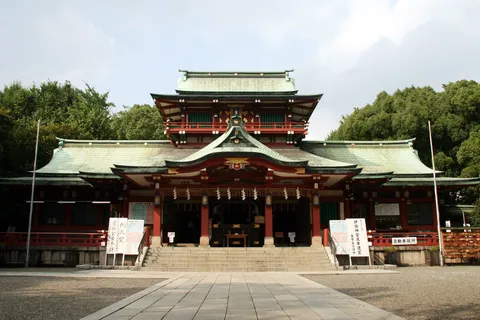
After Tokugawa Ieyasu entered Edo in 1590, Hie Jinja came to be venerated as the guardian shrine of Edo Castle and the tutelary deity (ubusunagami) of the Tokugawa shogunal family itself. The shrine’s location shifted more than once as the castle grounds expanded, and after its buildings were lost to the Great Meireki Fire of 1657, the shrine was relocated in 1659, by order of the fourth shogun Tokugawa Ietsuna, to its present site in what is now Akasaka/Nagatacho. The shrine hall built at that time was a celebrated example of early Edo-period Gongen-zukuri architecture and had even been designated a National Treasure — but in May 1945, it was destroyed in the air raids on Tokyo, with only the subsidiary Sanno Inari Shrine surviving the flames. After the war, parishioners and supporters funded a reconstruction effort, and the current shrine hall was completed in June 1958.
From the Meiji era onward, Hie Jinja was ranked among Tokyo’s junchokusaisha (semi-imperially-venerated shrines), and today it is counted as one of the “Tokyo Ten Shrines” alongside Kanda Myojin and Tomioka Hachimangu. Standing in Nagatacho, within walking distance of the Imperial Palace, the National Diet Building, and the Prime Minister’s Office, Hie Jinja has long been revered as “Guardian of the Imperial Castle,” and remains one of central Tokyo’s foremost shrines, still drawing devotion from the worlds of politics and business today.
Highlights
One of Hie Jinja’s most photographed sights is the tunnel of vermillion torii gates lining the Inari approach path. Climbing this Fushimi-Inari-style corridor of stacked torii leads to the subsidiary Sanno Inari Shrine and Sarutahiko Shrine. The sight of torii gate after torii gate rising up the stone steps makes visitors forget, for a moment, that they’re in the middle of Tokyo.
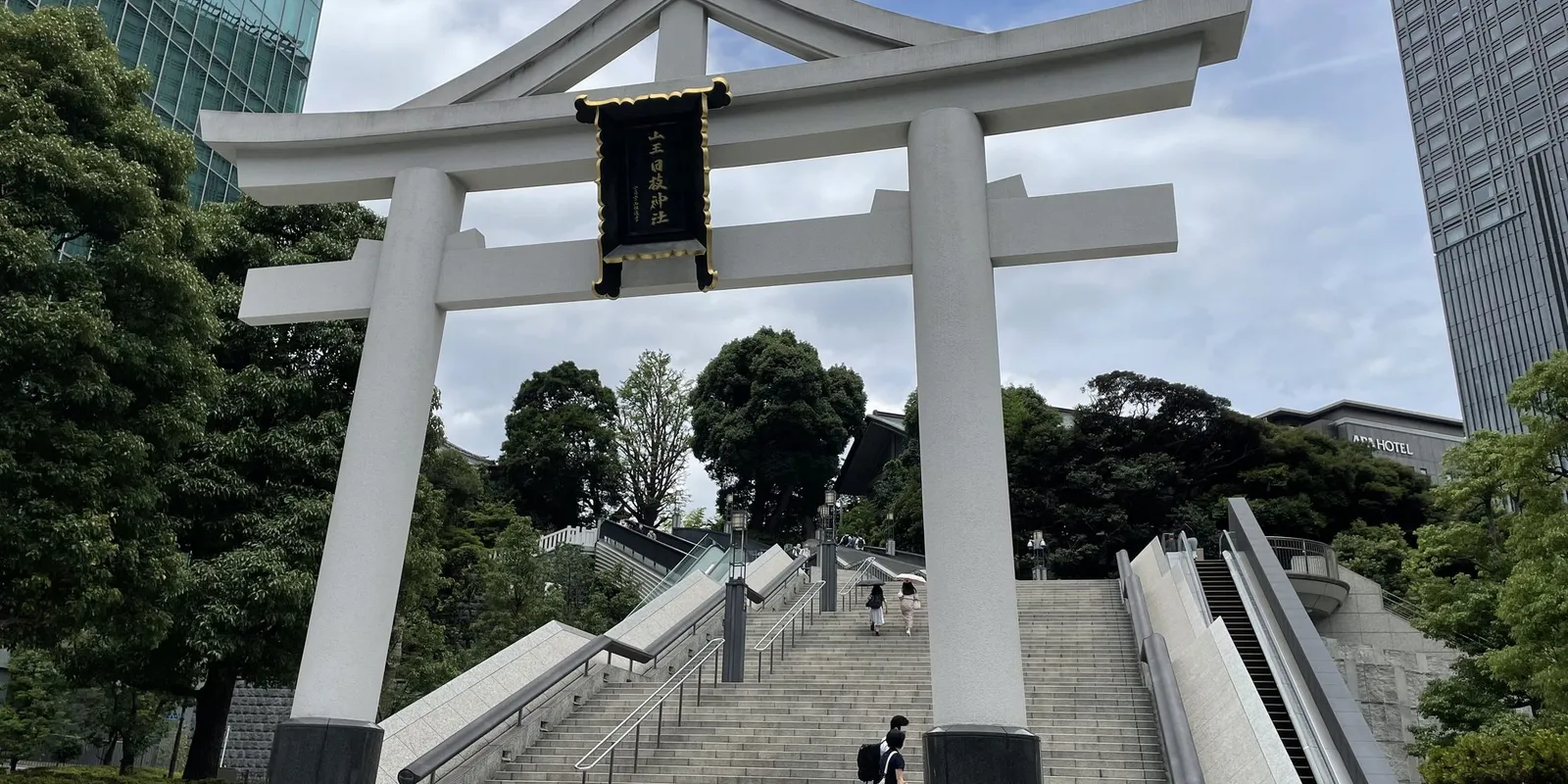
The shrine’s other famous feature is the escalator installed beside the great Sanno torii gate on the Tameike-sanno Station side. In addition to the steep stone stairways of the Onnazaka (women’s slope) and Otokozaka (men’s slope), this escalator lets visitors in kimono, those with mobility difficulties, and parents with small children reach the shrine grounds without climbing. Such a facility is highly unusual for a historic shrine in the middle of the city, and Hie Jinja is frequently featured in the media as “the shrine with an escalator.”
Also not to be missed is the pair of monkey statues placed before the worship hall. Oyamakui-no-Kami, the shrine’s principal deity, is said to have the monkey as his messenger, known as “Masaru” — a name that plays on Japanese words for “to surpass” and “evil retreats,” making it an auspicious symbol. On the right stands a male monkey wearing an eboshi cap; on the left, a female monkey cradling her baby. Because monkeys are known to give birth easily and bear many young, they are associated with blessings for safe childbirth and conceiving children, as well as marital harmony and good relationships — a particular draw for women visitors.
Visiting Tips
The shrine grounds are open 6:00–17:00, but the office where goshuin and amulets are available closes earlier, at 16:00, so it’s worth allowing enough time. Access is excellent from either Kokkai-Gijidomae or Tameike-sanno stations, both about a 5-minute walk, and it’s common to see suit-clad office workers stopping by to pray on weekday mornings.
Besides the traditional Otokozaka and Onnazaka stone stairways of the main approach, there’s a route with an escalator on the Tameike-sanno Station side — a convenient option for anyone with mobility concerns or traveling with young children. After paying your respects at the worship hall, take some time to walk through the vermillion torii tunnel of the Inari approach and admire the monkey statues in front of the hall. The shrine gets extremely crowded during New Year’s and the Sanno Matsuri, so a weekday morning is the best time to visit if you prefer a quieter atmosphere.
Annual Festivals
- Sanno Matsuri (annually in June; the grand procession is biennial): Hie Jinja’s principal festival, ranked alongside Kanda Myojin’s Kanda Matsuri and Tomioka Hachimangu’s Fukagawa Matsuri as one of Edo’s three great festivals. Because Edo-era shoguns reviewed its procession in person, it was also known as the “Tenka Matsuri” (“Festival Under Heaven”). The grand Shinkosai procession — a lavish parade of mikoshi and floats through the area around the Imperial Palace, Ginza, and Nihonbashi — alternates with the Kanda Matsuri and is held in even-numbered years (most recently June 12, 2026).
- Setsubun Festival (early February): A bean-throwing ritual to drive away misfortune and invite good luck for the year ahead.
- Sanno Summer Purification (June 30): A ritual passage through a great chinowa ring of woven grass to purify the sins and impurities of the past six months.
- New Year’s Visit (January): As a shrine in the heart of Tokyo’s business district, and a noted power spot for good relationships and conceiving children, Hie Jinja draws large crowds during the first three days of the New Year.
Nearby Food & Sightseeing
- Akasaka Sacas: A short walk from Hie Jinja, this entertainment complex built around the TBS broadcast center is packed with restaurants and shops, making it a convenient stop before or after a visit to the shrine.
- Akasaka’s back streets (around Hitotsugi-dori): A sophisticated district lined with long-established Japanese restaurants, izakaya, and bars — many visitors combine a shrine visit with a meal in Akasaka’s dining scene.
- National Diet Building: Within walking distance of Hie Jinja. Reservation-based tours of the House of Councillors and House of Representatives let visitors see the heart of Japanese politics up close.
- Akasaka Hikawa Jinja: Another of the Tokyo Ten Shrines, this quiet, historic shrine retains a shrine hall dating to the Kyoho era (early 18th century). Just a short walk from the bustle of Akasaka, it’s often visited together with Hie Jinja.
Frequently Asked Questions
- Q. What are the visiting hours?
- A. The shrine grounds are open 6:00–17:00. The office where you can receive goshuin and amulets is open 8:00–16:00, and prayer services and the treasure hall are available 9:00–16:00.
- Q. Can I get a goshuin here?
- A. Yes, at the shrine office just behind and to the left of the worship hall, open 8:00–16:00, for a fee of ¥500.
- Q. How do I get to Hie Jinja?
- A. It's a 5-minute walk from Exit 5 of Kokkai-Gijidomae Station on the Tokyo Metro Chiyoda Line, or just 3 minutes from Exit 7 of Tameike-sanno Station on the Ginza/Namboku Lines. Beside the large Sanno torii gate on the Tameike-sanno side, an escalator runs alongside the stone steps of the main approach, so you can reach the grounds without climbing the hill on foot.
- Q. Is parking available?
- A. Yes, there's a parking area for worshippers, accessed via the Onnazaka (women's slope) entrance. Space is limited and it gets very crowded during New Year's and the June Sanno Matsuri, so public transport is recommended at those times.
- Q. What is the Sanno Matsuri, and what do the monkey statues at the shrine mean?
- A. The Sanno Matsuri is Hie Jinja's grand annual festival, ranked alongside Kanda Myojin's Kanda Matsuri and Tomioka Hachimangu's Fukagawa Matsuri as one of Edo's three great festivals. Its grand procession, the Shinkosai — a parade of mikoshi and floats through central Tokyo near the Imperial Palace and Ginza — is held every other year (even-numbered years), most recently scheduled for June 12, 2026. The monkey statues in the shrine grounds represent "Masaru," the divine messenger of Oyamakui-no-Kami; the name plays on Japanese words meaning both "to surpass" and "evil retreats." Because monkeys give birth easily and have many offspring, they're associated with blessings for safe childbirth, conceiving children, marital harmony, and good relationships.
Related Shrines
Tokyo, Minato Ward
Shiba Daijingu
Shiba Daijingu
- Good Fortune
- Business Prosperity
- Good Relationships
Tokyo, Bunkyo
Nezu Jinja
Nezu-jinja
- Good Relationships
- Academic Success
- Protection from Misfortune
Tokyo, Koto Ward
Tomioka Hachimangu
Tomioka Hachiman-gu
- Victory in Competition
- Luck in Competition
- Business Prosperity