History
Nezu Jinja traces its origins back roughly 1,900 years, to a legend that the mythic prince Yamato Takeru enshrined Susanoo-no-Mikoto here during his eastern military campaign. The shrine originally stood in nearby Sendagi, but its move to the current site was set in motion by an unlikely twist of Tokugawa family politics.
The land where Nezu Jinja now stands was once the residential estate of Tokugawa Tsunashige, lord of the Kofu domain and elder brother of the 5th shogun, Tokugawa Tsunayoshi. When Tsunayoshi failed to produce an heir, he adopted Tsunashige’s son, Tsunatoyo — later the 6th shogun, Tokugawa Ienobu — and resolved to build Ienobu a grand shrine on the family’s own land as his tutelary “ubusuna” deity. Completed in 1706, the project produced a full set of Gongen-zukuri style buildings — a main hall, worship hall, and connecting offering hall, together with the Kara-mon gate, Ro-mon gate, latticed fence, and west gate — built at shogunal expense as part of a “tenka-bushin” project. These seven surviving structures are now designated National Important Cultural Properties, forming one of the finest intact examples of early Edo-period shrine architecture anywhere in Japan.
Since the Meiji era, Nezu Jinja has been counted among the “Tokyo Ten Shrines,” and it remains the guardian shrine of the Nezu, Sendagi, and Mukogaoka neighborhoods, deeply woven into the daily life of this atmospheric old quarter of the city.
Highlights
The centerpiece of Nezu Jinja is its nearly complete set of Edo-period Gongen-zukuri buildings. The complex, linking the main hall and worship hall through an offering hall, is decorated throughout with vividly colored carvings and lacquerwork, its weathered grandeur a testament to more than 300 years standing largely unchanged. Together with the Kara-mon and Ro-mon gates and the surrounding latticed fence, the whole ensemble is nationally protected — a rare chance to see, in the middle of central Tokyo, the same early Edo architectural style found at the far grander Nikko Toshogu.
To the west of the main halls lies the shrine’s azalea garden, said to trace back to Kirishima azaleas that Tsunashige brought from Tatebayashi in Kozuke province (present-day Gunma), where he had once been domain lord and which was already famed for its azaleas. Today the roughly 2,000-tsubo garden holds some 3,000 bushes across 100 varieties, and their simultaneous bloom from mid-April to early May is a spectacular sight, drawing large crowds each year for the “Bunkyo Azalea Festival.”
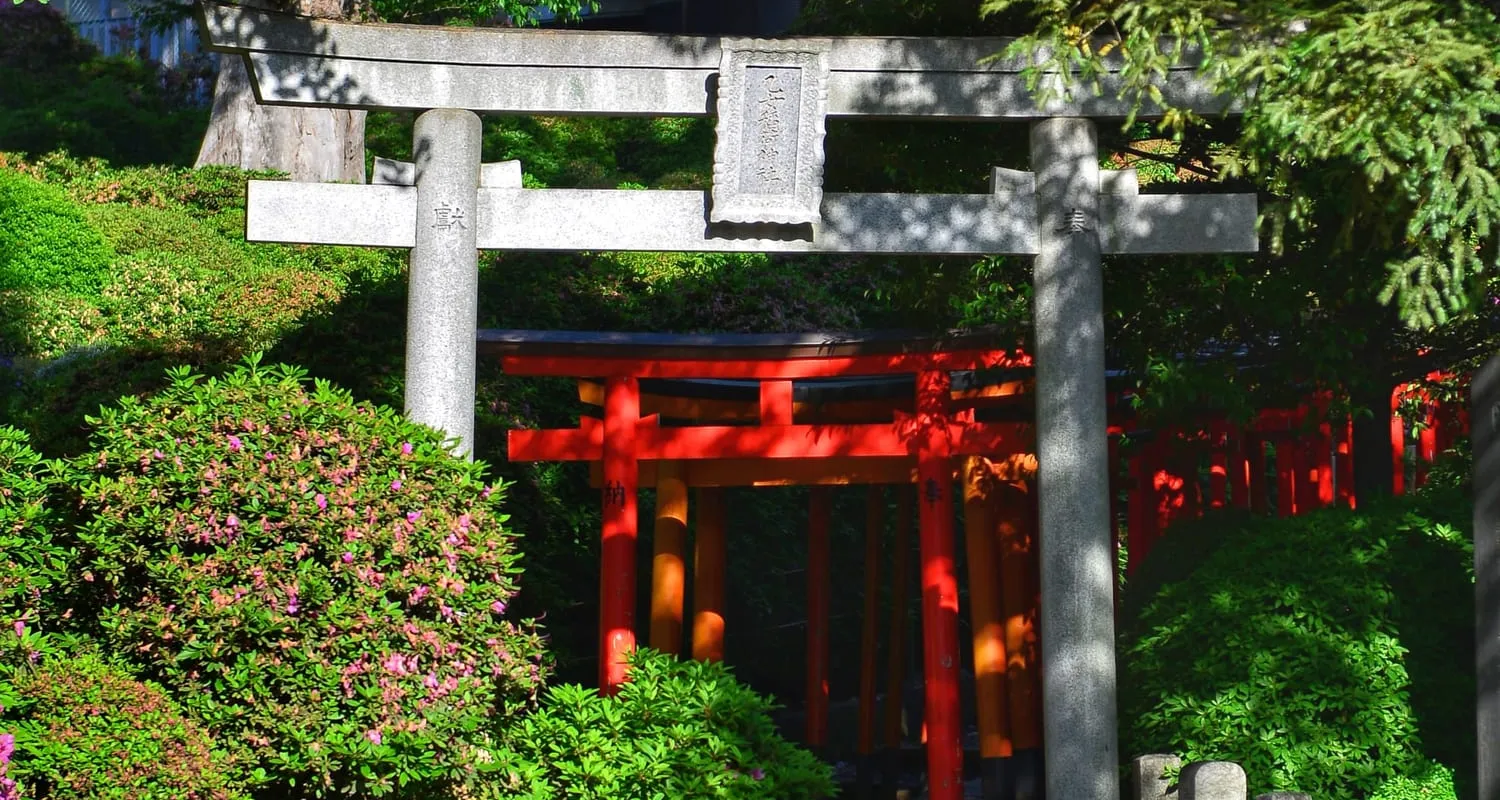
Beyond the azalea garden, a path lined with tightly packed vermillion torii gates — a miniature “senbon torii” tunnel — leads to the sub-shrine Otome Inari Jinja. Though far smaller in scale than the famous tunnel at Fushimi Inari, it offers a strikingly mysterious, almost otherworldly stretch of path in the heart of the capital, and has become a favorite photo spot for visitors from abroad.
Visiting Tips
The formal route to the shrine runs through the Ro-mon gate on the main approach, then through the Kara-mon gate to the main hall. The grounds themselves are free to explore at any time, but note that during the azalea festival some years a small entry donation is requested for the azalea garden itself — it’s worth checking the official website for current details before visiting. The amulet and goshuin office keeps hours of roughly 9:30–16:30, and since the shrine also hosts many Shichi-Go-San and wedding ceremonies, it’s best to allow extra time on weekends. The senbon-torii path to Otome Inari Jinja is quietest and most atmospheric early in the morning, before the crowds arrive.
Annual Festivals
- Bunkyo Azalea Festival (mid-April to early May): Nezu Jinja’s signature event, timed to the peak bloom of the azalea garden. Food stalls line the grounds during the festival, and the shrine becomes one of central Tokyo’s most celebrated flower-viewing spots.
- Grand Festival (a weekend in mid-September): Once every four years, a “hon-matsuri” year sees the sacred palanquin (mikoshi) paraded through the surrounding parish neighborhoods; in between, a quieter “kage-matsuri” year features a joint procession of neighborhood mikoshi into the shrine grounds. The shrine’s traditional sacred dance, “Sanza no Mai,” is also performed.
- Setsubun Festival (early February): A bean-throwing ritual held to pray for good health and freedom from misfortune in the year ahead.
- Shichi-Go-San Season (October–November): Families flock to the shrine for commemorative visits against the backdrop of its colorful historic buildings.
Nearby Food & Sightseeing
- Yanaka Ginza Shopping Street: A short walk from Nezu Jinja, this old-fashioned shopping street is the classic stop on any Yanesen stroll, famous for street food like menchi-katsu (minced meat cutlets) and croquettes.
- Kayaba Coffee: A retro café in a wooden building dating to 1938, famous for its long lines, egg sandwiches, and pudding.
- HAGISO: A 68-year-old wooden apartment building converted into a cultural complex, with a ground-floor café known for its seasonal menu of shaved ice and curry.
- Former Yasuda Kusuo Residence and Garden: A preserved Taisho-era businessman’s house and garden, a designated Bunkyo Ward cultural property and a fitting stop alongside the Yanesen area’s other historic architecture.
Frequently Asked Questions
- Q. What are the visiting hours?
- A. The grounds are generally open 6:00–17:00, though closing time shifts seasonally (18:00 in March and September, 17:00 from November to January, 17:30 in February and October). The amulet/goshuin office keeps roughly 9:30–16:30, closing 30 minutes before the gate.
- Q. Can I get a goshuin here?
- A. Yes, from 9:00 to 17:00, starting at ¥300. Besides Nezu Jinja's own goshuin, you can also receive ones for the on-site sub-shrines Otome Inari Jinja and Komagome Inari Jinja.
- Q. How do I get to Nezu Jinja?
- A. It's about a 5-minute walk from Nezu or Sendagi Station on the Tokyo Metro Chiyoda Line, or from Todai-mae Station on the Namboku Line. Hakusan Station on the Toei Mita Line is about a 10-minute walk away.
- Q. Is parking available?
- A. There is a paid parking area on the north approach side (about 23 spaces); visitors receive a service voucher at the reception desk. Wedding and prayer-ceremony attendees can use the on-site parking for free.
- Q. When is the azalea festival?
- A. The "Bunkyo Azalea Festival" is held each year from mid-April through early May, when roughly 3,000 azalea bushes of 100 varieties bloom across the shrine's azalea garden. A small entry fee (around ¥200 for adults) is typically charged for the garden during the festival period.