History
Hinokuma Jingu and Kunikakasu Jingu are two separate Shinto shrines sharing a single precinct in Wakayama City, Wakayama Prefecture — an arrangement found almost nowhere else in Japan. Together they are affectionately known as Nichizengu, and for centuries the paired shrines have been venerated as the ichinomiya, or highest-ranked shrine, of former Kii Province.
Shrine tradition traces its origin to the 2nd year of Emperor Jinmu’s reign. Amenomichine no Mikoto, ancestor of the Kii clan (Kii no Kuni no Miyatsuko), was appointed governor of Kii Province following Emperor Jinmu’s eastern campaign and is said to have enshrined the two sacred mirrors at Kemi, in Nagusa District along the Kii coast (part of present-day Wakayama City). The shrine was later moved to its current site in Akizuki during the 16th year of Emperor Suinin’s reign, where it has remained ever since.
The two mirrors carry a mythology closely tied to Ise Jingu. According to the Nihon Shoki, when Amaterasu Omikami withdrew into the heavenly rock cave, the mirror-making deity Ishikoridome no Mikoto cast trial mirrors before completing the Yata no Kagami — the sacred mirror that would ultimately become Amaterasu’s own sacred object, still enshrined today at Ise Jingu’s Inner Shrine. Tradition holds that those very trial mirrors are Hinokuma Jingu’s Higata no Kagami (“sun-image mirror”) and Kunikakasu Jingu’s Hiboko no Kagami (“sun-spear mirror”). Both are regarded as being of equal sanctity to the Yata no Kagami, and Hinokuma no Okami and Kunikakasu no Okami have long been treated as quasi-imperial ancestral deities on this account. Notably, neither deity was ever granted a formal court kami rank (shinkai) — an honor (or rather, the deliberate absence of one) shared only with Ise Jingu, and considered an extraordinary distinction among Japan’s shrines. It’s worth being precise about the nuance here, though: the mythology frames these mirrors as trial versions made before the Yata no Kagami was completed, a parallel origin story rather than any claim that they are senior to or more authoritative than Ise’s own sacred mirror.
Both shrines are listed as Myojin Taisha, the highest category of named shrines, in the Heian-era Engishiki shrine register, cementing their status as ichinomiya of Kii Province. In 1871 (Meiji 4), they were ranked Kanpei Taisha, the highest tier of state-supported shrines, though today the complex operates as an independent religious corporation unaffiliated with the national Association of Shinto Shrines. The shrine’s fortunes suffered during Toyotomi Hideyoshi’s 1585 campaign against Kii Province, when its landholdings were confiscated and the precinct fell into decline, but it was restored under the patronage of Tokugawa Yorinobu, the first lord of the Kii branch of the Tokugawa family, in the Edo period. The current shrine buildings date from a rebuilding carried out between 1919 and 1926, which gave the precinct its present symmetrical layout, with Hinokuma Jingu on the left and Kunikakasu Jingu on the right.
Highlights
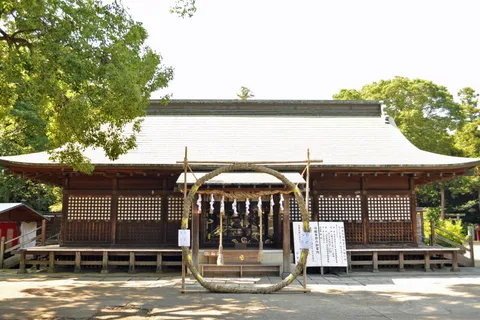
The precinct’s most distinctive feature is its symmetrical, side-by-side arrangement of two independent shrines within one sacred forest. Past the great torii gate and a stone drum bridge, the approach splits in two, leading to a separate haiden and honden for Hinokuma Jingu on the left and for Kunikakasu Jingu on the right — a rare sight not replicated at almost any other shrine in Japan.
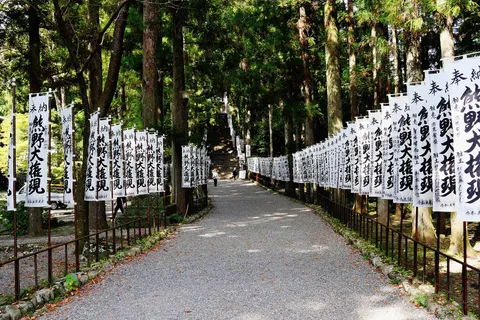
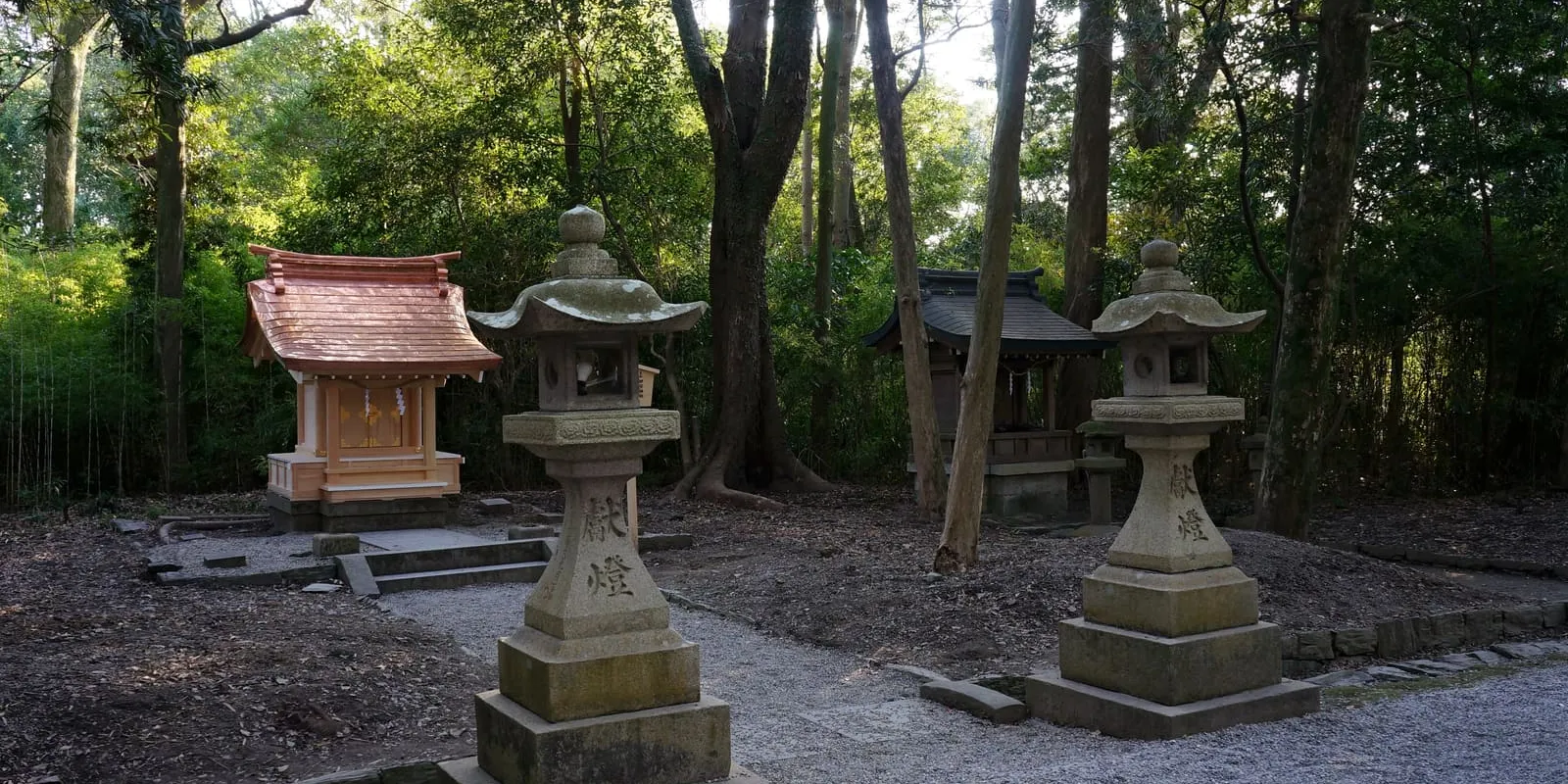
The shrine forest itself, known locally as the sacred grove of Nichizengu, is a notable feature in its own right: a swath of old-growth woodland that has survived largely intact even as central Wakayama City grew up around it. Stone lanterns donated by generations of worshippers line the approach, and visitors can also pay respects at the precinct’s subsidiary shrines — Nakagoto Jinja, dedicated to Nagusahime no Mikoto and other local deities, and Amenomichine Jinja, dedicated to the shrine’s founding ancestor — to get a fuller sense of the Kii clan’s deep historical ties to this site.
Visiting Tips
The shrine is open 9:00–16:40, with prayer and ritual reception ending at 16:00. Goshuin are available as a single pre-printed design combining both shrines’ names, for ¥300. The grounds are shaded and quiet, and an early-morning visit is especially pleasant.
Visitors arriving by car can use the free on-site parking lot (up to 100 vehicles, including large buses), but note that the area around the west gate and the stone drum bridge on the main approach is off-limits to vehicles — follow the posted signs to the correct parking area. By train, Hinokuma-jingu Station on the Wakayama Electric Railway Kishigawa Line is about a one-minute walk from the shrine.
Annual Festivals
- Setsubun Festival and Old Amulet Burning (February 3): Alongside the traditional bean-throwing of Setsubun, a ritual is held to burn amulets and talismans that worshippers have used over the past year.
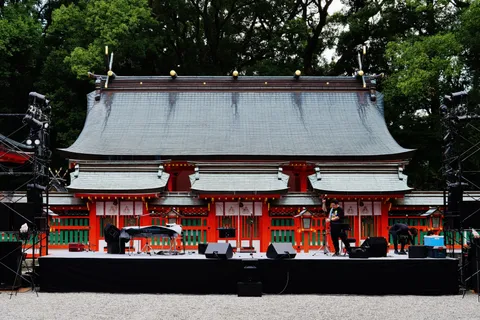
- Hinokuma-gu Takigi Noh (evening of April 8): A firelit outdoor Noh performance staged at the Kagura hall, a beloved seasonal tradition in the Kishu region. Admission is free, but numbered tickets (distributed from March 1) are required.
- Annual Grand Festival, Reitaisai (September 26): The single most important festival for both shrines, with Hinokuma Jingu’s rites beginning at 10:00 and Kunikakasu Jingu’s at 11:00.
Nearby Food & Sightseeing
- Ide Shoten: Founded in 1953, this is the original shop behind the “Ide-style” of Wakayama ramen, famous nationwide. It’s about a 5-minute drive from the shrine.
- Wakayama Castle: One of Japan’s “100 Fine Castles,” and the historic seat of the Kii branch of the Tokugawa family, standing in central Wakayama City about a 10-minute drive from the shrine.
- Kii Fudoki no Oka: A museum and archaeological park built around the Iwase Senzuka Tumulus Cluster, a nationally designated Special Historic Site believed to be the burial ground of the ancient Kii clan whose ancestor founded this very shrine.
Frequently Asked Questions
- Q. Who is enshrined at Hinokuma Jingu and Kunikakasu Jingu, and what are their sacred objects?
- A. Hinokuma Jingu, on the left as you enter, enshrines Hinokuma no Okami, embodied in the sacred mirror Higata no Kagami. Kunikakasu Jingu, on the right, enshrines Kunikakasu no Okami, embodied in the sacred mirror Hiboko no Kagami. Both mirrors are kept deep within their respective main halls and are not visible to visitors.
- Q. Can I receive a goshuin here?
- A. Yes. Goshuin are available 9:00–16:40 for ¥300. A single pre-printed (kaki-oki) design combining both shrines' names is offered; goshuin are not hand-written into your own book on the spot, nor inscribed into a dedicated ichinomiya goshuin book.
- Q. How do I get to Hinokuma Jingu and Kunikakasu Jingu?
- A. The shrine is directly outside Hinokuma-jingu Station on the Wakayama Electric Railway Kishigawa Line. From JR Wakayama Station it's about a 10-minute bus ride to the "Hinokuma-gu-mae" stop, and by car it's roughly 5 minutes from Wakayama Interchange on the Hanwa Expressway.
- Q. Is there parking at the shrine?
- A. Yes, free on-site parking is available for up to 100 vehicles, including large tour buses. Vehicles cannot pass or park near the west gate or the stone drum bridge on the main approach, so follow the posted signage.
- Q. What is the shrine's connection to Ise Jingu?
- A. According to the Nihon Shoki, when Amaterasu Omikami hid herself in the heavenly cave, the mirror-making deity Ishikoridome no Mikoto is said to have cast trial mirrors before completing the Yata no Kagami, the sacred mirror ultimately enshrined at Ise Jingu. Tradition holds that those trial mirrors are the very Higata no Kagami and Hiboko no Kagami enshrined here, considered mirrors of equal sanctity to Ise's own. Uniquely among Japan's shrines, neither this shrine's deities nor those of Ise ever received a formal court-bestowed kami rank, reflecting their shared status as quasi-imperial ancestral deities. That said, this mythology positions the mirrors here as trial pieces made before Ise's mirror was completed — it is a parallel, not a claim that they outrank or predate Ise's own sacred mirror in status.