History
Masumida Jinja stands in the center of Ichinomiya City, Aichi Prefecture, and is the ichinomiya (chief shrine) of former Owari Province. According to shrine tradition it was founded in the 33rd year of the legendary Emperor Jimmu, and it enshrines Ame-no-Hoakari-no-Mikoto, the ancestral god of the Owari clan, which governed and developed the region. The name “Masumida” is said to come from the paddy fields that the clear irrigation water of the Kiso River once made possible here.
In the Heian period the shrine was recorded as a Myojin Taisha in the Engishiki register of shrines, and its court rank rose in the ninth century from Junior Fifth Rank, Lower Grade to Senior Fourth Rank, Upper Grade. Revered as Owari’s ichinomiya by provincial governors and common people alike, it is traditionally said to have received many bugaku dance masks from Emperor Juntoku in the Kamakura period, and these masks are still preserved at the shrine today. In the Edo period the shogunate granted it a shrine estate of 333 koku, and Tokugawa Yoshinao, lord of Owari Domain, carried out major repairs in 1631. The shrine was ranked as a minor national shrine (Kokuhei-shosha) in 1885 and raised to a middle-rank national shrine (Kokuhei-chusha) in 1914; today it is a Beppyo shrine of the Association of Shinto Shrines.
The shrine buildings were destroyed in the wartime air raids of 1945. The main hall and other buildings were rebuilt in 1957, followed by the two-story gate (romon) in 1961, and the sub-shrine Hatori Jinja was built to the right of the main hall in 1965.
Enshrined Deities
The principal deity is Ame-no-Hoakari-no-Mikoto, described as a grandson of the sun goddess Amaterasu and revered since ancient times as the ancestral god who opened up the Owari region. The sub-shrine Hatori Jinja on the grounds enshrines Yorozuhata-Toyoakitsushi-hime-no-Mikoto. Because Ichinomiya is a famous textile town, she is also beloved as a matchmaking deity who, like threads woven together, binds people to one another.
Why the City Is Called “Ichinomiya”
The city of Ichinomiya takes its name from Masumida Jinja’s status as the ichinomiya of Owari Province. According to the shrine’s official website, about one city and six towns across Japan carry the name “Ichinomiya,” but Ichinomiya is the only one with city status. The shrine’s website also notes that Owari’s ninomiya is Oagata Jinja in Inuyama, so the first- and second-ranked shrines of Owari both stand within the same former province.
Cultural Properties and Highlights
The shrine holds twelve wooden bugaku masks (Kamakura to Nanbokucho periods) and 25 pieces of red lacquerware (Muromachi period), all designated Important Cultural Properties of Japan. A further seven bugaku masks are said to be designated as Aichi Prefecture cultural properties. Among the buildings, the main hall and connecting corridor (2006), the Saimonden hall (2007), and the north gate with its open-work wall (2007) are Registered Tangible Cultural Properties of Japan.
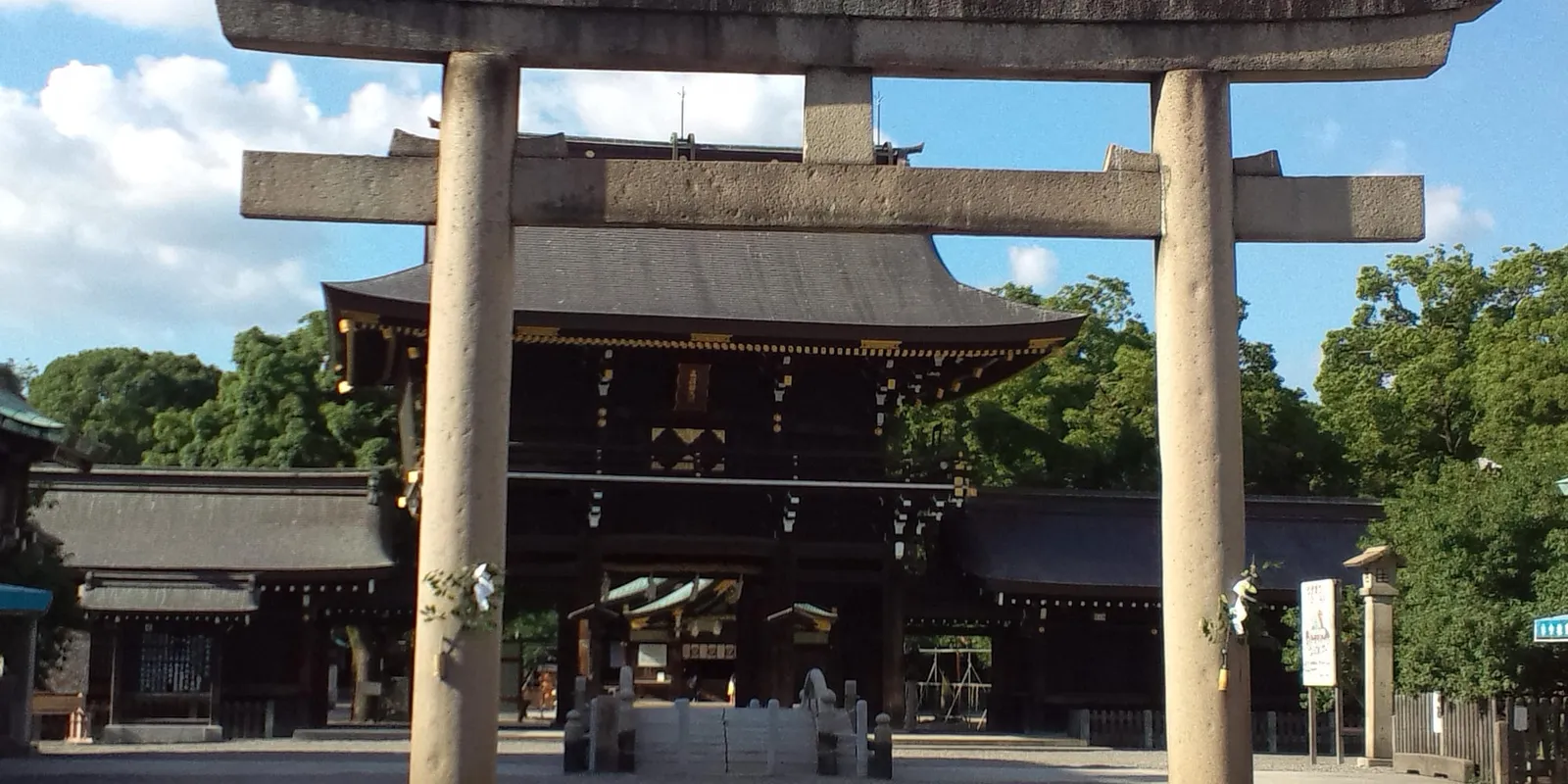
A stone torii stands on the main approach, and beyond it rises the romon gate, rebuilt in 1961. The plaque on the gate was carved by the Living National Treasure Hirakushi Denchu, modeled on an older plaque said to be in the hand of Emperor Shomu. The well at the Shinsuisha (sacred water house) is said to have supplied the water for Emperor Meiji’s midday meal when he visited Ichinomiya in 1878. The treasure hall, completed in 1989, displays heirlooms of the shrine and the horse equipment used in the Toka-sai festival.
Annual Festivals
- Toka-sai (Peach Blossom Festival) (April 3): The shrine’s main annual festival, also known as the “Horse Festival.” In ancient times peach trees grew thickly around the shrine, and the festival is said to have begun with people purifying themselves with peach branches and floating them down the Kiso River to pray for protection from misfortune. Decorated horses called “uma-no-to” accompany the portable-shrine procession, and a yabusame mounted-archery rite is held on the grounds the same day. Related rites are held on the days before: the Tanzaku-sai on April 1, and the Hosha Shinji (archery rite) and Shiraku-sai on April 2.
- Bugaku Shinji (sacred court dance rite) (April 29): The shrine has performed bugaku and kagura since ancient times, and a program of dances is offered here every April 29.
- Ichinomiya Tanabata Festival (Orimono Kansha-sai) (late July): Begun in 1956, this festival lights up summer in Ichinomiya, a textile town. It typically draws around one million visitors, and about 1.039 million were recorded in 2025. In 2026 it is the 71st festival, held July 23–26, with venues at Masumida Jinja, the Honmachi shopping street, Ginza-dori, and the area around Ichinomiya Station. It is said to trace its origins to the textile thanksgiving rite at Hatori Jinja, and the program includes the Onzo Kenpo Dai-gyoretsu, a grand procession offering ceremonial robes.
- Komahiki Shinji and Daidai Kagura (October 15): Sacred rites held in autumn.
- Wa-kuguri (Chinowa Rite) (summer): Worshippers pass through a ring of woven miscanthus reed to purify the sins and impurities of the year.
Visiting Tips
The shrine is open 9:00–17:00 every day of the year, and admission is free (prayer services are for a fee). Goshuin are handed out at the goshuin counter in the shrine office on the left side of the approach, and two kinds are available: Masumida Jinja and Hatori Jinja. Seasonal handwritten-in-advance goshuin and special New Year goshuin are sometimes offered as well. Advance reservations are not needed for prayer services, and offerings begin at ¥6,000.
Parking is in a paid dedicated lot entered from the west side of the shrine, but the shrine is only about 8 minutes on foot from the station, so the train is a convenient way to visit. If you are praying for good relationships, be sure to also visit Hatori Jinja to the right of the main hall.
Nearby Food & Sightseeing
- Honmachi Shopping Street: A shopping street stretching out in front of Masumida Jinja and one of the main venues of the Ichinomiya Tanabata Festival, decked out in colorful Tanabata decorations in season.
- Ichinomiya City Setsuko Migishi Memorial Museum of Art: A museum devoted to the works of Setsuko Migishi, a Western-style painter and honorary citizen of Ichinomiya. It lies in a different part of the city from the shrine, so plan on traveling by car or public transport. It is open 9:00–17:00 (last admission 16:30) and is closed on Mondays, among other days.
- 138 Tower Park: A riverside park along the Kiso River and one of Ichinomiya’s sightseeing spots. It is some distance from the shrine, so visiting by car is convenient.
Frequently Asked Questions
- Q. Can I get a goshuin at Masumida Jinja?
- A. Yes, at the shrine office's goshuin counter, 9:00–17:00, for a fee of ¥500. In addition to the main shrine's goshuin, one is also available for the sub-shrine Hatori Jinja on the grounds. Some older sources list the fee as ¥300, so it is worth confirming the amount when you visit.
- Q. What are the visiting hours at Masumida Jinja, and is there parking?
- A. The shrine is open 9:00–17:00 every day of the year (prayer services are received until about 16:00). A dedicated lot with about 80 spaces is available for a fee: free for the first 30 minutes, then ¥200 up to one hour and ¥100 per additional 30 minutes. The entrance is on the west side of the shrine.
- Q. How do I get to Masumida Jinja from the nearest station?
- A. It is about an 8-minute walk from either Owari-Ichinomiya Station (JR) or Meitetsu-Ichinomiya Station (Meitetsu). By car, it is about 20 minutes from the Owari-Ichinomiya IC on the Meishin Expressway, or about 10 minutes from the Ichinomiya-Higashi exit of the Nagoya Expressway Ichinomiya Route.
- Q. Is the city name "Ichinomiya" connected to Masumida Jinja?
- A. Yes. Masumida Jinja is the ichinomiya of former Owari Province, and the city of Ichinomiya takes its name from this status. Of the municipalities in Japan that carry the name "Ichinomiya," Ichinomiya is the only one with city status.
- Q. When is the Ichinomiya Tanabata Festival held?
- A. It is held over four days, Thursday to Sunday, in late July each year; in 2026 it is the 71st Orimono Kansha-sai Ichinomiya Tanabata Festival, running July 23–26. Venues include Masumida Jinja, the Honmachi shopping street, Ginza-dori, and the area around Ichinomiya Station, and a ceremony offering ceremonial robes (onzo) is held at the shrine's sub-shrine Hatori Jinja.