History
Hodosan Jinja stands at the southern foot of Mount Hodo (497m), at the northern edge of the Chichibu basin. According to shrine tradition, in the 41st year of Emperor Keiko’s reign (111 CE), the legendary prince Yamato Takeru passed through this area on his way home from a campaign to pacify Japan’s eastern provinces. Drawn to the mountain’s unspoiled beauty, he set out to climb it, but was suddenly cut off by a raging wildfire partway up, with no way forward or back. At that moment, a mountain dog appeared out of nowhere, leapt into the flames to extinguish them, and guided Yamato Takeru safely to the summit before vanishing. Recognizing the dog as a messenger (goshinshi) of Oyamatsumi-no-Kami, the mountain god, Yamato Takeru gave thanks for the gods’ protection and named the mountain “Hodo” — written with characters meaning “fire-stopping” — before enshrining three deities here: Kamiyamato-Iwarehiko-no-Mikoto (posthumously venerated as Emperor Jimmu, Japan’s legendary first emperor and an ancestral deity of the imperial line), Oyamatsumi-no-Kami, the mountain god, and Homusubi-no-Kami, the god of fire. This is traditionally regarded as the founding of Hodosan Jinja.
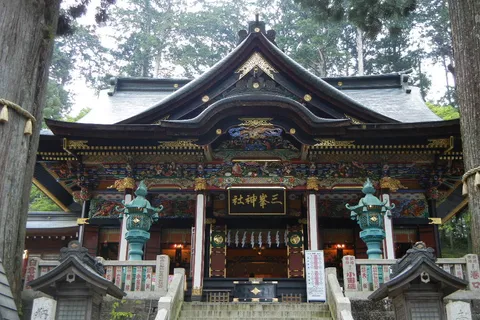
Since then, Hodosan Jinja has been venerated for centuries as one of the “Chichibu Sanja,” the three great shrines of the Chichibu region, alongside Chichibu Jinja and Mitsumine Jinja. Mitsumine Jinja is likewise associated with a wolf-messenger legend tied to Yamato Takeru’s eastern campaign, but the wolf veneration at the two shrines grew out of the same regional tradition of mountain asceticism (shugendo) in Chichibu as independent traditions in their own right — no record survives of a direct branch relationship or shared lineage between the two. From the Edo period onward, Hodosan Jinja became known for its protective power against fire and theft; in the modern era, Eiichi Shibusawa — the industrialist later called “the father of Japanese capitalism,” born in neighboring Fukaya and a driving force behind developing Nagatoro as a tourist destination — was a frequent visitor, and the shrine’s goshuin today still carries a stamp referencing “Seien,” his pen name.
Highlights
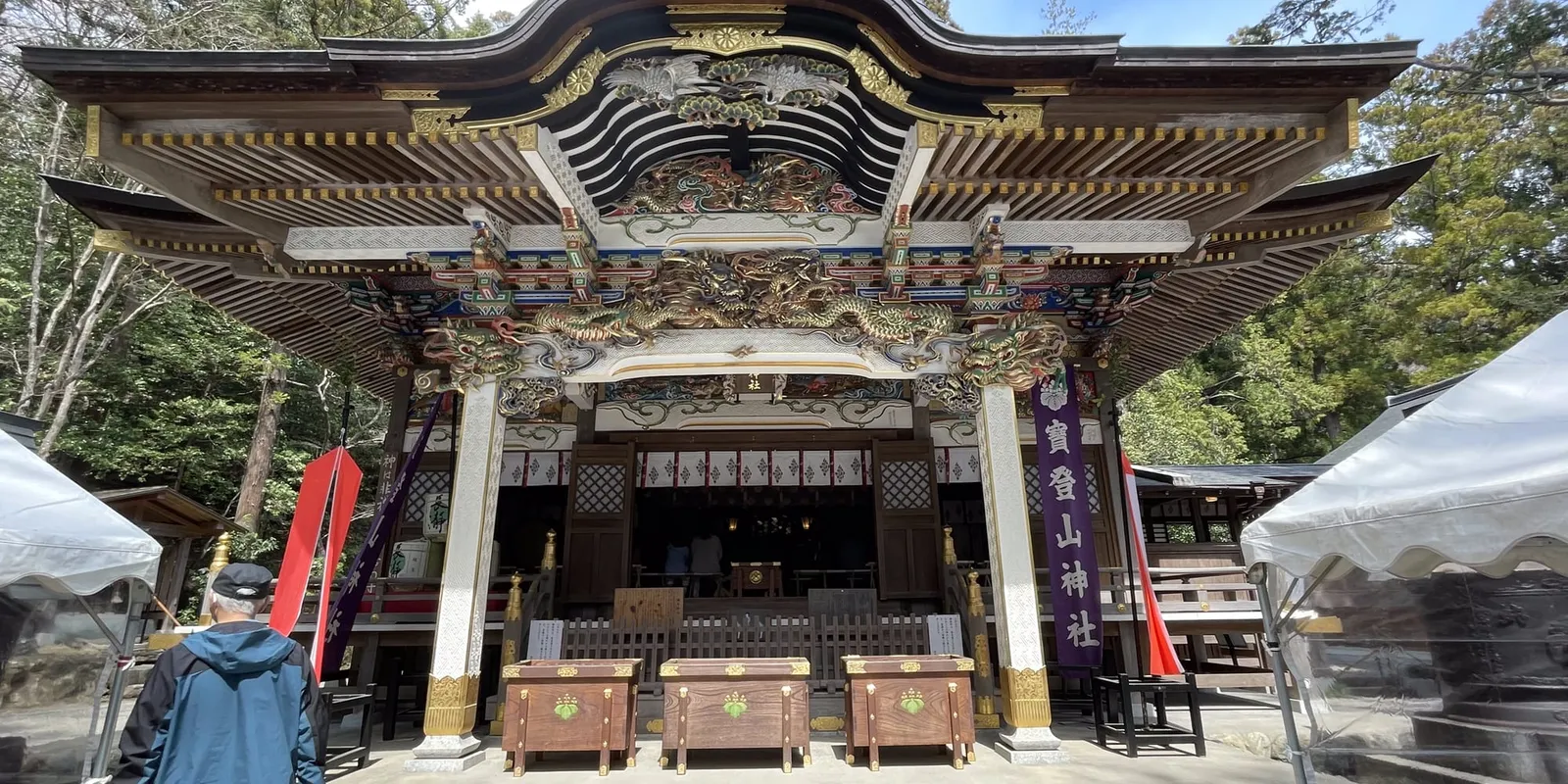
Pairs of mountain-dog statues (the shrine’s guardian messengers, known locally as Okuchi-no-Magami or simply “Oinu-sama”) stand throughout the grounds in the position usually reserved for komainu lion-dogs, a living reminder of the dog that is said to have saved Yamato Takeru — and they remain objects of devotion for protection against fire and theft. The shrine buildings, built in the ornate gongen-zukuri style with a honden, heiden, and haiden, are covered in vividly colored carvings considered some of the finest in the region.
Behind the main shrine, the Okumiya (inner shrine) near the summit of Mount Hodo is easily reached by the Hodosan Ropeway, a roughly 5-minute, 832-meter ride from a station beside the shrine. The summit area gathers the quiet Okumiya — guarded by its own pair of mountain-dog statues — alongside the Ume Hyakkaen plum garden (about 170 varieties and 470 trees, best viewed early February through late March), a wintersweet (robai) grove of around 3,000 trees that perfumes the mountainside from late December through late February, a small animal park with rabbits, monkeys, llamas and more, and the SUSABINO Terrace café with its mountain views — together making for a full day’s visit. Some visitors skip the ropeway and reach the Okumiya on foot via a hiking trail, a round trip of roughly two hours.
Visiting Tips
After paying your respects at the worship hall, take time to admire the mountain-dog statues and the shrine’s carvings up close. The shrine office, where goshuin and amulets are available, keeps hours of roughly 8:30–17:00 from April through September and 8:30–16:30 from October through March, so plan your visit with time to spare. The free parking lot in front of the shrine has limited capacity and tends to fill up by midday during the February wintersweet-and-plum season or on weekends, so arriving early or using the paid lot near the ropeway’s base station is a safer bet. If you plan to visit the Okumiya, check the ropeway’s operating hours (roughly 9:30 or 9:40 to 17:00) in advance and budget extra time for the summit.
Annual Festivals
- Wintersweet Festival (late December–late February): The roughly 3,000 wintersweet (robai) trees atop Mount Hodo bloom, filling the mountainside with their sweet winter fragrance.
- Plum Festival (early February–late March): The summit’s Ume Hyakkaen garden bursts into bloom with about 170 varieties and 470 plum trees, painting the slope red and white.
- Spring Grand Festival (April 3): The shrine’s most important annual festival, with rites beginning at 10:00 a.m. followed by a performance of sacred Hodosan kagura dance.
- Okumiya Festival (May 2): A rite held at the Okumiya near the summit.
- Funadama Festival (August 15): A Nagatoro-specific festival praying for safety on the waters of the Arakawa River.
Nearby Food & Sightseeing
- Asami Reizo Hodosando Branch: A shaved-ice shop near the shrine’s approach, founded in 1890, famous for its delicate, melt-in-your-mouth kakigori made from natural Chichibu ice — popular enough to draw queues from across the region.
- Nagatoro Iwadatami: A National Natural Monument where uplifted crystalline schist spreads out along the Arakawa River like a giant stone “tatami” floor, within walking distance of the shrine, with the cliffs of “Chichibu Red Wall” visible across the water.
- Nagatoro Line-Kudari Boat Ride: Traditional river boats departing right by the Iwadatami, taking passengers through the scenic Nagatoro gorge with narration from the boatmen.
- Chichibu Onsen Mangan-no-Yu: A day-use hot spring about 30 minutes away by car in neighboring Minano, a relaxing way to unwind after paying your respects.
Frequently Asked Questions
- Q. What are the visiting hours?
- A. The grounds can be visited at any time. The shrine office, where goshuin and amulets are available, is open roughly 8:30–17:00 from April to September and 8:30–16:30 from October to March.
- Q. Can I get a goshuin here?
- A. Yes, at the shrine office to the right of the worship hall, during office hours (roughly 8:30–17:00 April–September, 8:30–16:30 October–March), for ¥500. Seasonal limited-edition goshuin for spring, summer, autumn, and winter are also available, ¥500 each.
- Q. How do I get to Hodosan Jinja?
- A. It's about a 15-minute walk from Nagatoro Station on the Chichibu Railway. By car, it's about 25 minutes from the Hanazono Interchange on the Kan-etsu Expressway, or about 20 minutes from Seibu-Chichibu Station.
- Q. Is parking available?
- A. Yes, there's free parking right by the shrine for about 40 cars, though it can fill up by midday during busy seasons. There's also paid parking near the ropeway's base station (about 320 spaces, ¥500 per day) as a backup.
- Q. Can I reach the inner shrine by ropeway?
- A. Yes. The Hodosan Ropeway runs from a station beside the shrine to the summit of Mount Hodo (497m) in about 5 minutes (¥1,200 round trip for adults), making it easy to visit the Okumiya (inner shrine) near the top. The summit area also has a wintersweet grove, a plum garden, and a small animal park, making it a popular destination from winter through early spring.
Related Shrines
Saitama, Chichibu
Mitsumine Jinja
Mitsumine-jinja
- Protection from Misfortune
- Good Fortune
- Marital Harmony
Gunma Prefecture, Myogi-cho, Tomioka
Myogi Jinja
Myōgi-jinja
- Good Fortune
- Business Prosperity
- Protection from Fire
Shizuoka, Mishima
Mishima Taisha
Mishima Taisha
- Business Prosperity
- Good Fortune
- Victory in Competition