History
Myogi Jinja stands at the eastern foot of Mount Hakuun, the main peak of Mount Myogi — one of the “Three Mountains of Jomo” (the old name for Gunma). Shrine tradition traces its founding to 537, in the reign of Emperor Senka, when it was known as “Hakoso no Okami,” a name that appears in the Heian-period chronicle Nihon Sandai Jitsuroku. From the medieval period onward, the shrine came to venerate Yamato Takeru no Mikoto as its principal deity, later adding Toyouke no Okami, Sugawara no Michizane, and Gon-Dainagon Nagachika to form the four deities enshrined today.
During the Edo period, Myogi Jinja’s location to the northwest (inui) of Edo Castle earned it deep reverence from the Tokugawa shogunate as a guardian shrine warding off misfortune from that direction, and the shogunate funded extensive rebuilding over the centuries. The present honden, heiden, and haiden date to 1756, in the mid-Edo period. The shrine’s older main hall survives today as the separate Hakoso-sha building on the grounds, preserving a tangible link to the mountain’s ancient cult.
A Richly Decorated Gongen-zukuri Complex
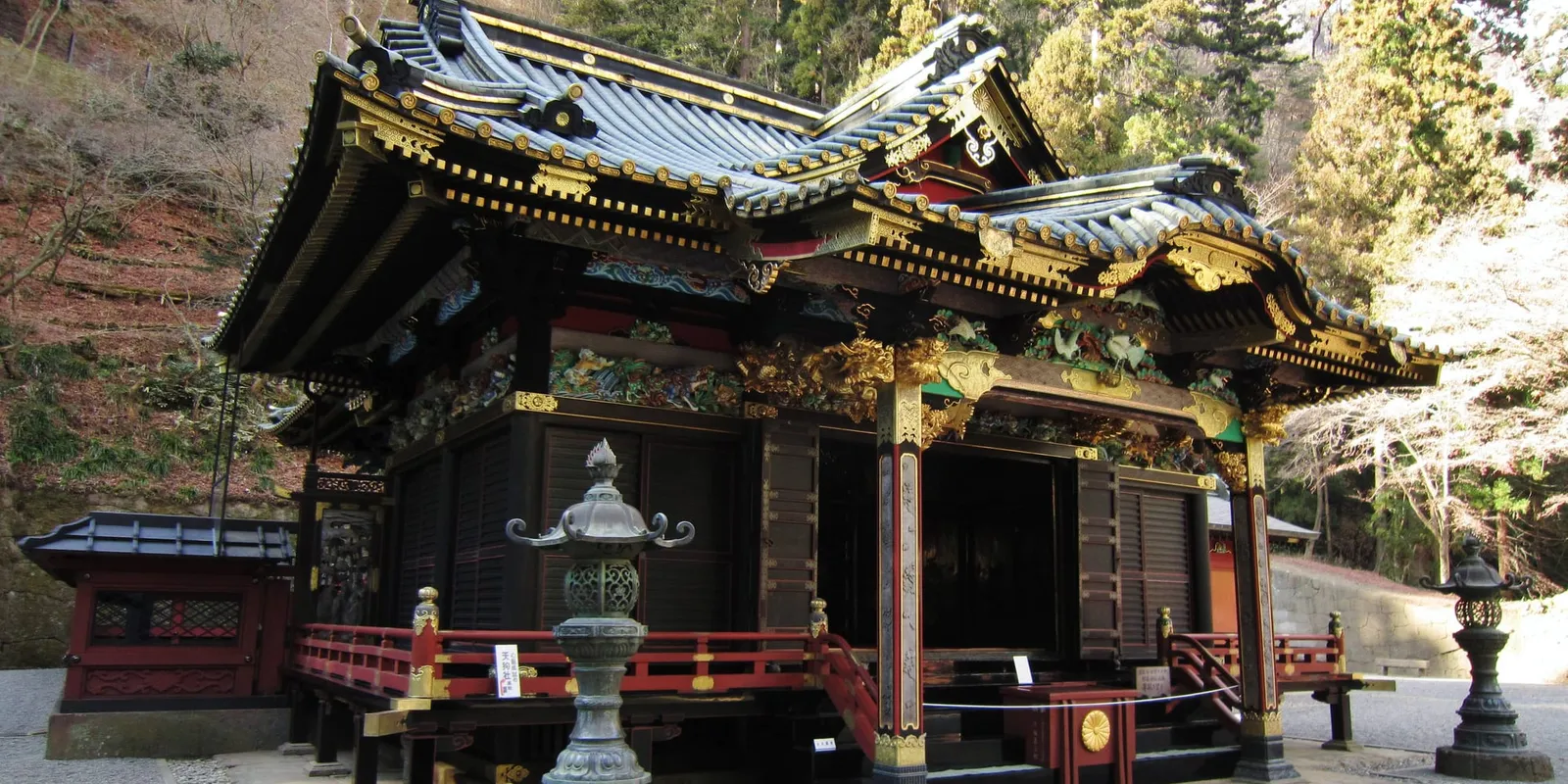
The heart of a visit to Myogi Jinja is the honden-heiden-haiden complex, reached by climbing a steep stone stairway of 165 steps past the Somon gate. Built in the Gongen-zukuri style — the same compound hall-and-corridor form used at Nikko Toshogu — the complex is finished almost entirely in black lacquer, with gilded ascending and descending dragons on its pillars, vividly painted phoenixes and birds-and-flowers on its panel walls, a carved dragon worked fully in the round on the haiden’s connecting beam, and cloud-form carving on the honden’s bracket arms. The structural timbers themselves are turned into sculpture — a density of decoration that has earned the shrine the long-standing nickname “Nikko of Jomo,” placing it in the same breath as Nikko Toshogu itself.
The honden, heiden, haiden, Karamon gate, and Somon gate were designated National Important Cultural Properties on June 5, 1981. A further designation on December 9, 2024 added the Zuishin-mon gate, corridors, bronze torii, Goten hall, shrine office, and the Hakoso-sha’s own honden and haiden, bringing the total number of designated structures to seven. The roughly 12-meter-tall Somon gate, said to be among the largest of its kind in the Kanto region, and the elaborately carved Karamon gate are destinations in their own right, well beyond the main hall alone.
Mount Myogi: One of Japan’s Three Great Strange-Rock Mountains
The mountain Myogi Jinja sits beneath is known for its jagged, needle-like rock peaks, formed as volcanic material erupted some six million years ago was sculpted over the ages by wind and rain. Together with Yabakei Gorge in Oita Prefecture and Kankakei Gorge in Kagawa Prefecture, Mount Myogi is counted among Japan’s “Three Great Strange-Rock Mountains” (Nihon Sandai Kikei) — its dramatic silhouette has long been compared to the limestone peaks of Guilin, China, and draws hikers and worshippers alike.
The Chukan-do (“mid-mountain path”) running from Myogi Jinja to Nakanotake Jinja is a roughly four-hour route that, while it includes iron stairways and chain-assisted sections, remains open to ordinary hikers — though the footing can be unstable even outside the snow season, and a helmet and proper equipment are recommended. The Omote-Myogi ridge traverse, by contrast, follows the peaks directly over Soma-dake and other summits, with a continuous run of serious chain climbs at spots like Takamodoshi, Horikiri, and Okunoin. Slip-and-fall accidents occur there almost every year, prompting the 2010 formation of the Mount Myogi Range Accident Prevention Council, with Gunma Prefecture, local municipalities, police, fire services, and mountaineering groups as members. General visitors and casual hikers are not advised to attempt the ridge traverse, and even the Chukan-do calls for caution. Trail access across the mountain is also occasionally and temporarily restricted on short notice — for example, following bear sightings — so it’s worth checking current conditions with the city of Tomioka or town of Shimonita before setting out.
Visiting Tips
Beyond the Somon gate, the 165-step stone stairway to the main hall is steep and noticeably uneven underfoot, so wear shoes suited to climbing stairs rather than casual sandals. The grounds also hold a weeping cherry tree said to be over 200 years old and a garden that borrows the shrine buildings themselves as scenery, giving the shrine a different character across the seasons — cherry blossoms in spring, vivid color in autumn.
The shrine office, just inside the Somon gate on the right, handles goshuin, goshuincho, and amulets. There is no admission fee to visit the grounds, but since the office keeps hours of 9:00 AM to 5:00 PM, it’s best to arrive with enough time to spare.
Annual Festivals
- Reisai (April 15): The shrine’s principal annual festival.
- Yamabiraki Festival (May 5): A rite praying for safety through the coming Mount Myogi climbing season.
- Momiji Matsuri (November 3): Held to coincide with the mountain’s peak autumn color against its jagged rock peaks — one of the busiest times of year for visitors and sightseers alike.
Access & Visiting Information
By car, it’s about 5 minutes from the Matsuida-Myogi interchange on the Joshin-etsu Expressway. By train, take a roughly 10-minute taxi from Matsuida Station on the JR Shin’etsu Main Line (about a 50-minute downhill walk on foot). Scheduled bus service has been discontinued, so travelers relying on public transit alone can instead use Tomioka City’s reservation-based shared taxi service, “Aitaku.” Free parking for 89 regular vehicles and 8 large vehicles is available at the “Michi-no-Eki Myogi” roadside station right next to the shrine, open 9:00 AM–5:00 PM (until 4:00 PM in winter). There is no fee to visit the shrine grounds.
Nearby Food & Sightseeing
- Michi-no-Eki Myogi: The roadside station right next to the shrine, selling local produce and the area’s famous “Mount Myogi croquette” — a convenient stop for a break, and the shrine’s main parking area.
- Nakanotake Jinja: A shrine on the opposite side of Mount Myogi, reachable via roughly a four-hour walk along the Chukan-do from Myogi Jinja. Known for its stone statue of Daikokuten, it rounds out a fuller picture of Mount Myogi’s mountain-worship tradition.
- Hot springs at the foot of Mount Myogi: A handful of day-use hot spring facilities dot the area, a welcome way for hikers and visitors to rest tired legs after a climb or a shrine visit.
Frequently Asked Questions
- Q. Can I get a goshuin here, and how much does it cost?
- A. Yes — the shrine office, just inside the Somon gate on the right, hand-writes a goshuin directly into your book for a fee of ¥500. Reception hours run from 9:00 AM to 5:00 PM.
- Q. Why are the main hall and worship hall designated Important Cultural Properties?
- A. The current honden, heiden, and haiden were built in 1756, in the mid-Edo period, in the Gongen-zukuri style, with copper-tile roofing throughout and lavish carvings finished in black lacquer and color — a level of craftsmanship that earned them, along with the Karamon gate and Somon gate, designation as National Important Cultural Properties on June 5, 1981. A further designation on December 9, 2024 added the Zuishin-mon gate, corridors, bronze torii, Goten hall, shrine office, and the Hakoso-sha's own honden and haiden — bringing the total to seven designated buildings. The decorative splendor has long earned the shrine the nickname 'Nikko of Jomo,' placing it in the same conversation as Nikko Toshogu.
- Q. Can anyone walk Mount Myogi's Chukan-do trail and its chain sections?
- A. The Chukan-do ('mid-mountain path') connecting Myogi Jinja to Nakanotake Jinja is a relatively moderate route open to ordinary hikers, though it includes iron stairways and chain-assisted sections and should only be attempted in good weather outside the snow season. By contrast, the Omote-Myogi ridge traverse over peaks like Soma-dake is a serious, advanced-only route with a continuous series of difficult chain climbs — including the notorious Takamodoshi — where slip-and-fall accidents occur almost every year; it is not recommended for general visitors or casual hikers. Trail access is also occasionally restricted on short notice, for reasons such as bear sightings, so check current conditions with the city of Tomioka or town of Shimonita before you go.
- Q. What festivals does Myogi Jinja hold?
- A. The shrine's main annual events are the Reisai festival on April 15, the Yamabiraki ('mountain-opening') festival on May 5 — a rite praying for safety through the coming climbing season — and the Momiji Matsuri (autumn leaves festival) on November 3, when the jagged peaks of Mount Myogi framed by fall color draw some of the largest crowds of the year.
- Q. How do I get to the shrine, and is there parking?
- A. By car, it's about 5 minutes from the Matsuida-Myogi interchange on the Joshin-etsu Expressway. By train, take a roughly 10-minute taxi from Matsuida Station on the JR Shin'etsu Main Line (about a 50-minute downhill walk if you go on foot). Free parking for 89 regular vehicles and 8 large vehicles is available at the 'Michi-no-Eki Myogi' roadside station right next to the shrine, open 9:00 AM–5:00 PM (until 4:00 PM in winter).
Related Shrines
Saitama, Nagatoro
Hodosan Jinja
Hodosan-jinja
- Protection from Fire
- Protection from Theft
- Business Prosperity
Nara Prefecture, Sakurai
Tanzan Jinja
Tanzan-jinja
- Academic Success
- Good Fortune
- Protection from Misfortune
Shizuoka, Mishima
Mishima Taisha
Mishima Taisha
- Business Prosperity
- Good Fortune
- Victory in Competition