History
According to shrine tradition, Ikisu Jinja’s origins trace back to the reign of Emperor Ojin, when it was first established at a site called Hikawa, somewhat west of its present location (now Hikawa, Kamisu). In 807, early in the Heian period, Fujiwara no Uchimaro, acting on the orders of Emperor Heizei, relocated the shrine to its current site in Ikisu, close to the Tone River. This date of relocation, April 13, is still observed today as the date of the shrine’s most important festival, the Reitaisai.
The principal deity is Kunado no Kami (also written with characters meaning “diverging paths”), long worshipped as a guardian of crossroads and boundaries, a protector against misfortune and of safe travel, and a god of wells. Enshrined alongside as secondary deities are Ame no Torifune no Kami, who in Japanese mythology’s kuniyuzuri story guided Takemikazuchi and Futsunushi, and the Three Sumiyoshi Deities (Sokotsutsu no O, Nakatsutsu no O, and Uwatsutsu no O), gods of maritime safety fitting for a shrine that once stood at a key point on the Tone River’s water transport routes.
Ikisu Jinja is counted, together with Kashima Jingu (Kashima, Ibaraki) and Katori Jingu (Katori, Chiba), among the “Togoku Sansha,” the Three Shrines of the Eastern Provinces. In the Nihon Shoki’s account of the kuniyuzuri myth, Kashima’s Takemikazuchi and Katori’s Futsunushi were sent down to pacify the land of Ashihara no Nakatsukuni, guided by Ikisu’s Kunado no Kami — a shared origin that binds the three shrines together in mythology as well as geography. When water transport on the Tone River flourished during the Edo period, it became popular among ordinary pilgrims returning from Ise Jingu to complete their journey with a purification visit to all three shrines, known as the “Shimo-sangu Meguri” or Togoku Sansha pilgrimage — a custom that continues to draw visitors as the “Togoku Sansha Meguri” today.
Highlights
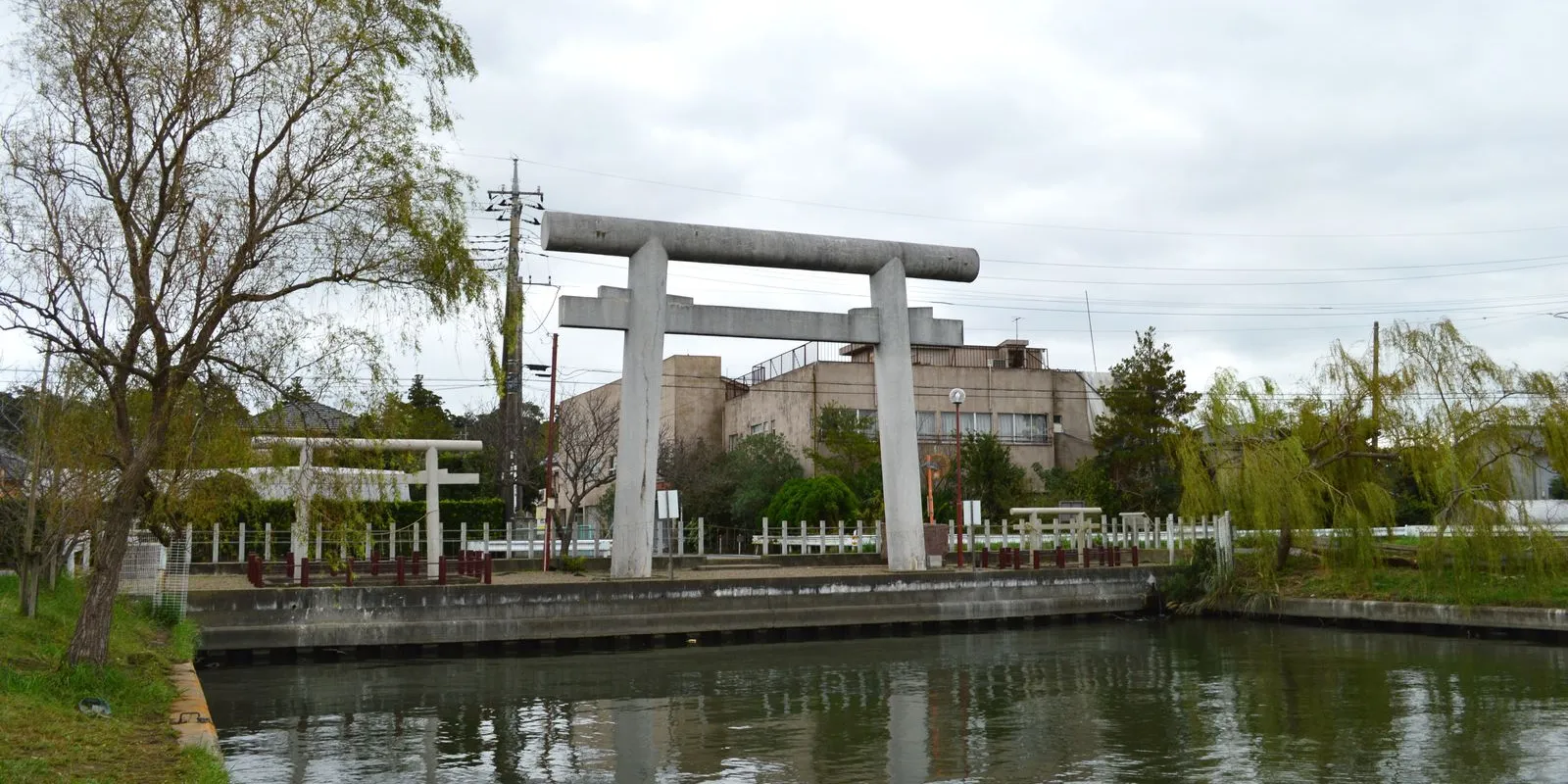
The feature that best symbolizes Ikisu Jinja is the great torii standing on the bank of the Tone River, flanked by the twin wells known as Oshioi. Each square well contains a small torii of its own; the eastern well is called the “male jar” and the western the “female jar.” Together with Ise Jingu’s Akebono-i and the Naoi well of old Yamashiro Province, Oshioi is counted among Japan’s “Three Sacred Springs” — a remarkable freshwater source that is said to have kept flowing clear for over a thousand years despite sitting in this brackish, tidal stretch of river. Tradition holds that a woman who drinks from the male jar and a man who drinks from the female jar will be bound together, and Oshioi is accordingly also known as a spot for blessings in relationships.
Beyond the approach and through the shrine gate lies a quiet compound centered on the haiden (worship hall) and honden (main hall). The honden was rebuilt in 1723, destroyed by fire in 1960, and reconstructed in 1963. The grounds also include a chikaraishi (traditional strength-testing stone) and several subsidiary shrines, including an Inari shrine associated with business prosperity and bountiful harvests, all reflecting Ikisu Jinja’s standing as one of the Togoku Sansha.
Visiting Tips
The grounds can be visited at any hour, but the shrine office, which handles goshuin and amulets, is open 8:30–16:00, with goshuin issued 9:00–16:00 and prayer requests (gokito) accepted 9:00–15:30. Free parking for 82 standard vehicles is available on the grounds, with room for large tour buses as well. Many visitors combine a trip here with Kashima Jingu and Katori Jingu as part of a full “Togoku Sansha” circuit in a single day; each leg of the drive between the three shrines takes roughly 30–40 minutes.
Annual Festivals
- Reitaisai Grand Festival (April 13 each year): Held on the anniversary of the shrine’s relocation to Ikisu in 807, this is Ikisu Jinja’s most important festival. The chief priest of Kashima Jingu serves as officiant and recites the ritual prayers, a tradition reflecting the deep ties between the two shrines.
- Kinensai (Prayer Festival, spring): Held as the agricultural season begins, praying for a bountiful harvest of the five grains.
- Mikoshi Procession: A portable-shrine procession through the parish neighborhoods that draws a lively crowd from the local community.
Nearby Food & Sightseeing
- Kashima Jingu: A fellow member of the Togoku Sansha, about a 30–40 minute drive from Ikisu Jinja; many visitors combine a visit to both.
- Katori Jingu: Also one of the Togoku Sansha, about a 30-minute drive from Ikisu Jinja.
- Suigo-Tsukuba Quasi-National Park irises: The wetlands along the Tone River bloom with irises in early summer, and boat tours of the waterways are also available.
Frequently Asked Questions
- Q. Who is enshrined at Ikisu Jinja?
- A. The principal deity is Kunado no Kami, worshipped since ancient times as a guardian against misfortune, a protector of travel and roads, and a god of wells. Enshrined alongside as secondary deities are Ame no Torifune no Kami, who led Takemikazuchi and Futsunushi in Japanese mythology, and the Three Sumiyoshi Deities, revered for maritime safety.
- Q. What are the goshuin hours and fee at Ikisu Jinja?
- A. The shrine office is open 8:30–16:00, and goshuin are issued 9:00–16:00 for a fee of ¥500. The seal features the shrine's name in the center and the characters for "Togoku Sansha" (Three Shrines of the Eastern Provinces) on the right.
- Q. How do I get to Ikisu Jinja?
- A. By train, it's about a 15-minute drive from Omigawa Station on the JR Narita Line (there is no station within easy walking distance, so a taxi or car is recommended). By car, it's about 15 minutes from the Itako IC or about 20 minutes from the Sawara-Katori IC on the Higashi-Kanto Expressway. Free parking for 82 standard vehicles is available on the grounds.
- Q. What is the Oshioi well at Ikisu Jinja?
- A. Oshioi is a pair of square wells flanking the great torii on the bank of the Tone River, each containing a small torii gate of its own. Known as the "male jar" and "female jar," they are said to have produced clear fresh water for over a thousand years despite sitting in a brackish tidal area, and together with Ise's Akebono-i and Yamashiro's Naoi they are counted among Japan's three sacred springs. Tradition holds that a woman who drinks from the male jar and a man who drinks from the female jar will be bound together, making Oshioi a spot associated with good relationships as well.
- Q. How is Ikisu Jinja connected to Kashima Jingu and Katori Jingu as the "Togoku Sansha"?
- A. In the Nihon Shoki's account of the "kuniyuzuri" (land-ceding) myth, Kashima Jingu's Takemikazuchi and Katori Jingu's Futsunushi were dispatched to pacify the land, guided by Ikisu Jinja's Kunado no Kami. Because of this shared origin story, the three shrines have long been known together as the "Togoku Sansha," and during the Edo period, pilgrims who had visited Ise Jingu would often complete their journey with a purification circuit of all three, known as the "Shimo-sangu Meguri." The three shrines are also known for forming a near-perfect right isosceles triangle on a map, and visiting all three together as a "Togoku Sansha Meguri" remains a popular pilgrimage today.
Related Shrines
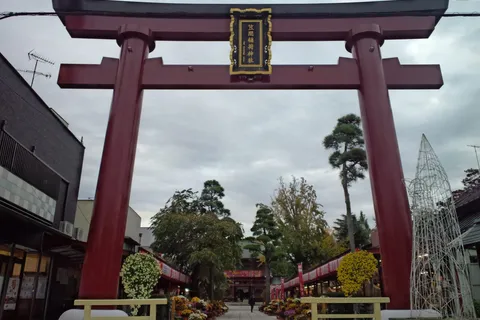
Ibaraki, Kasama
Kasama Inari Jinja
Kasama Inari-jinja
- Business Prosperity
- Bountiful Harvest
- Household Safety
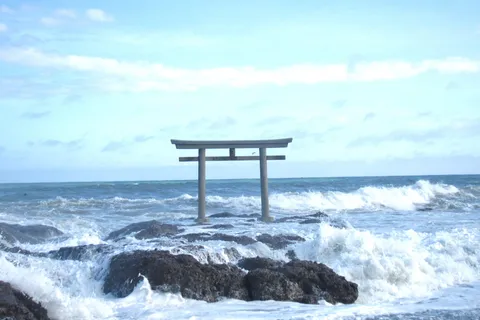
Ibaraki, Oarai
Oarai Isosaki Jinja
Ōarai Isosaki-jinja
- Maritime Safety
- Business Prosperity
- Good Relationships
Kanagawa, Hakone
Hakone Jinja
Hakone-jinja
- Good Fortune
- Protection from Misfortune
- Good Relationships