History
Imamiya Jinja stands in Murasakino, Kita Ward, Kyoto, and is read “Imamiya Jinja.” It is a different shrine from Imamiya Ebisu Jinja in Osaka. The official site names Susanoo no Mikoto, Kushinadahime no Mikoto, Onamuchi no Mikoto and Kotoshironushi no Mikoto as the enshrined deities, with the main shrine divided into west, central and east seats.
According to the official history, a shrine to plague deities is said to have stood on this site even before Heian-kyō was founded. In 994 (Shōryaku 5), to pray for the end of plague in the capital, mikoshi were made and placed on Funaoka Hill in the “Murasakino Goryō-e,” which is regarded as the origin of the Imamiya Festival. In 1001 (Chōhō 3) a Goryō-e was held again to calm the plague deities, and the shrine was named “Imamiya-sha” together with the newly built halls; this is counted as the shrine’s founding. All of this is the shrine’s own account.
The shrine later drew devotion as the tutelary shrine of Nishijin, and in the Genroku era Keishōin (Otama no Kata), mother of the fifth shogun Tokugawa Tsunayoshi, funded the rebuilding of the halls and a donation of lands. She is said to have been born the daughter of a greengrocer in Nishijin, and her rise to the Junior First Rank is also said to be the origin of the word “tama no koshi.” The shrine presents the “tama no koshi” connection as bringing blessings of good relationships and good fortune.
Highlights
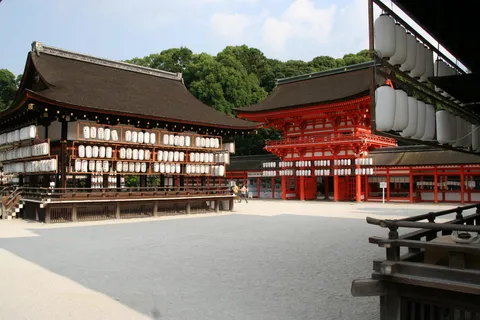
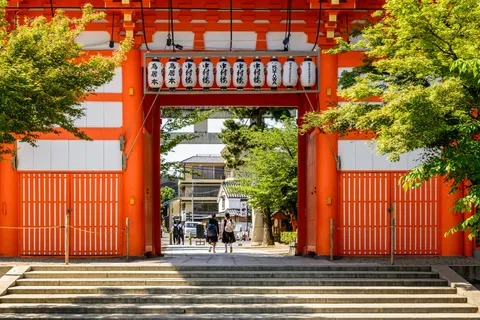
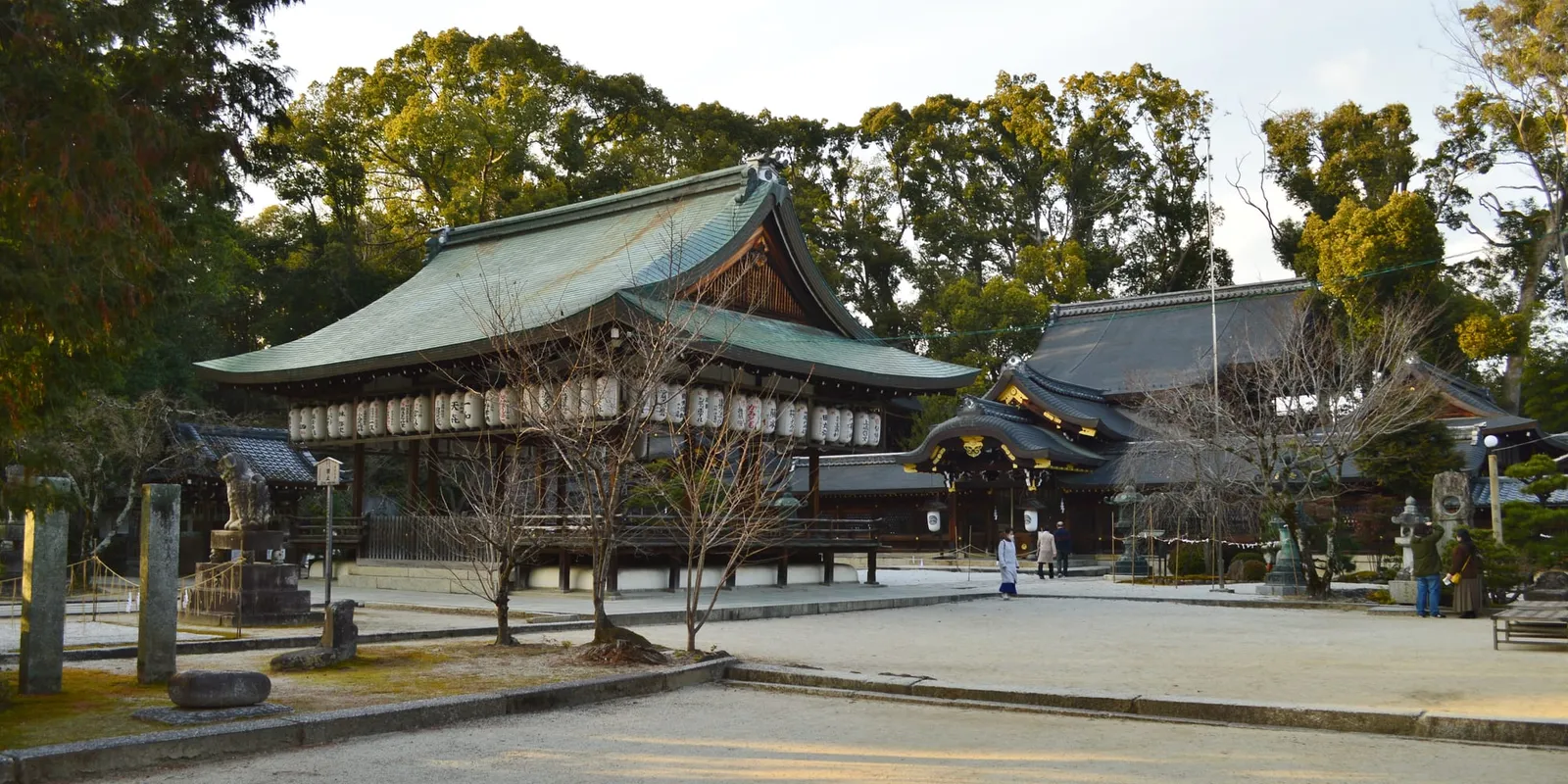
The grounds hold the main shrine, the Eki-sha and many other small shrines. According to the official cultural-property guide, besides the Important Cultural Property “Senkoku Shimen Sekibutsu” (a stone Buddhist carving), many buildings are registered national tangible cultural properties, including the main hall, worship hall, two-story gate, east and west corridors, the Hassha and the Wakamiya-sha. The worship hall was built in 1694 (Genroku 7) and renovated in 1846, the same site says.
The Wakamiya-sha has long drawn people hoping for children, and a prayer ceremony for children is held on a Day of the Dog each month. The Orihime-sha enshrines Takuhatachijihime no Mikoto, a deity of weaving, and draws people seeking skill in the arts through its ties to Nishijin weaving. The Munakata-sha has a carved catfish on its base stone, said to be a messenger of the deity, and there is also the Oda Inari-sha, which enshrines Oda Nobunaga and his retainers.
A curious rock known as “Ahokashi-san” is also called the “heavy-light stone.” According to the official site, you lightly strike it three times with your palm and lift it, then stroke it three times with a wish and lift it again; if it feels lighter, the wish is said to come true.
Visiting Tips
The official site gives no visiting hours for the grounds, only phone inquiry hours of 9:00 AM–5:00 PM. Among the amulets are the “Tama no Koshi Mamori” (good relationships and good fortune) tied to Keishōin, as well as the “Tama no Kodakara Mamori,” “Orihime Mamori,” “Sanhime Mamori” and “Yasurai Mamori” (per the official amulet notice).
According to the official site’s 2018 notice, goshuin cost ¥300 (single), ¥500 (two-panel) and ¥1,500 (three-panel), and the three-panel type comes in three colors: white peach, white navy and white scarlet. Hours and current types may change, so ask at the shrine office.
It is a short walk from the “Imamiya Jinja-mae” bus stop on City Bus 46, or about 7 minutes north of “Funaokayama” from Kitaoji Station. The dedicated paid lot has 44 spaces (regular cars only), but because the area gets crowded, public transport is recommended. The east approach keeps its stone paving and, according to the official site, is the traditional main approach; the site also notes that an entrance just west of the gate on the south approach is a relatively flat route with fewer steps.
Annual Festivals
These are the main events from the official annual schedule. Dates can change from year to year.
- Ekijin-sai (January 19): The annual festival of the Eki-jinja sub-shrine, at which “Gō-ō Hōin” talismans are given out.
- Yasurai Festival (second Sunday of April): A spring festival in which red-haired and black-haired demons dance and walk around a flower umbrella toward the shrine, at about 3:00 PM. “Yasurai Hana” is a national Important Intangible Folk Cultural Property.
- Imamiya Festival, Shinkō-sai (May 5): Three mikoshi are carried in procession from the main shrine to the otabisho, departing at 1:00 PM. The return procession (Kankō-sai) is on the second or third Sunday of May.
- Nagoshi no Harae (June 30): Visitors pass through a ring of reeds and a “Yasurai doll” is burned in a purification rite; the shrine says anyone is welcome to attend.
- Annual festival (October 9): On the eve (October 8) there is the Zenseki Shinji (eve-of-festival rite) with the Ninjō-mai dance, and the annual festival features the ritual dance “Azuma-asobi.”
- Wakamiya-sha Kodakara Kigan-sai (a Day of the Dog each month): 10:00 AM.
Nearby Food & Sightseeing
- Ichimonjiya Wasuke (Ichiwa): A teahouse selling aburimochi in front of the east gate. According to Kyoto City’s “Kyoto Irodoru Buildings and Gardens” page, it was founded in 1000 and is designated a Landscape Important Building. Check the shop for hours.
- Aburimochi Honke Nemoto Kazariya: An aburimochi shop on the south side of the east gate (per Kyoto City’s tourism site). The two shops face each other across the east approach.
- Kenkun Shrine: The official site’s access guide lists about 10 minutes on foot north from Kenkun Shrine to Imamiya Jinja.
- Daitokuji: The official access guide also gives directions from the Daitokuji area (about 5 minutes on foot north from Kōtō-in).
Frequently Asked Questions
- Q. What are the visiting hours?
- A. The official site does not state visiting hours for the grounds. What it does list is the phone inquiry time, 9:00 AM–5:00 PM, so that is a reasonable guide if you want a prayer service or amulets. On festival days things can change; for example, a 2025 notice says regular prayer services are not accepted from the morning until 2:00 PM on the day of the annual festival (October 9), so check the official site beforehand.
- Q. Can I get a goshuin at Imamiya Jinja?
- A. Yes. According to the official site's 2018 notice, the single-panel goshuin is ¥300, the two-panel goshuin featuring the flower umbrella of the Yasurai Festival is ¥500, and the three-panel goshuin with a design tied to Keishōin is ¥1,500. Hours for goshuin are not given on the site, and the types and fees can change, so ask at the shrine office when you visit.
- Q. How do I get there, and is there parking?
- A. Per the official site, City Bus 46 stops at "Imamiya Jinja-mae," right at the shrine. From Kitaoji Station on the Subway Karasuma Line, take a City Bus (such as 205 or 206) to "Funaokayama" and walk about 7 minutes north; walking from the station takes about 20 minutes west. There is a paid lot with 44 spaces (regular cars only): on regular days 9:00 AM–6:00 PM it is ¥100 for the first 60 minutes, then ¥100 per 30 minutes. Cars cannot enter the grounds and the area gets crowded, so public transport is recommended.
- Q. What is the connection between Imamiya Jinja and "tama no koshi"?
- A. According to the official site, Keishōin (Otama no Kata), mother of the fifth shogun Tokugawa Tsunayoshi, is said to have been born the daughter of a greengrocer in Nishijin and later rose to the Junior First Rank, and this is also said to be the origin of the word "tama no koshi" (marrying into great wealth). She is said to have worked hard to restore Imamiya, the guardian shrine of her home district, and the grounds contain a relief of her. The shrine offers a "Tama no Koshi Mamori" (good relationships and good fortune) amulet (see the amulet notice on the official site). The word origin is only said to be "also thought" to come from her story.
- Q. When is the Yasurai Festival?
- A. The official annual schedule gives the Yasurai Festival as the second Sunday of April, around 3:00 PM, held at the shrine. It is a "flower-calming" festival to quell plague, and it is said that standing under the flower umbrella keeps you healthy for a year. The Agency for Cultural Affairs database lists "Yasurai Hana" as an Important Intangible Folk Cultural Property (designated in 1987) and says it was inscribed in 2022 on the UNESCO Intangible Cultural Heritage list as one of the "Furyu-odori" dances.
Plan Your Visit
Before you go, you can book a stay and get your shrine-visit items ready.
Amazon links open Amazon.co.jp (Japan) in English; whether an item ships overseas depends on the product.
※ Contains ads (PR). Links open external sites such as Amazon, Rakuten, Trip.com and Booking.com.