History
Izanagi Jingu is traditionally regarded as the oldest shrine in Japan, its founding recorded within the creation myths of the Nihon Shoki and Kojiki themselves. According to these ancient chronicles, after completing the great work of creating the islands and gods of Japan, Izanagi-no-Mikoto withdrew to a secluded retirement palace — a “yukyu-no-miya” — at Taga on Awaji Island, the very first island he had created, and there spent his final years before passing away. The shrine is said to have originated when his children, including the sun goddess Amaterasu, built a sanctuary on the site of that retirement palace to enshrine him.
According to shrine tradition, only Izanagi-no-Mikoto was originally enshrined here. In 1930, however, when the inner sanctuary was opened for inspection, it was discovered that Izanami-no-Mikoto — Izanagi’s spouse deity in the creation myth — had in fact been enshrined there as well. Following an official petition, the Home Ministry granted approval in 1932 for both deities to be formally recognized as co-enshrined. As recently as 2004, nine devotional statues of Izanami dating to the Heian or Kamakura period were newly discovered at the shrine — a reminder that its history continues to yield fresh discoveries even today.
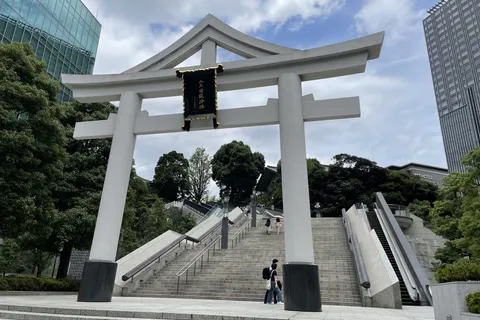
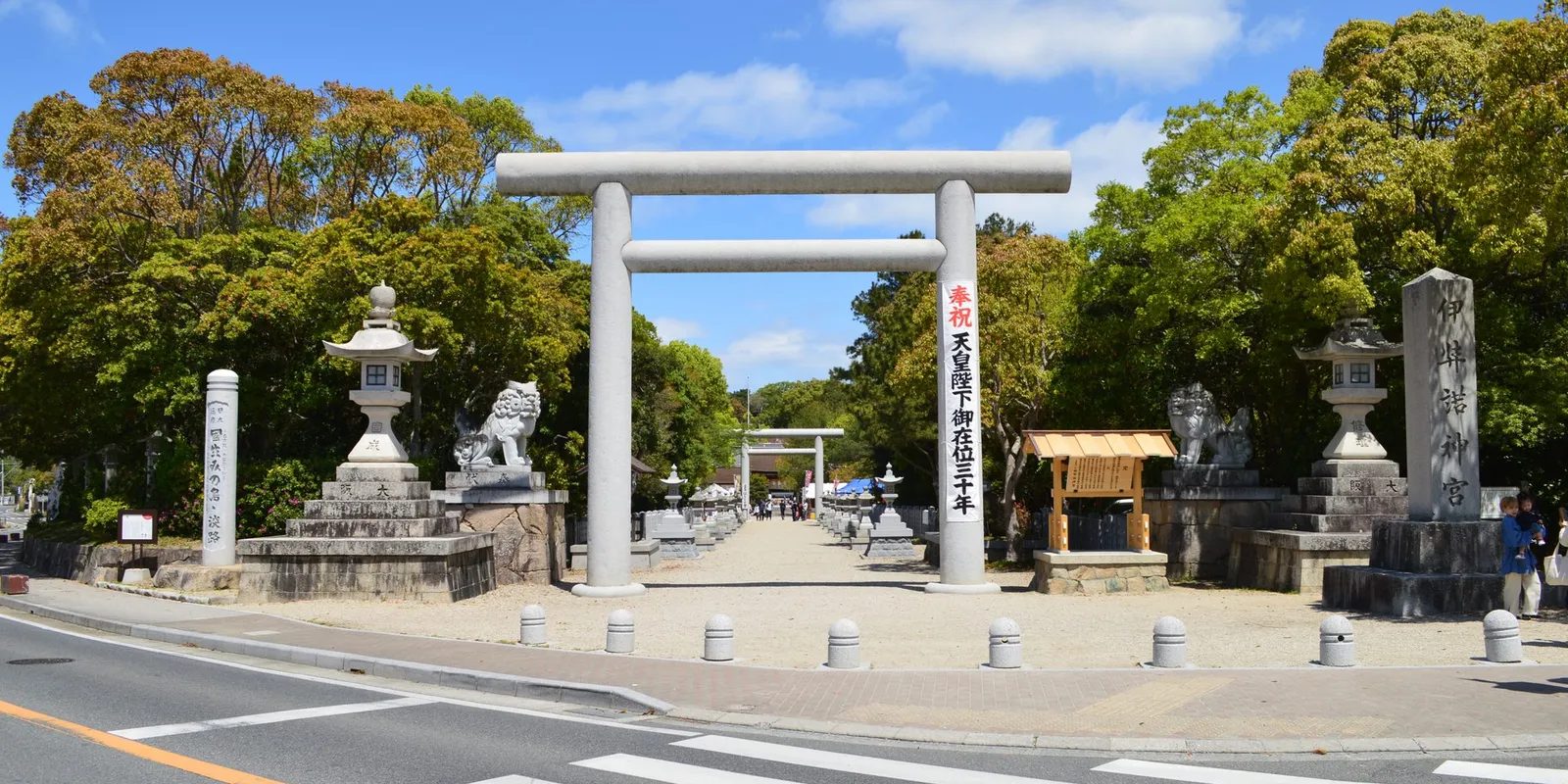
Revered since antiquity as the ichinomiya (highest-ranked shrine) of Awaji Province, Izanagi Jingu is listed as a “myojin taisha” — a shrine of great distinction — in the 927 Engishiki shrine register. The 1995 Great Hanshin-Awaji Earthquake caused serious damage to the shrine, including its great torii gate, but the gate was rebuilt in modified form by that November, and the shrine has continued ever since as the guardian shrine of all Awaji Island.
Highlights
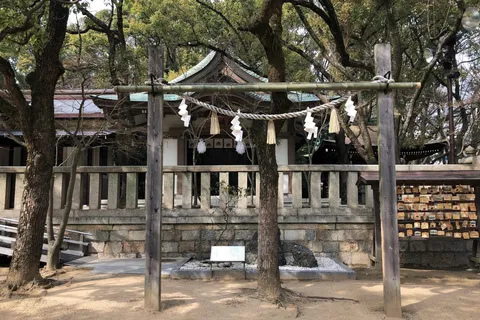
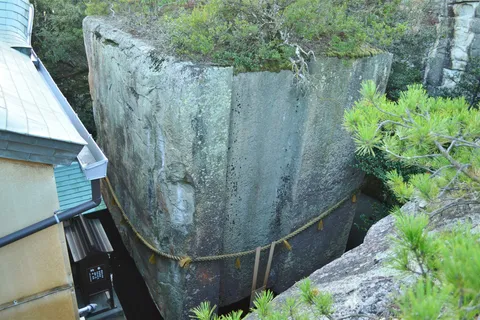
The shrine’s best-known feature is the “Meoto Okusu” (“married-couple camphor”), standing beside the sub-shrine Iwakusu-jinja within the grounds. Two enormous camphor trees, each believed to be roughly 900 years old, grew together over time until their trunks fused into one at the base — a phenomenon already recorded as the “rengri no kusu” (“intertwined camphor”) in an Edo-period gazetteer of Awaji. Now a designated Hyogo Prefecture natural monument, the sight of the two trunks standing as one draws countless visitors who come to pray for marital harmony and good relationships.
Taga, where the shrine stands, lies at very nearly the same longitude as the city of Akashi — the city that defines Japan’s 135°E standard-time meridian. It’s an evocative coincidence often noted by visitors: the shrine devoted to Izanagi-no-Mikoto, the mythic god who first created the Japanese islands, sits almost precisely on the line that today still defines Japanese time itself.
Also within the grounds is a circular monument called “Hi no Michishirube” (“Guidepost of the Sun”), which maps out Izanagi Jingu’s position relative to other major shrines across Japan — including Ise Jingu, Suwa Taisha, Izumo Taisha, and Kumano Nachi Taisha — in relation to the sun’s rising and setting points at the equinoxes and solstices, inviting visitors to reflect on the significance ancient people placed in the sun’s movements and the cardinal directions. A camphor tree said to have been planted personally by Emperor Showa in 1922 also still stands on the grounds, linking the shrine’s mythic past to more recent imperial history.
Visiting Tips
The grounds are open to the public at all hours, making it possible to visit quietly at any time of day. The approach from the great torii gate through the Omote-shinmon gate to the worship hall is spacious and unhurried, inviting a relaxed stroll through greenery that changes with the seasons. Iwakusu-jinja, home to the connected camphor trees, sits just behind the main hall, so it’s worth continuing on to see it after paying respects at the worship hall.
Goshuin and amulets are available at the shrine office between 8:30 and 17:00. Since Awaji Island has no railway line, the main way to reach the shrine by public transport is via highway bus from the Kobe or Osaka area. Visitors arriving by car will find the Tsuna-Ichinomiya Interchange on the Kobe-Awaji-Naruto Expressway most convenient, with free parking available directly in front of the shrine.
Annual Festivals
- Grand Festival (April 22): The shrine’s most important annual observance, featuring sacred dance and ceremonial offerings attended by many devotees.
- Rice Gruel Divination Festival (January 15): A Koshogatsu (Little New Year) ritual to divine the fortunes of the year’s harvest.
- Summer and Year-End Great Purification (June and December): Rites held twice a year to cleanse accumulated impurities, including passing through a large sacred ring of woven grass (chinowa).
- New Year’s Visit (January): As Japan’s oldest shrine, Izanagi Jingu draws large crowds from across Awaji Island and beyond, praying for peace and good fortune in the year ahead.
Nearby Food & Sightseeing
- Awaji City Fragrance Garden: About a 7-minute walk from the shrine, this garden is planted with roughly a thousand fragrant herbs — lavender, rosemary, and more — making it a pleasant stop after paying your respects.
- Tsuzumiya: A restaurant about a 9-minute walk from the shrine, known for its Awaji anago (conger eel) noodle dish, which pairs the region’s charcoal-grilled eel with the natural sweetness of Awaji’s famous onions.
- Hokudan Earthquake Memorial Park (Nojima Fault Preservation Museum): About a 20-minute drive away, this museum preserves and displays the actual fault line that ruptured during the 1995 Great Hanshin-Awaji Earthquake, offering one of Awaji Island’s most memorable lessons in the power of earthquakes and the importance of disaster preparedness.
- Taga-no-hama Beach: A swimming beach about a 20-minute walk from the shrine, busy with swimmers in summer and offering calm views out over the Seto Inland Sea.
Frequently Asked Questions
- Q. What are the visiting hours?
- A. The grounds are open at all times and admission is free. The office where goshuin and amulets are available keeps hours of 8:30–17:00.
- Q. Can I get a goshuin here?
- A. Yes, at the shrine office between 8:30 and 17:00, starting at ¥500.
- Q. How do I get to Izanagi Jingu?
- A. From JR Sannomiya Station, take the Sannomiya–Nishiura highway bus line for about 70 minutes and get off at the "Izanagi-jingu-mae" stop, right by the shrine. By car, it's about 3km from the Tsuna-Ichinomiya Interchange on the Kobe-Awaji-Naruto Expressway.
- Q. Is parking available?
- A. Yes, there's free parking for about 60 cars directly in front of the shrine. The main lot is open 7:00–18:00.
- Q. What is the story behind the connected camphor trees?
- A. In the grounds of the sub-shrine Iwakusu-jinja stand two ancient camphor trees, said to be roughly 900 years old, whose trunks have grown together at the base into a single tree. Known as the "Meoto Okusu" (married-couple camphor), and designated a Hyogo Prefecture natural monument, the sight of the two trunks fused as one is said to bring blessings of marital harmony and good relationships, drawing visitors from across the country.