History
Oushiko Jinja’s founding is traditionally traced to the reign of Emperor Sujin, Japan’s tenth emperor. According to shrine tradition, an epidemic was spreading through the land at the time, and the deities Oanamuchi no Mikoto (Okuninushi no Okami) and Sukunahikona no Mikoto appeared in the emperor’s dream, telling him that if they were reverently enshrined, peace would return to the realm. The epidemic is said to have subsided once the two deities were enshrined as instructed, marking the origin of the shrine.
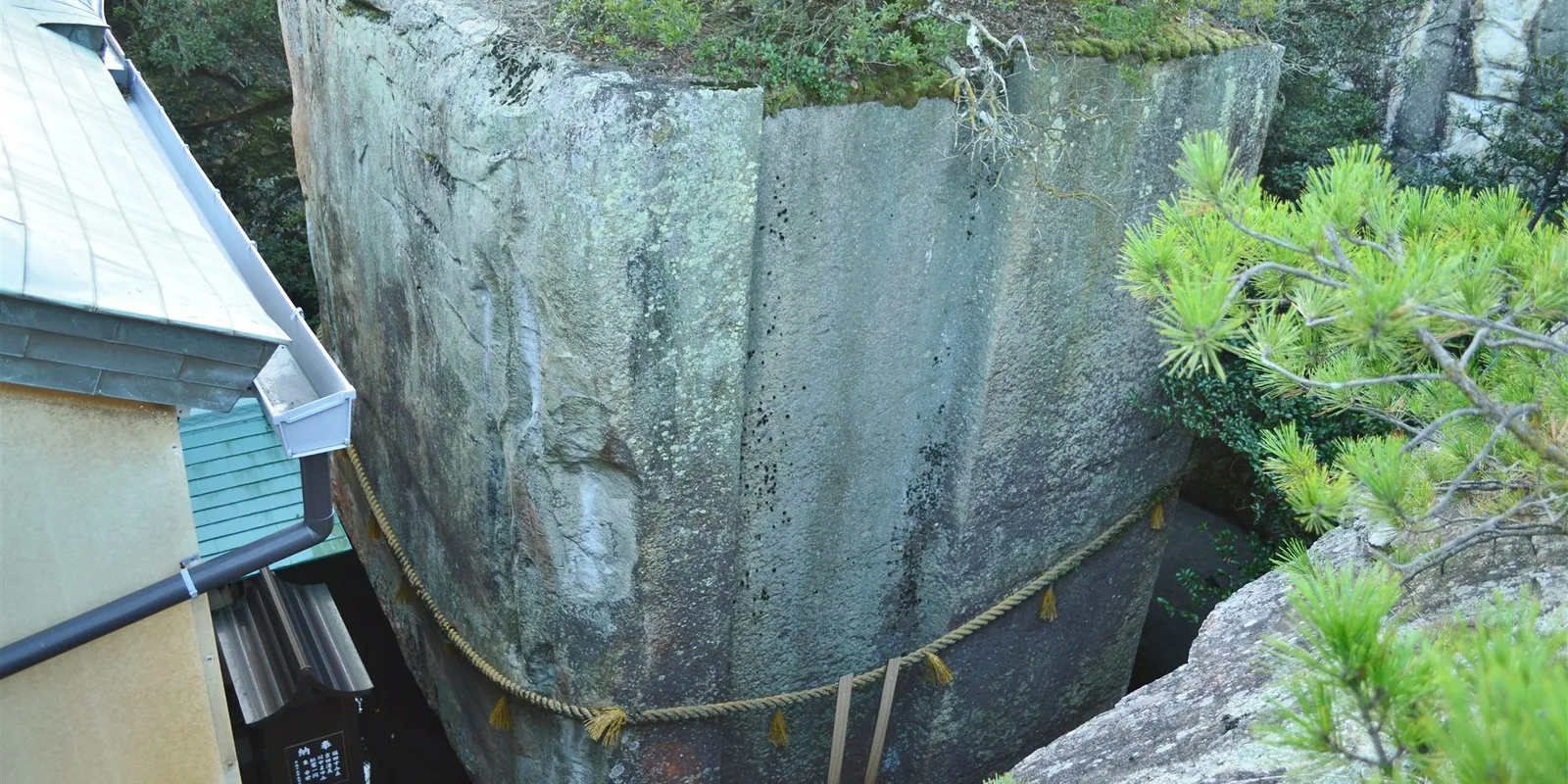
A second, closely linked tradition explains the origin of the shrine’s sacred object itself, the Ishi-no-Hoden. According to this account, when Oanamuchi and Sukunahikona traveled from Izumo to Harima, they set out — on orders from the heavenly deities — to build a stone palace, and carved it into its present form in a single night. But a rebellion by a local deity of Harima broke out, and by the time the two gods had put it down, dawn had broken; the palace was left lying on its side, impossible to raise upright. Even so, the two deities are said to have vowed that, unfinished or not, they would remain enshrined there and protect the land for eternity — and it is this vast, still-unfinished stone itself that has been worshipped as the shrine’s go-shintai ever since.
An older written record offers a different account: the Harima Fudoki (an 8th-century regional gazetteer) attributes its construction to Mononobe no Moriya during the era of Prince Shotoku, though historians note this creates a chronological contradiction. A separate account in the 14th-century regional text Minaiki describes it more simply as the work of heavenly beings who ran out of time to finish it by dawn and departed.
Today, the leading archaeological theory holds that the stone was carved from the bedrock of Mt. Tatsuyama during the Asuka period (6th–7th century) as an unfinished yokoguchi-shiki sekkaku — a house-shaped stone burial chamber of a kind once quarried nearby for the coffins of powerful clan leaders — though who commissioned it and for what purpose remains unresolved. The site was designated a National Historic Site on October 6, 2014, as part of the “Ishi-no-Hoden and Tatsuyama Stone Quarry Ruins.”
Highlights
The undisputed highlight is the Ishi-no-Hoden itself, standing in a rock-walled hollow on the hillside behind the main hall. At roughly 6.4m wide, 5.7m tall, and 7.2m deep, with an estimated weight of about 500 tons, its sheer scale is overwhelming up close. Water pooling in the trench cut around its base gives it the appearance of floating — hence its nickname, ukiishi (“floating stone”). A stairway from the main hall leads up to a viewing platform right beside the monument, where visitors can also touch a section known as the reigan (“sacred rock”).
Mt. Tatsuyama, the hill from which the stone was carved, has itself been quarried for over 1,700 years, from the Kofun period to the present day, and its stone — Tatsuyama-ishi — was historically prized for the burial coffins of powerful rulers. The dramatic, quarried rock face of the mountain is visible from the shrine grounds, offering a sense of the landscape the monument was carved from.
Visiting Tips
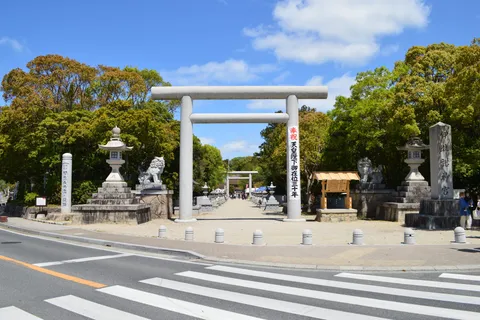
The shrine grounds can be visited at any time, but viewing the Ishi-no-Hoden up close requires an admission fee (¥100 for adults, ¥50 for children) and is limited to 9:30–16:30. Goshuin are available during the same hours at the shrine office, though the priest is not always present — a pre-written goshuin is left out in that case. Free parking for about 50 cars is available on the grounds, making a car the most convenient way to visit; the walk from JR Hoden Station takes about 25 minutes, so comfortable shoes are recommended if arriving by train.
Annual Festivals
- Autumn Festival / Yassa Festival (3rd Saturday and Sunday of October): A boisterous Banshu-style autumn festival, its highlight is the yassa — oversized portable shrines carried through the grounds and clashed together forcefully. Young men carry the red mikoshi dedicated to Oanamuchi no Mikoto, while older parishioners carry the yellow mikoshi dedicated to Sukunahikona no Mikoto. The event also features a lion dance performed by the local Shima district and a ritual in which the deity Sarutahiko chases after parishioners.
Nearby Food & Sightseeing
- Matsushita Sekizaiten (Tatsuyama Stone Quarry): A stoneworking company founded in 1872, about a 15-minute walk from Oushiko Jinja, working the same Tatsuyama stone the Ishi-no-Hoden was carved from. Quarry tours are available by advance reservation.
- Takasago Jinja: The shrine associated with the classical Noh play “Takasago,” famed for its Aioi-no-Matsu (“wedded pine”), a symbol of marital harmony. It sits in central Takasago City, about a 15-minute drive from Oushiko Jinja.
- Sone Tenmangu: A shrine dedicated to the scholar-deity Sugawara no Michizane, known for its sacred pine tree said to have been planted by Michizane himself. It also holds a well-known autumn festival, making it an easy shrine to pair with a visit to Oushiko Jinja elsewhere in Takasago City.
Frequently Asked Questions
- Q. How is Oushiko Jinja's name pronounced, and who is enshrined there?
- A. The name is pronounced "Oushiko Jinja" (locally sometimes heard as "Ooshiko"). It enshrines two deities, Oanamuchi no Mikoto (Okuninushi no Okami) and Sukunahikona no Mikoto — worshipped through the massive stone monument itself, which serves as the shrine's go-shintai (sacred object).
- Q. What is the Ishi-no-Hoden (Stone Treasure Hall)?
- A. It's a colossal carved stone structure standing behind the shrine's main hall, roughly 6.4m wide, 5.7m tall, and 7.2m deep, with an estimated weight of about 500 tons. Because it appears to float on water pooled in the surrounding trench, it's also known as the "floating stone." It's counted among Japan's Three Mysterious Structures, alongside Shiogama in Miyagi and Ama-no-Sakahoko in Miyazaki. Who carved it and why remains unresolved — shrine tradition holds it was left unfinished by two visiting deities, while one leading modern theory holds it's an unfinished Asuka-period stone burial chamber (yokoguchi-shiki sekkaku). It was designated a National Historic Site in 2014 as part of the "Ishi-no-Hoden and Tatsuyama Stone Quarry Ruins."
- Q. What are the viewing hours and admission fee for the Ishi-no-Hoden?
- A. The stone is open for viewing 9:30–16:30, with an admission fee of ¥100 for adults. The shrine grounds themselves can be visited at any time.
- Q. Can I get a goshuin at Oushiko Jinja?
- A. Yes, goshuin are available at the shrine office during the 9:30–16:30 opening hours, for ¥300. The priest is not always present, in which case a pre-written goshuin is left out for visitors instead.
- Q. How do I get to Oushiko Jinja, and is there parking?
- A. It's about a 25-minute walk from JR Hoden Station on the JR San'yo Main Line. By car, it's roughly 3 minutes from the Takasago-kita ramp on the Kakogawa Bypass, and the shrine has free parking for about 50 vehicles on the grounds.