History
Kawagoe Hikawa Jinja traces its founding to 541 CE, in the reign of Emperor Kinmei. Shrine tradition holds that a radiant light appeared on the banks of the Arakawa River, and the people who witnessed it revered it as a manifestation of the Hikawa deity. Some accounts describe the shrine as a branch of the great Hikawa Jinja in Omiya (present-day Saitama City), and for over 1,400 years since, it has drawn deep devotion from the people of this region.
After Ota Dokan and his father Ota Doshin built Kawagoe Castle in 1457, the shrine became revered as the castle’s guardian deity by successive generations of lords. Through the Edo period it served as the tutelary shrine of the entire Kawagoe domain, honored by everyone from the ruling lord down to ordinary townspeople. Today it remains the guardian shrine of the “Little Edo” townscape, quietly watching over the historic streets of Kawagoe.
Highlights
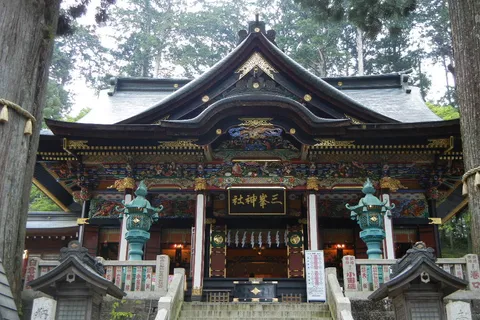
What sets Kawagoe Hikawa Jinja apart is the family structure of its five enshrined deities. The principal deity Susanoo and his wife Kushinadahime are joined by their son Onamuchi (also known as Okuninushi), and by Kushinadahime’s own parents, Ashinazuchi and Tenazuchi — together, two married couples and their child, all enshrined as one family. This unusual composition is the reason the shrine is revered nationwide as a deity of household harmony, marital harmony, and good relationships.
The shrine’s celebrated summer tradition, the “Enmusubi Furin” (Wind Chime of Good Relationships), began relatively recently in 2014 but has quickly become one of Kawagoe’s most popular seasonal events. Over 2,000 traditional Edo-style glass wind chimes are hung throughout the grounds to form a “wind chime corridor,” their cool chimes filling the air as visitors tie paper strips inscribed with wishes onto the chimes — a modern take on the old belief that “the wind carries people’s feelings.” The corridor is illuminated at night, drawing large crowds of worshippers and sightseers alike.
Among the shrine’s most popular good-luck charms for relationships is the “tai-omikuji” (fortune-telling fish), a playful twist on the standard omikuji fortune slip: visitors use a small fishing rod to “catch” a papier-mâché sea bream floating in a wave-patterned tub, then pull the folded fortune out from inside the fish, for ¥300 per catch. Equally popular is the free “Enmusubi Tama” (relationship stone) — a pebble hand-gathered from the ground before the main hall by a purified shrine maiden and distributed in limited numbers each morning at 8:00 — so sought-after that visitors line up before dawn on busy weekends to claim one.
Visiting Tips
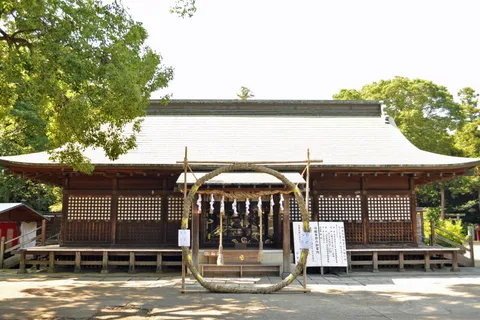
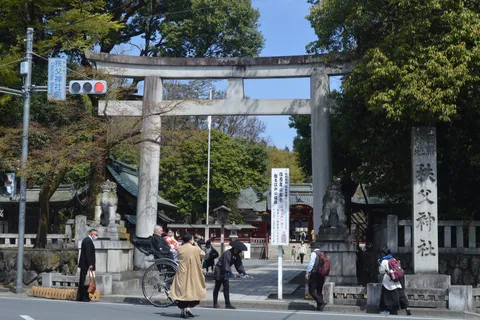
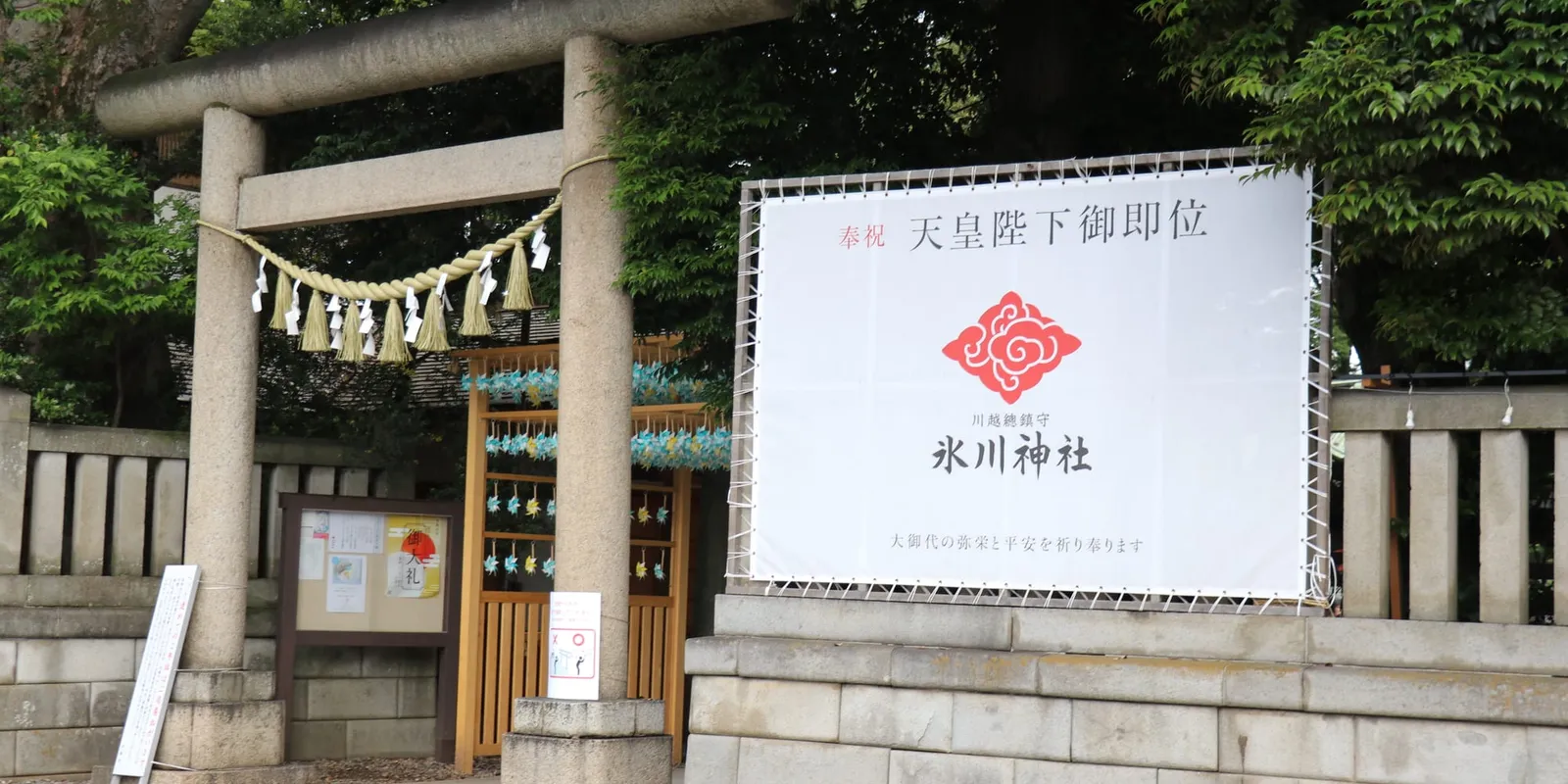
A large vermillion first torii gate marks the shrine’s entrance, with the approach continuing past the dance pavilion (maiden) to the worship hall beyond. The grounds are especially crowded during the “Enmusubi Furin” season (roughly early July to early September), so weekday mornings are the best time to enjoy the wind chime corridor at a relaxed pace. Anyone hoping to receive an “Enmusubi Tama” relationship stone should know that numbered tickets are handed out around 6:00 a.m., with the stones themselves distributed from 8:00 in limited quantities — arriving early is essential. Since the shrine has no parking lot of its own, drivers should plan around the operating hours (9:30–18:00) of the adjacent municipal parking facility, “Aguresshu Kawagoe.”
Annual Festivals
- Enmusubi Furin (early July – early September): The shrine’s signature summer event, when over 2,000 Edo-style wind chimes fill the grounds in a “wind chime corridor.” Visitors tie wish-strips to the chimes, and the corridor is lit up at night.
- Grand Festival & Divine Procession (around October 14): The origin point of the “Kawagoe Matsuri,” Kawagoe’s largest festival. Following the shrine’s own grand festival, a mikoshi procession sets the stage for the “Float Event of the Kawagoe Hikawa Festival,” in which around 30 elaborately decorated floats parade through the city — a nationally designated Important Intangible Folk Cultural Property and a UNESCO Intangible Cultural Heritage listing.
- Ningyo-nagashi Purification (June and December): A purification ritual in which paper effigies (hitogata), inscribed to carry away half a year’s accumulated impurity, are set adrift on the river.
- New Year’s Visits (January): As a shrine famed for good relationships, Kawagoe Hikawa Jinja draws large crowds of visitors at the New Year.
Nearby Food & Sightseeing
- Kurazukuri Street (Warehouse District): The heart of “Little Edo” Kawagoe, lined with imposing black-plastered merchant warehouses. Known as “Ichibangai,” the street is packed with street-food stalls and souvenir shops.
- Toki no Kane (Bell Tower): A roughly 16-meter wooden three-story bell tower, said to have been first built by Kawagoe domain lord Sakai Tadakatsu in the early Edo period. The bell still rings four times a day (6:00, noon, 15:00, and 18:00) and remains Kawagoe’s best-known symbol.
- Kashiya Yokocho (Candy Alley): A nostalgic lane lined with old-fashioned penny-candy shops, perfect for snacking on traditional treats like fu-gashi (wheat gluten crackers) and imo-kenpi (sweet potato sticks) while strolling.
- Kawagoe Daishi Kitain Temple: A major Tendai-sect temple with deep historical ties to the Tokugawa family, known for its 500 rakan statues and the “Room of Iemitsu’s Birth,” relocated here from Edo Castle. Often visited as part of the same day trip as Kawagoe Hikawa Jinja.
Frequently Asked Questions
- Q. What are the visiting hours?
- A. Worship hours are 8:00–18:00, though the grounds themselves are accessible around the clock. The prayer reception and amulet office keeps roughly 9:00–17:00 hours (amulets are sold until 18:00).
- Q. Can I get a goshuin here?
- A. Yes, from roughly 9:00 to 17:00, starting at ¥300. At certain times of year, colorful limited-edition goshuin designs are also available.
- Q. How do I get to Kawagoe Hikawa Jinja?
- A. Take a Tobu Bus about 10 minutes from Kawagoe Station or Hon-Kawagoe Station and get off at "Kawagoe Hikawa Jinja," right by the shrine. The Koedo loop bus stops directly in front at "Hikawa Jinja-mae."
- Q. Is parking available?
- A. The shrine itself has no parking lot, but the adjacent municipal tourist parking lot at "Aguresshu Kawagoe" (about 232 spaces total, open 9:30–18:00) is a short walk away. Nearby pay parking lots are also an option if it's full.
- Q. When is the Wind Chime Festival?
- A. The "Enmusubi Furin" (Wind Chime of Good Relationships) festival typically runs from early July through early September. A "corridor" of over 2,000 hanging Edo furin wind chimes fills the shrine grounds, and visitors can tie strips of paper with their wishes onto the chimes.