History
Kora Taisha stands on Mount Kora (elevation 312 m) in Kurume, Fukuoka Prefecture, and has long been revered as the ichinomiya, or chief shrine, of former Chikugo Province. Shrine tradition dates its founding to the first year of Emperor Richu’s reign, traditionally placed at 400 CE, though other traditions instead place it in the 55th or 78th year of Emperor Nintoku’s reign. One founding legend holds that the deity Takagi no Kami originally resided on Mount Kora, and that Kora Tamatare no Mikoto later marked out a sacred boundary and settled there in the deity’s place.
The shrine was ranked among the Myojin shrines in 818 and granted the senior first court rank in 897. It appears in the 10th-century Engishiki shrine register as “Kora Tamatare no Mikoto Jinja” of Mii District, Chikugo Province, ranked as a Myojin Taisha — a designation that shows how highly the Imperial court regarded it as the preeminent shrine of Chikugo Province from the Heian period onward. In 1871 it was ranked a Kokuhei Chusha, and in 1915 elevated to Kokuhei Taisha. Since the postwar reorganization of Shinto administration, it has held the status of a beppyo shrine under the Association of Shinto Shrines, maintaining its standing as one of Kyushu’s foremost ancient shrines to this day.
The main sanctuary enshrines Kora Tamatare no Mikoto, with Hachiman Okami in the left sanctuary and Sumiyoshi Okami in the right; Toyohime Okami is also enshrined within the honden. Kora Tamatare no Mikoto is a deity absent from both the Kojiki and Nihon Shoki, and the identity behind the name has been debated since ancient times — theories include Takeuchi no Sukune, the close retainer of Empress Jingu; an ancestral deity of the Mononobe clan; and Azumi no Isora, a deity associated with seafaring clans. This unresolved, enigmatic origin adds a distinctive depth to the shrine’s tradition of worship.
The slopes of Mount Kora also hold ruins far older than the shrine itself: the Kora-san Kogoishi, an ancient mountain fortification. Believed to date from roughly the 6th to 7th century, it consists of massive cut stones laid end to end across two valleys, running about 1.5 km and comprising some 1,300 stones. It is generally thought to have been built by the Yamato court to defend northern Kyushu amid the tense diplomatic climate before and after the Battle of Hakusukinoe in 663, when Yamato forces were defeated by the combined armies of Tang China and Silla, and it is now a National Historic Site. Notably, the very term “kogoishi” originated from this site on Mount Kora, after scholars first reported its discovery here; similar ruins later found elsewhere in Japan came to be called by the same name.
Highlights
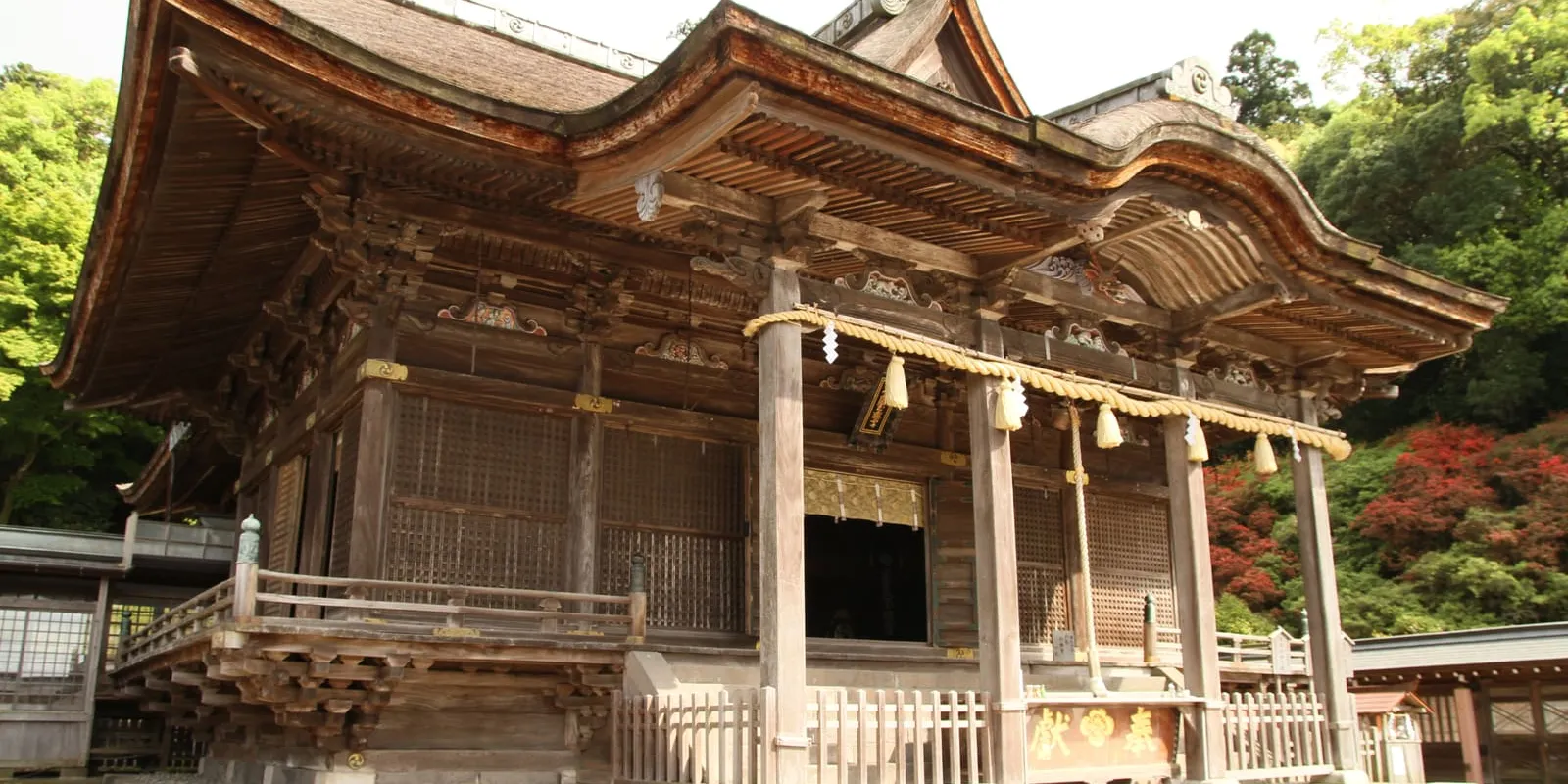
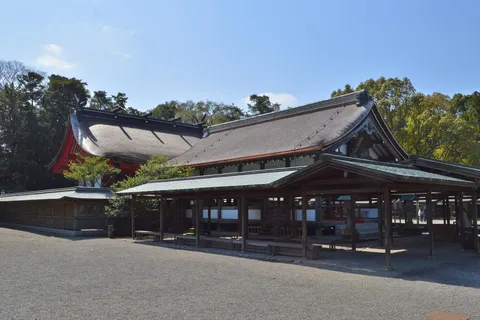
The current honden, heiden, and haiden were built between 1660 and 1661, funded by Arima Yoritoshi, the third lord of the Kurume domain. Built in an irimoya style with cypress-bark shingled roofing and an elaborate three-tiered bracket system supporting a railed veranda, the complex is one of the largest shrine building groups in all of Kyushu. The stone grand torii at the entrance to the approach was donated in 1655 by Arima Tadayori, the domain’s second lord, and together with the honden, heiden, and haiden was designated an Important Cultural Property of Japan in 1972.
The main approach features a 131-step stone staircase known as “Honzaka,” rising at roughly a 30-degree grade with a 20-meter change in elevation, with views over the city of Kurume from partway up. For visitors who find the stairs difficult, a paid, shared slope car runs alongside the staircase, carrying passengers up to the shrine grounds in about ninety seconds. Further beyond the main precinct, a path through the forest behind the honden leads to the Okumiya (inner shrine), where a Bishamon hall said to have been founded in 678 and the Mitarai Pond — where, tradition holds, the deities once washed their hands — offer a quieter setting for worship. The grounds are also known for a grove of moso kinmei bamboo, a species designated a National Natural Monument and found in only a handful of locations nationwide, as well as a pair of sacred sakaki trees associated with matchmaking blessings.
Visiting Tips
The grounds can be visited at any hour, but the shrine office handling prayer requests and goshuin is open 9:00–16:00. Six free parking lots (Lots 1–6) are available on the grounds, with Lots 5 and 6, near the moso kinmei bamboo grove, offering especially generous space. The New Year period and the October Kora-san Kunchi festival draw large crowds, so visitors driving up are advised to allow extra time. The shrine’s observation deck offers sweeping views over the city of Kurume and the Chikugo Plain, and is also a popular spot for night views.
Annual Festivals
- Kawatari Festival (also known as “Hekokaki Matsuri,” June 1–2): A midsummer purification rite in which participants pass through a ring of woven reeds to cleanse half a year’s accumulated impurities; at Kora Taisha it is especially known by its local nickname, the Hekokaki Matsuri.
- Reitaisai Grand Festival / Kora-san Kunchi (October 9–11): Kora Taisha’s most important festival, held over three days with a divine procession and a variety of ceremonies and dedicatory events.
- Goshinki Festival (once every 50 years): A special grand festival held once every half-century; in 1992 it was celebrated as the 1,600th-anniversary Goshinki Grand Festival.
Nearby Food & Sightseeing
- Kora-san Kogoishi: The ancient mountain fortification ruins on the slopes behind Kora Taisha, a National Historic Site where visitors can walk among the rows of massive cut stones.
- Suitengu Shrine: The head shrine of all Suitengu shrines nationwide, about a 10-minute drive from Kora Taisha in central Kurume, long revered for blessings of safe childbirth and children.
- Ishibashi Cultural Center: A cultural complex in central Kurume housing the Kurume City Art Museum along with a Japanese garden and rose garden, one of the city’s leading attractions.
Frequently Asked Questions
- Q. What kind of shrine is Kora Taisha?
- A. Kora Taisha stands on Mount Kora in Kurume, Fukuoka Prefecture, and is the ichinomiya (chief shrine) of former Chikugo Province. It appears in the Engishiki shrine register as "Kora Tamatare no Mikoto Jinja" of Mii District, Chikugo Province, ranked as a Myojin Taisha — one of Kyushu's most historically important shrines. In the modern era it was ranked a Kokuhei Chusha and later a Kokuhei Taisha, and today holds the status of a beppyo shrine under the Association of Shinto Shrines.
- Q. Who are the deities enshrined at Kora Taisha?
- A. The main sanctuary enshrines Kora Tamatare no Mikoto, with Hachiman Okami in the left sanctuary and Sumiyoshi Okami in the right; Toyohime Okami is also enshrined within the main hall. Kora Tamatare no Mikoto does not appear in the Kojiki or Nihon Shoki, and various theories have long circulated about the deity's true identity — including that it may be Takeuchi no Sukune, an ancestral deity of the Mononobe clan, or the seafaring deity Azumi no Isora — though none has been settled.
- Q. What is the Kora-san Kogoishi, and how is it connected to Kora Taisha?
- A. The Kora-san Kogoishi is an ancient stone fortification built into the slopes of Mount Hongu, the peak rising behind Kora Taisha, and is designated a National Historic Site. Dating to roughly the 6th–7th century, it consists of massive cut stones laid in a line across two valleys, extending about 1.5 km and comprising roughly 1,300 stones. It is generally believed to have been built by the Yamato court to defend northern Kyushu around the time of the Battle of Hakusukinoe (663). The very term "kogoishi" originated from this Mount Kora site, after which similar ruins found elsewhere in Japan came to share the name.
- Q. Is the honden at Kora Taisha a cultural property?
- A. Yes. The current honden, heiden, and haiden were built between 1660 and 1661, funded by Arima Yoritoshi, the third lord of the Kurume domain, and together form one of the largest shrine building complexes in Kyushu. Along with the stone grand torii at the entrance to the approach, they were designated Important Cultural Properties of Japan on May 15, 1972.
- Q. How do I get to Kora Taisha, and is there a slope car?
- A. It's about a 9-minute taxi ride from Kurume-Daigaku-mae Station on the JR Kyudai Main Line, or about 15 minutes (4.7 km) by car from the Kurume IC on the Kyushu Expressway. The main approach includes a 131-step stone staircase called "Honzaka," and a paid slope car runs alongside it for visitors who find the stairs difficult. Six free parking lots (Lots 1–6) are available on the grounds.
Related Shrines
Fukuoka, Soeda, Tagawa District
Hikosan Jingu
Hikosan Jingu
- Good Fortune
- Protection from Misfortune
- Household Safety
Fukuoka, Dazaifu
Kamado Jinja
Kamado-jinja
- Good Relationships
- Protection from Bad Directions
- Protection from Misfortune
Fukuoka, Munakata
Munakata Taisha (Hetsumiya)
Munakata Taisha Hetsu-gū
- Maritime Safety
- Traffic Safety
- Good Fortune