History
Hikosan Jingu sits on Mount Hiko, a 1,199-meter sacred peak straddling Soeda Town in Fukuoka Prefecture and Nakatsu City in Oita Prefecture, revered since antiquity as the dwelling place of a god. According to tradition, the mountain was first opened in 531, during the reign of Emperor Keitai, when a monk named Zenshō who had traveled from Northern Wei encountered a hunter, Fujiwara no Tsuneo; but the mountain does not appear clearly in reliable records until the Heian period. It was originally written with characters read “Hikosan” (彦山); Emperor Saga ordered the characters changed in 819, and in 1729 the retired Emperor Reigen granted the character “英,” fixing the name as “英彦山” (Hikosan, written with the added character for “eminent”).
From the medieval period onward, Hikosan flourished under Buddhist-Shinto syncretism as “Hikosan Gongen,” a major shugendo training ground, and came to be counted among Japan’s three great shugendo mountains alongside Dewa Sanzan and Mount Omine. At its height the mountain was covered with lodges housing several thousand yamabushi ascetics, who trained in 49 caves scattered across the slopes. Kyushu’s feudal lords lavished the mountain with patronage during the Edo period: in 1637 Nabeshima Katsushige, lord of the Saga domain, donated the bronze Copper Torii, and in 1616 Hosokawa Tadaoki, lord of the Kokura domain, rebuilt what is now Hoheiden Hall.
Following the Meiji Restoration’s separation of Buddhism and Shinto, the mountain’s Buddhist institutions were dissolved and it became “Hikosan Shrine” in 1871, with the head priest’s family leaving the priesthood and taking the surname Takachiho. On June 24, 1975, it was granted the honorific title “Jingu” — only the third shrine in postwar Japan to receive this distinction — becoming Hikosan Jingu as it is known today. Its principal deity, Masakatsu Akatsu Kachihayahi Ame no Oshihomimi no Mikoto, is regarded as a son of Amaterasu Omikami, and is enshrined together with Izanagi no Mikoto and Izanami no Mikoto.
Highlights
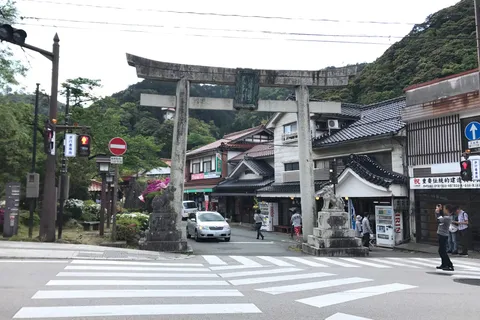
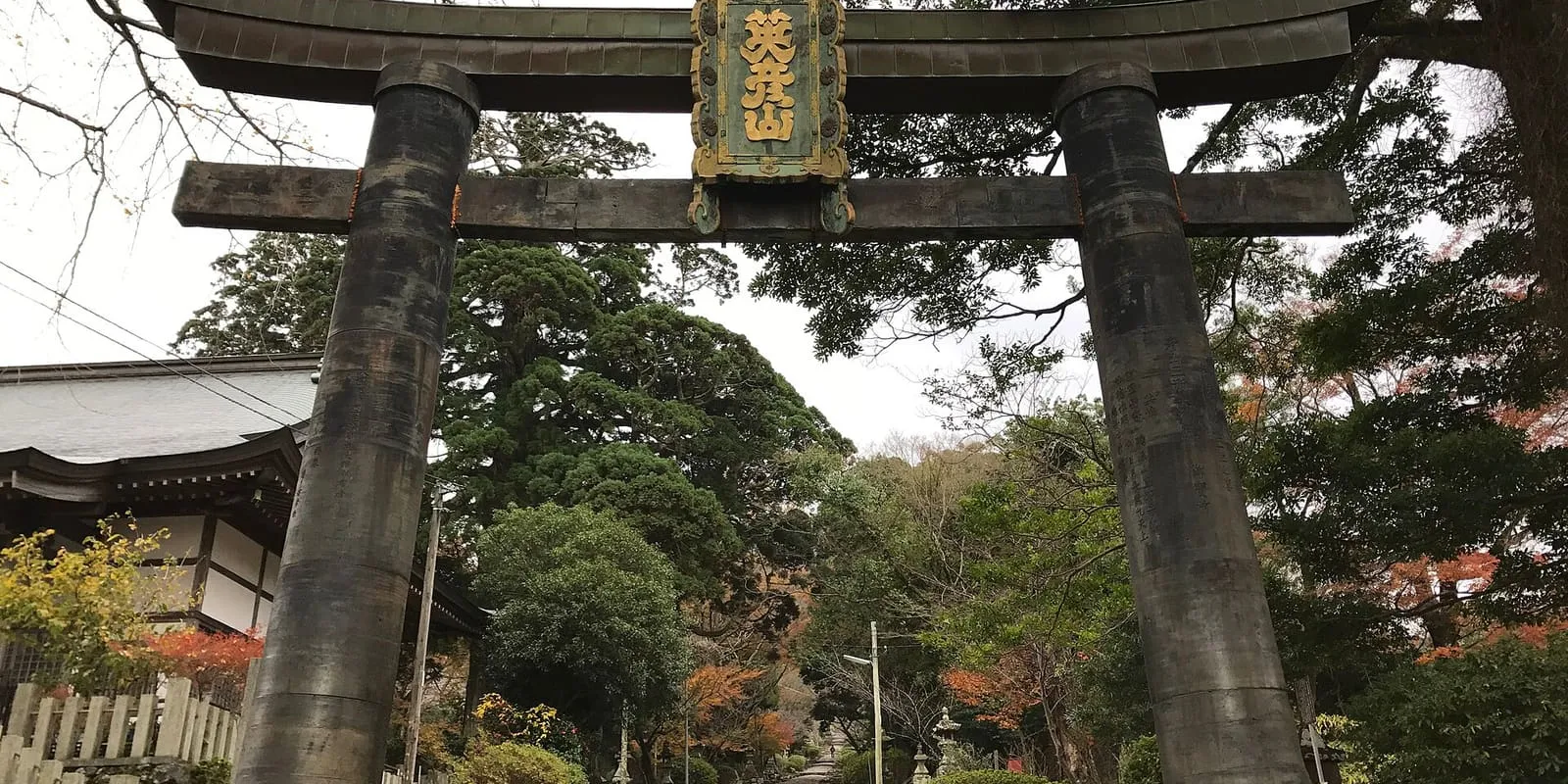
The bronze Copper Torii standing at the entrance to the approach was donated in 1637 by Nabeshima Katsushige, lord of the Saga domain, and was designated a National Important Cultural Property in 1939. The wooden plaque reading “Hikosan” that hangs on it was brought from Kyoto in 1734 by order of the retired Emperor Reigen — a piece of imperial history layered onto the gate’s own three-and-a-half centuries of standing watch over the mountain.
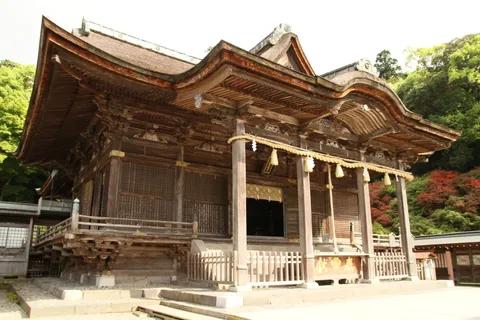
Climbing the stone steps beyond the torii leads to Hoheiden Hall, rebuilt in 1616 by Hosokawa Tadaoki, lord of the Kokura domain, and designated a National Important Cultural Property in 1907. Originally built as a lecture hall for the temple Reisen-ji, it has been repaired many times over the centuries yet still stands today. Located roughly 700 meters up the mountainside, Hoheiden effectively serves as the shrine’s main hall for everyday worship, since the true summit shrine (Jogu) becomes difficult to reach once snow sets in.
The approach continues from the shrine grounds up roughly 1,000 stone steps toward the summit shrine, winding through ancient cedar forest with a hushed, sacred atmosphere. The steepest stretch between the Copper Torii and Hoheiden Hall — a roughly 40-minute climb on foot — can instead be covered in about 7 minutes on the barrier-free Hikosan Slope Car, which opened in 2005. Fresh green in spring and vivid foliage in autumn make the mountain scenery itself one of Hikosan Jingu’s central attractions.
Visiting Tips
The grounds can be visited at any time, but the shrine office — for goshuin and amulets — is open roughly 9:00–17:00. Reaching Hoheiden Hall from the Copper Torii means climbing over 300 stone steps, so wear comfortable walking shoes. Visitors who prefer not to climb, or who want to save time, can take the Hikosan Slope Car between Hana Station and Kami Station (roughly 7 minutes, running every 20 minutes from 8:40 to 17:10, ¥350 one-way for adults). Continuing on to the summit shrine requires proper hiking preparation, so plan around the weather and your own fitness. In winter, snow and icy roads are common, so it’s worth checking road and slope-car conditions before setting out.
Annual Festivals
- New Year’s Day Festival (January 1): The first festival of the year, drawing crowds of hatsumode visitors.
- Setsubun Festival (February 3): A rite to drive away misfortune and invite good fortune, held together with a star festival.
- Kinen Otaue Festival (March 15): A spring festival praying for a bountiful harvest, featuring a ritual re-enactment of rice planting.
- Goshinko Procession (2nd Saturday and Sunday of April): One of the Tagawa region’s largest spring festivals, in which a portable shrine carrying the deities descends the mountain from Hoheiden Hall and parades along the approach — descending at 2:00 pm on Saturday and returning at 2:00 pm on Sunday.
- Grand Festival / Gongen Kosha Festival (September 28): The year’s most important festival, attended by parish and confraternity representatives giving thanks for the deities’ blessings and praying for national peace and a bountiful harvest.
Nearby Food & Sightseeing
- Michi-no-Eki Kanyusha Hikosan: A roadside market selling local specialties, including “Soeda Rice Lager” craft beer brewed with local rice and dried shiitake mushrooms cultivated on logs at the foot of Mount Hiko for over a century. A Forest Adventure aerial park is attached to the site.
- Former Suyama Family Residence: A thatched-roof farmhouse built in 1842, standing at Tsunoguchi, one of the traditional pilgrim entrances to Mount Hiko, and designated a National Important Cultural Property as a fine example of Edo-period farmhouse architecture.
- Hikosan Garden & Slope Car Hana Station: The area around the slope car’s base station near the Copper Torii is planted with seasonal flowers and autumn foliage, making it a popular spot for visitors to rest before or after climbing to the shrine.
Frequently Asked Questions
- Q. What is the famous "Copper Torii" (Kane no Torii) at Hikosan Jingu?
- A. It's a bronze torii gate donated in 1637 by Nabeshima Katsushige, lord of the Saga domain, and it was designated a National Important Cultural Property on October 25, 1939. It originally stood taller; when it was moved to its present site around 1686, one ring was removed from each pillar, giving it its current height. The wooden plaque reading "Hikosan" was brought from Kyoto and installed in 1734 by order of the retired Emperor Reigen.
- Q. How do I get to Hikosan Jingu, and how much does the slope car cost?
- A. From Soeda Station on the JR Hita-Hikosan Line, take the BRT Hikoboshi Line to the Kane no Torii (Copper Torii) stop, then ride the Hikosan Slope Car from Hana Station to Kami Station — about 7 minutes to cover 469 meters. Fares are ¥350 one-way / ¥700 round-trip for adults and ¥250 one-way / ¥500 round-trip for children, running roughly every 20 minutes between 8:40 and 17:10. Hoheiden Hall is about a 5-minute walk from Kami Station. By car, the free Kane no Torii lot (70 spaces) or Bessho lot (50 spaces) are both available.
- Q. Can I receive a goshuin here? What are the hours and fee?
- A. Yes, goshuin are available at the shrine office near Hoheiden Hall, generally 9:00–17:00, for a fee of ¥300.
- Q. Why is Hikosan Jingu considered a major shugendo site?
- A. Mount Hiko is counted among Japan's three great shugendo mountains, alongside Dewa Sanzan and Mount Omine. From the medieval period it flourished as "Hikosan Gongen," a syncretic Buddhist-Shinto training ground that at its peak housed thousands of yamabushi ascetics across hundreds of lodges, with 49 caves used for ascetic practice. Following the Meiji-era separation of Buddhism and Shinto it became Hikosan Shrine, and in 1975 it was renamed Hikosan Jingu.
- Q. Is there parking at Hikosan Jingu?
- A. Yes. The Kane no Torii (Copper Torii) parking lot, right by the bronze gate, has 70 free spaces, and the Bessho parking lot a little further down has 50 free spaces, is open 24 hours, and has restrooms. From either, visitors continue on foot up the stone steps or via the Hikosan Slope Car.